Next Generation Sequencing (NGS) allows researchers to sequence large numbers of genetic fragments present in many different samples, including blood, tumors, microbes, and environmental samples.
Analysis of results obtained from NGS is critical to identify genetic variation, gene expression and meaningful conclusions within the data. NGS analysis platforms allow researchers to do this.
These platforms provide analysis software and computational analysis to allow researchers to gain meaningful conclusions from sequencing data. They have been used in research relating to cancer, rare diseases, infectious diseases, and microbiome research.
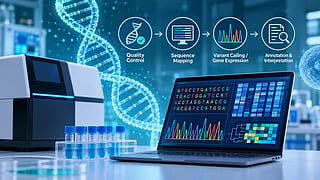
Depending on the sample type and research question, there are multiple steps involved in NGS analysis. Most NGS analysis techniques will follow these steps:
Quality control: Millions of short sequences of DNA/RNA fragments can be generated during sequencing. Quality control ensures that the data is of high quality. Any poor quality sequences, unwanted sequences (adapters) and potential contamination can be identified using software.
Sequence mapping: Once quality controlled, short sequences are mapped to a reference genome. Reference genomes provide a standard genome for comparison. This means that it is possible to determine where a sequence comes from in the genome, and any differences in the sample.
If an appropriate reference genome is not available, de novo genome assembly can be carried out to assemble long sequences from the short fragments.
Variant calling/ Gene expression: Depending on the experiment type, variants in the DNA can be identified. If RNA is sequenced, the amount of RNA produced from different genes can be quantified to determine gene expression.
Annotation and interpretation: Variants identified in sequence data can be compared to scientific/medical databases to determine potential significance. For example, it can be determined if the genetic difference has been associated with a disease, or if it is causing functional issues in a gene.
In a clinical setting, information from the patient, medical history, and other evidence is considered. Just because a computer program finds an issue, it does not automatically mean that a diagnosis can be made.
There are many different platforms to perform NGS analysis, and some allow full NGS analysis to occur, whilst others allow more specific analysis (variant identification, workflow management, etc).
Illumina BaseSpace Sequence Hub is a cloud-based analysis platform allowing storage, sharing, and analysis of sequence data. Compatible Illumina sequencing machines can have data sent to BaseSpace, and then various analysis programs can be used.
DRAGEN is an accelerated analysis platform from Illumina. It allows for sequence mapping and variant calling. These platforms are useful in labs processing large amounts of sequence data, as they allow for faster analyses.
Ion Reporter is a bioinformatics platform allowing analysis of data from Ion Torrent sequencing machines. Variant identification, annotation, and filtering can be performed using this platform.
This platform can be used to analyze genetic variation in cancer, inherited conditions, and reproductive health studies. However, the product has been specified for research purposes only, and cannot be used for diagnostic processes.
QIAGEN CLC Genomics Workbench allows analysis and comparison of sequence data. It can be used for whole genome analysis, RNA sequencing, sequence mapping, and variant identification.
This platform has a graphical user interface, making it useful to researchers who may be less comfortable using coding systems. Custom workflows are available to allow research specific to the requirements of the researcher.
SOPHiA DDM is a cloud based analysis platform for precision medicine. Using AI and data analysis, complex medical and genomic data can be explored.
This has applications in cancer research and rare disease research. Users can identify and interpret trends in genomic data. However, expert opinion and evidence is still required to make clinical decisions.
DNAnexus is a cloud based platform to manage and analyze large genomic data sets. It can be used to allow collaboration between researchers, medical institutions and pharmacological companies.
Various workflows can be performed, data access managed, and the platform can support large scale research projects. As it is cloud based, it may be very useful for organizations that have thousands of sequenced samples.
Velsera provides bioinformatics and clinical genomic solutions to research and healthcare institutions. The technology allows researchers to perform analysis on large genomic datasets, as well as developing workflows for precision medicine.
The Seven Bridges platform has been used to support research projects, including the National Cancer Institute’s Cancer Genomics Cloud. This project allows researchers to access cancer related data sets and analysis tools.
Terra is a collaboration between the Broad Institute, Microsoft, and Verily. This cloud-based platform allows researchers to analyze biomedical data using shared computing resources.
With this platform, large datasets do not have to be downloaded, allowing workflows to be run directly in the cloud. This can be very useful in collaborative research projects with large genomic data sets.
Galaxy is an open source analysis platform allowing researchers to analyze biological data using a graphical user interface. Workflows can be developed and run with little knowledge of programming.
A wide variety of bioinformatics tools are available, and workflows can be shared and repeated. This makes it very useful in education, in academic research, and in research laboratories. However, sensitive human genomic data should only be uploaded to secure environments.
GATK (Genome Analysis Toolkit) is a suite of tools provided by the Broad Institute. It is often used to perform analysis on genomic data, and find genetic variations.
Nextflow is a workflow management tool. It allows researchers to efficiently perform complex bioinformatics processes. Pipelines can be run on local computers, high performance computers, or in the cloud.
The choice of NGS analysis platform depends on the aims of the research, resources available, and skill level of users.
Consider what type of sequencing is being performed. Different analysis tools may be needed for whole genome sequencing, focused panel gene sequencing, and RNA sequencing.
Consider ease of use. Many platforms have graphical user interfaces, making them suitable for inexperienced researchers. Command line tools may be more flexible for experienced bioinformaticians.
Consider cost, storage, computing requirements, and data security. In labs working with human genomic data, data security, access controls, and any regulatory requirements should be considered.
Finally, in clinical laboratories, analysis pipelines must be validated. If results are going to be reported in relation to patients, appropriate quality checks must be in place. Expert interpretation and correlation with the patient’s clinical features must be considered.

References:
Hume, Stacey, Tanya N. Nelson, Marsha Speevak, Elizabeth McCready, Ron Agatep, Harriet Feilotter, Jillian Parboosingh, Dimitri J. Stavropoulos, Sherryl Taylor, and Tracy L. Stockley. “CCMG Practice Guideline: Laboratory Guidelines for Next-Generation Sequencing.” Journal of Medical Genetics 56, no. 12 (2019): 792–800. https://doi.org/10.1136/jmedgenet-2019-106152.
Austin-Tse, Christina A., Vaidehi Jobanputra, Denise L. Perry, David Bick, Ryan J. Taft, Eric Venner, Richard A. Gibbs, et al. “Best Practices for the Interpretation and Reporting of Clinical Whole Genome Sequencing.” npj Genomic Medicine 7, no. 1 (2022): 27. https://doi.org/10.1038/s41525-022-00295-z.
Marshall, Christian R., Shimul Chowdhury, Ryan J. Taft, Mathew S. Lebo, Jillian G. Buchan, Steven M. Harrison, Ross Rowsey, et al. “Best Practices for the Analytical Validation of Clinical Whole-Genome Sequencing Intended for the Diagnosis of Germline Disease.” npj Genomic Medicine 5, no. 1 (2020): 47. https://doi.org/10.1038/s41525-020-00154-9.
Koboldt, Daniel C. “Best Practices for Variant Calling in Clinical Sequencing.” Genome Medicine 12, no. 1 (2020): 91. https://doi.org/10.1186/s13073-020-00791-w.
He, Xiaoyu, Shanyu Chen, Ruilin Li, Xinyin Han, Zhipeng He, Danyang Yuan, Shuying Zhang, Xiaohong Duan, and Beifang Niu. “Comprehensive Fundamental Somatic Variant Calling and Quality Management Strategies for Human Cancer Genomes.” Briefings in Bioinformatics 22, no. 3 (2021): bbaa083. https://doi.org/10.1093/bib/bbaa083.
Lavrichenko, Ksenia, Emilie Sofie Engdal, Rasmus L. Marvig, Anders Jemt, Jone Marius Vignes, Henrikki Almusa, Kristine Bilgrav Saether, et al. “Recommendations for Bioinformatics in Clinical Practice.” Genome Medicine 17, no. 1 (2025): 124. https://doi.org/10.1186/s13073-025-01543-4.
OG/MF/MSM