
- Home
- About Us
- Contact Us
- Biography
- MedBound Hub
- InternshipInternship
- Daily Pulse
- Medicine
- Physical Therapy
- InterviewInterview
- Pharmacy
- Biotechnology
- College/InstituteCollege/Institute
- Dentistry
- Blog
- Wellness & Nutrition
- Nursing
- Opinion

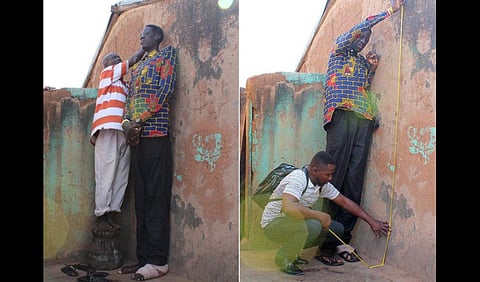
Sulemana Abdul Samed, known as Awuche, Ghana's tallest man at 7 feet 4 inches, died at 33 from an infected leg sore.
The BBC's report on Awuche says he was diagnosed with gigantism in his 20s, and had complications related to Marfan syndrome later.
Gigantism (acromegaly - adult onset) happens when a pituitary tumour causes excess growth hormone production leading to unusual height or enlarged hands, feet, jaw, and tongue.
Marfan syndrome is a genetic condition from birth, due to defect in the fibrillin gene, affecting the body's connective tissue rather than hormone levels.
Complications reported in his case include joint and spine problems and a severe leg ulcer that led to hospitalisation.
Sulemana Abdul Samed, known across Ghana as Awuche, meaning "Let's Go" in Hausa, has died at 33.
He passed away on July 27th at Tamale Teaching Hospital, roughly 160 kilometres from his home village of Gambaga.
He had become a national celebrity for his extraordinary height of 7 feet 4 inches. The BBC's report on Awuche says he was diagnosed with gigantism in his 20s, and had complications related to Marfan syndrome later. Other Ghanaian outlets report a third term, acromegaly (adult onset form of gigantism).
His death, following an infection in a sore on his leg, has drawn an outpouring of grief across Ghana.
The BBC reports that Awuche was first diagnosed with gigantism in his 20s, with Marfan syndrome-related complications developing later. Other Ghanaian outlets use yet a third term for his condition, acromegaly, which is essentially gigantism's adult-onset form.
Gigantism and acromegaly describe the same underlying mechanism at different life stages: a pituitary tumour secretes excess growth hormone, causing proportional overgrowth if it starts before growth plates close (gigantism), or thickening of the hands, feet, jaw, and tongue if it starts after growth plates have closed, as in adults (acromegaly)2.
Marfan syndrome works through an entirely different mechanism: it is a congenital connective tissue disorder present from birth, caused by a fault in the fibrillin gene, rather than a hormone excess1.
Awuche's growth spurt beginning at 22, along with tongue swelling that affected his breathing, are commonly described as features of gigantism or acromegaly.
Awuche was not always unusually tall; his rapid growth began at age 22, while he was working at a butcher's shop in Accra. He later described his tongue swelling until he struggled to breathe, and within days every part of his body seemed to be growing. Doctors eventually diagnosed him, though reports differ on the exact diagnosis, as noted above.
I used to play football like every other young man, I was athletic but now I cannot even walk short distances.
Sulemana Abdul Samed told the BBC in 2022
The condition cost Awuche's planned career and sporting life, while also making him a celebrated national figure.
His height forced him to abandon his ambition of becoming a driver; he returned to Gambaga, where he worked as a farmer and mechanic.
He gave up football, a sport he had once played avidly, and his spine developed a visible curve.
Those who knew Awuche describe him as generous and popular, someone who wore his fame with a positive outlook.
His height gave his village an identity of its own, mentioning Gambaga anywhere in Ghana was enough for people to recognise it as home of the country's tallest man.
Awuche had struggled to afford treatment until Ibrahim Mahama, brother of President John Mahama, stepped in to cover his care at Tamale Teaching Hospital.
Awuche died after a sore on his leg became infected, with doctors having earlier considered amputation before his condition worsened.
Bone and joint changes can alter how weight falls on the feet and legs, while impaired circulation and skin changes slow healing. Together, these can turn an ordinary sore into a persistent wound, and eventually a serious infection, as happened in Awuche's case.
He had appealed for public support before his admission, and doctors reportedly said he was responding well to treatment before his sudden death.
His family chose to bury him in Tamale rather than Gambaga, reasoning the village would be overwhelmed by mourners.
Milewicz, D. M., A. C. Braverman, J. De Backer, et al. "Marfan Syndrome." Nature Reviews Disease Primers 7, no. 1 (2021): 64. https://doi.org/10.1038/s41572-021-00298-7. Erratum in Nature Reviews Disease Primers 8, no. 1 (2022): 3, https://doi.org/10.1038/s41572-022-00338-w. PMID: 34475413; PMCID: PMC9261969.
He, Dan, Qinyi Wang, Zhifeng Sheng, and Guohua Li. "Preoperative Medical Therapy for Acromegaly: Current Knowledge and Clinical Significance." Frontiers in Endocrinology 16 (2026): 1636047. https://doi.org/10.3389/fendo.2025.1636047. PMID: 41550875; PMCID: PMC12807991.

