Why Biomedical Waste Management Certification Is Mandatory for Healthcare Professionals

Biomedical Waste Management certification is a critical compliance requirement that protects healthcare workers, patients, and institutions from infection risks, environmental harm, & legal penalties
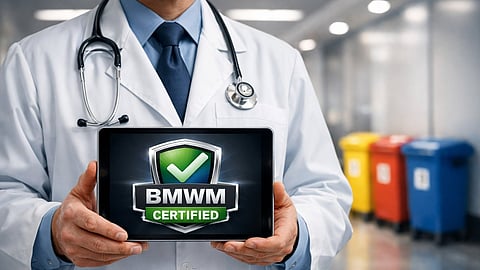
Cinematic shot of a healthcare professional in a clean lab coat, holding a digital tablet displaying a "BMWM Certified" badge
Biomedical Waste Management Certification: Training Healthcare Professionals for Regulatory Compliance
Published on
Updated on

Biomedical Waste Management (BMWM) is not a housekeeping activity or an auxiliary hospital function. It is a statutory requirement, a public health safeguard, and a core patient-safety responsibility embedded into healthcare delivery systems.

Every healthcare facility—whether a hospital, clinic, diagnostic laboratory, blood bank, or research institution—generates biomedical waste on a daily basis. If this waste is not managed correctly, it poses serious risks not only to healthcare workers and patients, but also to the community and the environment at large.

Improper biomedical waste handling can directly result in:
India generates over 700 tonnes of biomedical waste every day, and regulatory authorities consistently report that poor segregation at the point of generation is the most common cause of non-compliance.

This makes structured BMWM training and certification non-negotiable for healthcare professionals.

Important Academic & Regulatory Disclaimer

This Biomedical Waste Management Certification course is offered for educational, training, and academic understanding purposes only.

  • The certification does not replace any government-mandated or statutory certification required under the Biomedical Waste Management Rules, 2016 and its amendments.

  • It is not a substitute for training or certification issued by government authorities, pollution control boards, or regulatory bodies.

  • Healthcare institutions and professionals are required to comply with all applicable national, state, and local regulatory requirements independently.

The purpose of this course is to strengthen knowledge, awareness, and compliance readiness, not to override statutory obligations.

Why Biomedical Waste Management Certification Is Necessary

A high-quality 3D isometric infographic showing four stylized medical waste bins
Biomedical Waste Color Coding Guide: Yellow, Red, White, and Blue Segregation

Contrary to common belief, most biomedical waste management failures do not occur due to lack of infrastructure or equipment. They occur due to gaps in training, awareness, and accountability.

Common causes of biomedical waste non-compliance include:

  • Inadequate staff training and refresher education

  • Poor understanding of colour-coding and segregation rules

  • Limited awareness of legal responsibilities under BMWM Rules

  • Absence of documentation, audit, and reporting knowledge

Biomedical Waste Management Rules place direct responsibility on healthcare personnel, not just on housekeeping staff. Without structured training, errors become systemic and repeat across departments.

What This BMWM Certification Ensures

A minimalist illustration showing a hospital building protected by a shield icon made up of biomedical waste symbols
Biomedical Waste Management Protects Public Health, Environment, and Legal Compliance

A structured BMWM training program ensures that healthcare personnel are able to:

  • Understand the legal and ethical framework governing biomedical waste

  • Apply correct colour-coding and segregation protocols

  • Follow safe collection, storage, and transportation practices

  • Protect themselves, patients, and the environment

  • Improve audit preparedness and documentation practices

  • Reduce institutional risk and regulatory exposure

Certification converts biomedical waste handling from an assumed task into a documented, accountable professional responsibility.

Who Should Undertake Biomedical Waste Management Training

A powerful editorial image showing a healthcare professional in scrubs standing confidently in a hospital corridor.
Biomedical Waste Management Compliance: Healthcare Professional Following Color-Coded Waste Segregation Protocols

This training is recommended for:

  • Doctors and Medical Officers

  • Medical & allied healthcare students

  • Nurses and Nursing Supervisors

  • Laboratory Technicians

  • Housekeeping and Sanitation Staff

  • Hospital Administrators and Compliance Officers

Biomedical waste management is a shared responsibility, and failure at any level compromises the entire system.

Final Note

Biomedical waste mismanagement is not merely an operational lapse. It is a compliance failure with public-health and legal consequences.

While this course enhances understanding and institutional readiness, all healthcare professionals must adhere to government-approved certification and regulatory mandates provided by hospitals as applicable.

Education strengthens compliance. Certification builds accountability. Regulatory adherence remains mandatory.
Cinematic shot of a healthcare professional in a clean lab coat, holding a digital tablet displaying a "BMWM Certified" badge
Five Cutting-edge Advances in Biomedical Engineering and Their Applications in Medicine

Related Stories

No stories found.
logo
Medbound Times
www.medboundtimes.com