
- Home
- About Us
- Contact Us
- Biography
- MedBound Hub
- InternshipInternship
- Daily Pulse
- Medicine
- Physical Therapy
- InterviewInterview
- Pharmacy
- Biotechnology
- College/InstituteCollege/Institute
- Dentistry
- Blog
- Wellness & Nutrition
- Nursing
- Opinion

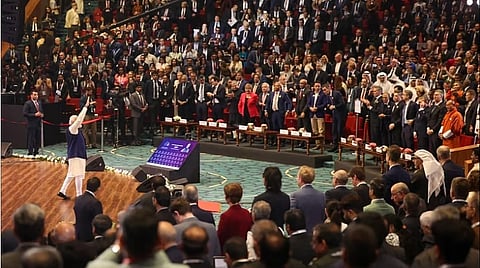
New Delhi, Feb 2026: AI is not about replacing clinicians; it is about giving time back to them, time to think, time to connect and time to care, according to industry leaders.
Roy Jakobs, CEO, Philips, positioned healthcare as the sector where AI could have the greatest human impact.
Highlighting how AI is already easing pressure on overburdened systems at the AI Impact Summit here, he said that “When we look back a decade from now, AI in healthcare will not be remembered for what was optimized on a screen, but for the billions of lives it helped improve.”
Alexander Wang, Chief AI Officer, Meta, highlighted AI’s growing integration into everyday life and India’s central role in shaping its trajectory.
Emphasising the company’s vision for “personal superintelligence,” he said, “Our vision is personal superintelligence, AI that knows you, your goals, your interests, and helps you with whatever you’re focused on doing”.
“It serves you, whoever you are, wherever you are.” Underscoring the importance of responsible deployment, he added, “Given how intimately your personal AI will know you, people aren’t going to hire us for the job if we’re not doing it responsibly. Trust, transparency and governance must move as fast as the models themselves,” said Wang.
According to Martin Schroeter, Chairman and CEO, Kyndryl, “The innovation is real. The challenge is readiness. AI today is not yet industrialized, infrastructure, data, operations and people must be prepared to support it at scale.”
Stressing trust and governance, he added, “The future of AI will not be decided in research labs or boardrooms. It will be decided by how reliably and responsibly it is embedded into the systems society depends on every day.”
Olivier Blum, Global CEO, Schneider Electric, underscored the deep interlinkages between AI and the global energy transition.
“AI means more compute, and more compute means more energy. We cannot underestimate the pressure this will put on global energy systems,” he noted. At the same time, he pointed to AI’s transformative potential for efficiency.
This news was originally posted on NewsGram.
(NG/ARC)
