1,394 Kg of Bananas Seized in Navi Mumbai: FDA Probe Flags Ethephon Dipping and Suspected Chemical Registration Violations

Behind the Turbhe market seizure, safety classifications of Ethephon, and authorized postharvest ripening practices
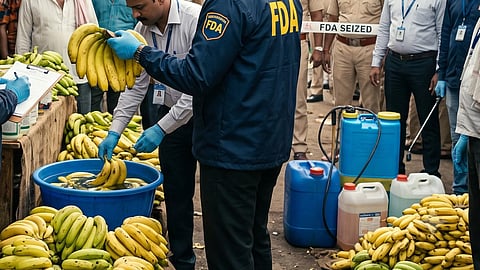
officer holding bananas
The FDA caught workers artificially ripening bananas by directly dipping them in a chemical solution of BTHILEX.AI Image
Author:
MBT Desk
Published on: 
Updated on: 

By Akanksha 

On October 6, acting on a tip-off regarding Stall No. N-919 at the APMC Fruit Market in Turbhe, Navi Mumbai, Maharashtra, Food and Drug Administration (FDA) officials, a food safety officer, and panch witnesses conducted an inspection. 

How Did the FDA Uncover Illegal Chemical Ripening at Turbhe APMC? 

During the raid, they caught workers artificially ripening bananas by directly dipping them in a chemical solution of BTHILEX (a plant growth regulator labelled as Ethephon 39% soluble liquid / 39% SL). The seller had allegedly prepared the mixture by diluting two caps of the chemical in five liters of water. 

Under Section 38 of the Food Safety and Standards Act, 2006, authorities seized the chemical alongside 1,394 kg of bananas valued at Rs. 67,814. Additionally, three statutory samples of bananas and one surveillance sample of the chemical solution were collected for laboratory analysis. 

An examination of the BTHILEX containers revealed fraudulent or entirely missing manufacturer details — including absent addresses, pin codes, contact numbers — as well as no mandatory Central Insecticides Board and Registration Committee (CIB&RC) registration number. Suspected to be either counterfeit or unregistered, the product was referred to the competent authorities under the Insecticides Act, 1968. Consequently, a case was registered at the APMC police station under relevant provisions of the Food Safety and Standards Act, 2006, Section 59 of the Bharatiya Nyaya Sanhita, 2023, and the Insecticides Act, 1968. 

Also Read: The Drugs and Devices Have Been on the Market for Years, but FDA-Ordered Studies Still Aren’t Done

Why Is Direct Ethephon Dipping Prohibited in Fruit Ripening?

The Food Safety and Standards Authority of India (FSSAI) distinguishes between using ethephon to generate ethylene gas and directly dipping fruit in an ethephon solution. Its prescribed ripening procedure requires ethylene gas to be used under controlled conditions, without direct contact between the fruit and the chemical source.

Ethephon is a plant growth regulator that releases ethylene under appropriate conditions. Ethylene is a plant hormone that promotes fruit ripening. Therefore, the concern in the Navi Mumbai case is the reported direct dipping of bananas, alongside questions about the product's registration and authenticity. Ethephon use should not be described as universally prohibited.

In an advisory dated April 16, 2026, FSSAI directed food safety authorities to intensify inspections concerning unauthorized fruit-ripening practices. The advisory also described a strip-paper test for detecting acetylene gas in storage facilities and ripening chambers.

What Are the Safety Limits and Technical Parameters for Ethephon? 

  • CIB&RC Classification: Moderately Toxic (Blue triangle sign).

  • WHO Classification: Class III (Slightly hazardous).

  • Acceptable Daily Intake (ADI): 0.05 mg/kg bw

  • Exposure Requirements: 100-150 ppm ethylene for 24-48 hours at 15-20°C (59-68°F) and 90-95% RH.

  • Carbon Dioxide: Kept below 1% to avoid delaying ethylene action. 

How Does Controlled Atmosphere Storage Extend Banana Shelf Life? 

  • Optimum CA: 2-5% O2 and 2-5% CO2. 

  • Postharvest storage potential: 2-4 weeks in air, 4-6 weeks at 14°C (58°F). 

  • Extreme Limits: Exposure to <2% O2 and/or >7% CO2 causes undesirable texture and flavor. 

fresh yellow bananas on wooden surface
The concern in the Navi Mumbai case is the reported direct dipping of bananas, alongside questions about the product's registration and authenticity.Mr. Pugo/pexels

How to Identify Artificially Ripened Bananas? 

  1. Appearance is uniformly yellow or attractive on the outside, but the fruit remains raw, hard, or bland inside. 

  2. Peels show spots, blemishes, or visible uneven color. 

  3. The stalk end appears green while the rest of the fruit appears quickly ripened. 

  4. Fruits spoil faster than naturally ripened ones. 

Consumers should not rely on appearance alone to determine whether bananas have been treated with unauthorized chemicals. FSSAI's guidance recommends washing fruit under running potable water before consumption.

Also Read: ₹11 IV Set Billed at ₹325: Maharashtra FDA Chief Tukaram Mundhe Flags 2,841% Markup at Private Hospitals

References: 

1. Food Safety and Standards Authority of India (FSSAI). Guidance Note No. 4/2018: Artificial Ripening of Fruits. Revised February 10, 2020. https://fssai.gov.in/upload/uploadfiles/files/Guidance_Note_Ver2_Artificial_Ripening_Fruits_03_01_2019_Revised_10_02_2020.pdf.

2. Food Safety and Standards Authority of India (FSSAI). “Ethephon.” FSSAI Pesticide Details Database. https://sites.fssai.gov.in/dataportal/pesticide_details.php?pid=Ethephon&type=%27%27&.

3. University of California, Davis, Postharvest Research and Extension Center. “Banana.” Produce Facts Sheets. https://postharvest.ucdavis.edu/produce-facts-sheets/banana.

4. Food Safety and Standards Authority of India (FSSAI). Advisory dated April 16, 2026, concerning unauthorized fruit-ripening practices. https://fssai.gov.in/upload/advisories/2026/04/69f1fd75afea7Advisory%20dated%2016.04.2026.pdf.

5. Food Safety and Standards Authority of India (FSSAI). Press release dated May 20, 2025, on artificial fruit ripening. https://www.fssai.gov.in/upload/uploadfiles/files/artificial_fruit_ripening_english.pdf.

(Rh/APC/MSM)

officer holding bananas
Maharashtra FDAs Festive Crackdown, 30 Food Licences Suspended, Rat Droppings, Live Flies, Dead Cockroaches Found Near Food Preparation Areas; Report
logo
Medbound Times
www.medboundtimes.com