
- Home
- About Us
- Contact Us
- Biography
- MedBound Hub
- InternshipInternship
- Daily Pulse
- Medicine
- Physical Therapy
- InterviewInterview
- Pharmacy
- Biotechnology
- College/InstituteCollege/Institute
- Dentistry
- Blog
- Wellness & Nutrition
- Nursing
- Opinion

Few hair-loss treatments have entered mainstream use as rapidly as light-based therapy. Once confined to specialist clinics, low-level light therapy (LLLT) is now delivered as often from a helmet used at home, and it has become one of the most widely adopted non-invasive methods for supporting hair growth and reducing visible thinning. For readers comparing the best red light therapy for hair growth, the relevant question is no longer whether the technology has a role, but which device suits the intended pattern of use. This guide compares the professional KERNEL hair growth systems available through UVTreat, from clinic-grade machines to wearable caps, to help match the equipment to the user's goals. For those still deciding whether the approach is appropriate, our overview of red light for hair growth sets out the fundamentals.
Every credible red light device works on the same principle. Wavelengths in the red band - most often near 650 nanometres - reach the follicle, where the mitochondria of the cells absorb the light and, across repeated sessions, help move resting follicles back into an active growth phase (1, 2). Because that mechanism is shared across the category, the real differences between products lie in how well they deliver the light, not in any proprietary effect. Several factors determine whether a device merits the investment.
Light source and technology. Professional systems rely on medical-grade laser diodes; some home devices use LEDs, and a few combine the two. The long-running argument over whether a laser is essential has largely been settled by the research: what governs the result is the wavelength delivered and the dose absorbed, not whether the light is coherent (3). A well-built LED array and a laser cap can both perform when the wavelength and output are correct, which is why the best hair growth laser device is defined by its specifications rather than its marketing language. The key indicators are a clinically relevant wavelength - the 650 nm region is the most studied - and a clearly stated output.
Coverage area. The more of the scalp a device treats evenly, the fewer gaps there are in the dose. Clinic machines fitted with several hundred diodes cover a wide field in a single session, while wearable helmets trade some of that reach for the convenience of self-treatment. Neither is automatically better; the right amount of coverage depends on whether the thinning is patchy or diffuse.
Ease of use and consistency. Light therapy rewards regular, correctly timed sessions sustained over several months rather than occasional long ones. A device comfortable and simple enough to use as directed will, in practice, outperform a more powerful one that ends up unused. This is among the most underestimated factors in real-world results, and frequently determines whether a device is used consistently.
Intended application. A machine built for a busy dermatology or trichology practice answers to different demands than a helmet meant for unsupervised home use. Deciding where treatment will take place narrows the field immediately, because it separates the stationary clinical systems from the portable wearables before any other comparison begins.
Regulatory standing and evidence. In the United States these products are FDA cleared through the 510(k) route rather than "approved" in the way a medicine is, so anyone searching for an fda approved red light therapy cap should read that phrase as cleared (11, 12). The supporting evidence is strongest for androgenetic alopecia, the common pattern hair loss seen in both sexes: randomised trials and meta-analyses have reported measurable increases in hair density (4, 5, 6), and controlled studies of 655 nm devices recorded gains in hair count for men and women alike (7, 8). Light therapy generally performs best as part of a wider plan - for instance, alongside topical minoxidil, which on its own helps only a minority of users (9, 10) - rather than as a standalone replacement for established treatments.
Overall value. Finally, the right device is the one whose cost and format match its purpose: a shared clinical asset that pays back across many patients in a practice, or a personal unit that one person can keep using at home.
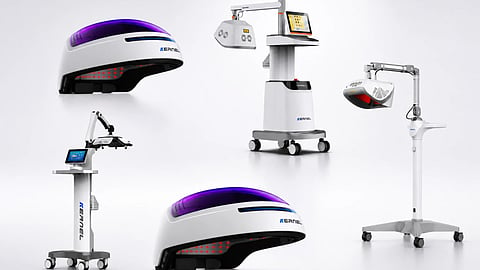
KERNEL's range is structured in tiers, with each model intended for a particular type of user or clinical setting. Reviewing them together clarifies the practical differences before a purchase.
The KN-8000A2 is the flagship of the clinical tier. It is fitted with 300 medical-grade laser diodes operating at 650 nm across a treatment field of approximately 900 cm², and is controlled from a 12.1-inch LCD touchscreen integrated into the trolley (13). The touchscreen is the model's principal distinction: it allows a clinician to configure, store and reproduce standardised treatment protocols, which is valuable in a practice performing hair-restoration sessions on a regular basis. Treatment is delivered hands-free, with the patient seated beneath the array. The A2 is best suited to dermatology and trichology clinics that provide hair restoration as an ongoing service, and to advanced users who require a professional-grade station at home.
The KN-8000A1 carries the same clinical configuration as the A2 - 300 medical-grade laser diodes at 650 nm and coverage of around 900 cm² on a wheeled trolley - with one omission: it has no integrated touchscreen (13). Removing that interface lowers the acquisition cost without altering the laser hardware, so the treatment delivered to the patient is equivalent to the A2. It is intended for practices that require A-series coverage and reliability but do not need on-board protocol control, and functions as the more economical machine in the clinical tier.
The KN-8000A holds the largest emitter array of any machine in the range: 424 medical-grade laser diodes at 650 nm covering approximately 935 cm², operated through an eight-inch colour touch panel mounted on an adjustable cantilever arm (13). The high diode count and broad field allow a clinic to treat the entire scalp efficiently and to reproduce a consistent dose across successive appointments. The design prioritises treatment delivery over additional features, which many practices regard as an advantage. In a fixed clinical setting seeking established, uncomplicated LLLT hardware, it is a leading candidate for the best laser for hair growth.
The KN-8000C addresses a frequent question among prospective buyers - what is the best laser cap for hair growth for use outside a clinical setting. It is a wearable helmet combining 80 medical-grade laser diodes with 30 LEDs across approximately 370 cm², with zoned irradiation and integrated sensors that monitor each session (13). Its principal advantage is convenience: because it can be worn during routine activities, it supports the regular, repeated use on which light therapy depends. It is suited to home users and to patients continuing treatment between clinical visits.
The KN-8000B is the most capable helmet in the range. It employs 204 medical-grade laser diodes - the highest count of any KERNEL helmet - across approximately 370 cm², and connects via Bluetooth to an application that manages session timing and records use (13). The elevated diode count provides an intensity approaching that of a clinical device in a self-administered form, while the rigid helmet maintains a consistent emitter-to-scalp distance for uniform exposure. It requires no clinician to operate, making it appropriate for users committed to home treatment.
The KN-8000D is the more economical of KERNEL's two dual-source helmets. It combines 21 laser diodes (650 nm ±10 nm) with 30 LEDs (655 nm ±10 nm), rated at 5 mW and 3.5 mW per emitter respectively, over approximately 370 cm² (13). Because its output is weighted toward the LEDs, it is priced below the KN-8000C while retaining the wearable format and zoned delivery of the range. It is indicated for seborrheic alopecia and alopecia areata, providing an accessible introduction to combined laser-and-LED treatment at home.
The KN-8000E is a single-source helmet for users who prefer laser light alone. It uses 81 medical-grade laser diodes at 650 nm, each rated at 5 mW, across approximately 370 cm², with no LED component (13). It provides the same wearable convenience as the other helmets. It represents the most straightforward configuration in the helmet line for users who want a laser-only device.
The appropriate device depends on a small number of practical considerations about how and where treatment will take place.
The first is setting. A clinic that treats hair loss as a service is best served by a trolley machine - the KN-8000A2, KN-8000A1 or KN-8000A - which offers wide coverage and supervised, repeatable sessions. For self-treatment, a wearable helmet - the KN-8000C, KN-8000B, KN-8000D or KN-8000E - is the practical option.
The second is coverage and consistency, which should be weighed together. The clinical machines treat the widest field in a single session, an advantage for diffuse thinning, but coverage is of little value if the device is not used. A helmet worn several times a week may deliver greater benefit than a machine that is seldom accessed.
The third is treatment frequency and portability. Because results accumulate over months of regular sessions, the device must fit the user's routine. Trolley systems are mobile within a practice but remain there; helmets are designed to be worn anywhere, which is what makes home consistency achievable.
The final consideration is budget and goals. A clinical machine is a capital investment recovered across many patients, whereas a helmet is intended for a single user. The device with the strongest specification is not necessarily the best hair growth laser device for a given situation; the appropriate choice is the one that matches the setting, the routine and the intended outcome. Where the decision is unclear, UVTreat can advise on the available options.
Each model has a distinct rationale: the KN-8000A for the largest clinical field, the KN-8000A2 for protocol-driven practices, the KN-8000A1 for cost-sensitive clinics, and the KN-8000C, KN-8000B, KN-8000D and KN-8000E for self-directed home care across a range of budgets and source configurations. No single device is optimal for every case. The most suitable option depends on the severity of the hair loss, the objective of treatment and the setting in which the device will be used, so the models are best compared against individual circumstances before a decision is made. In all cases, consistent use over several months - together with clinical assessment where hair loss is severe or progressing - contributes more to the outcome than any individual specification. UVTreat supplies and advises on the complete KERNEL range.
References:
Hamblin MR. "Mechanisms and applications of the anti-inflammatory effects of photobiomodulation." AIMS Biophysics. 2017;4(3):337–361. PMCID PMC5523874.
Hamblin MR. "Mechanisms and Mitochondrial Redox Signaling in Photobiomodulation." Photochemistry and Photobiology. 2018;94(2):199–212. PMID 29164625.
Heiskanen V, Hamblin MR. "Photobiomodulation: lasers vs. light emitting diodes?" Photochemical & Photobiological Sciences. 2018;17(8):1003–1017. PMID 30044464.
Liu KH, Liu D, Chen YT, Chin SY. "Comparative effectiveness of low-level laser therapy for adult androgenic alopecia: a systematic review and meta-analysis of randomized controlled trials." Lasers in Medical Science. 2019;34(6):1063–1069. PMID 30706177.
Gupta AK, Carviel JL. "Meta-analysis of photobiomodulation for the treatment of androgenetic alopecia." Journal of Dermatological Treatment. 2021;32(6):643–647. PMID 31746251.
Lueangarun S, Visutjindaporn P, Parcharoen Y, Jamparuang P, Tempark T. "A Systematic Review and Meta-analysis of Randomized Controlled Trials of United States Food and Drug Administration-Approved, Home-use, Low-Level Light/Laser Therapy Devices for Pattern Hair Loss: Device Design and Technology." Journal of Clinical and Aesthetic Dermatology. 2021;14(11):E64–E75. PMID 34980962.
Lanzafame RJ, Blanche RR, Bodian AB, Chiacchierini RP, Fernandez-Obregon A, Kazmirek ER. "The growth of human scalp hair mediated by visible red light laser and LED sources in males." Lasers in Surgery and Medicine. 2013;45(8):487–495. PMID 24078483.
Lanzafame RJ, Blanche RR, Chiacchierini RP, Kazmirek ER, Sklar JA. "The growth of human scalp hair in females using visible red light laser and LED sources." Lasers in Surgery and Medicine. 2014;46(8):601–607. PMID 25124964.
Topical 5% minoxidil clinical efficacy: approximately 30–40% of patients respond in clinical trials (McCoy J, Goren A, et al. Dermatologic Therapy. 2016;29(4):1153–1155, PMID 28078868; and corroborating literature, PMCID PMC10626207).
Xia Y, Chen H, Chen Y, Chen Z. "Relative efficacy of minoxidil in combination with other treatments for androgenic alopecia: a network meta-analysis based on randomized controlled trials." Frontiers in Medicine. 2025;12:1638496. PMCID PMC12483851.
U.S. Food and Drug Administration. 510(k) Premarket Notification K060305, HairMax LaserComb, Lexington International LLC, cleared January 18, 2007. Product code OAP, 21 CFR 890.5500. Available at: https://www.accessdata.fda.gov/cdrh_docs/pdf6/k060305.pdf
Wang S, et al. "Shedding light on the FDA's 510(k) approvals process: low-level laser therapy devices used in the treatment of androgenetic alopecia." Journal of Dermatological Treatment. 2019;30(5):489–491. PMID 30252550.
KERNEL Medical Equipment Co., Ltd., manufacturer product specifications and comparison table for the KN-8000 hair growth range (KN-8000A, A1, A2, B, C, D, E), kernelmedint.com; and UVTreat product pages, uvtreat.com.
KERNEL Medical Equipment Co., Ltd., company announcement, "LLLT diode laser hair regrowth helmet got FDA clearance" (hair growth system clearance covering models KN-8000B, KN-8000C, KN-8000D, and KN-8000E), kernelmedint.com; FDA 510(k) database (Class II, product code OAP, 21 CFR 890.5500).
MBTpg
