

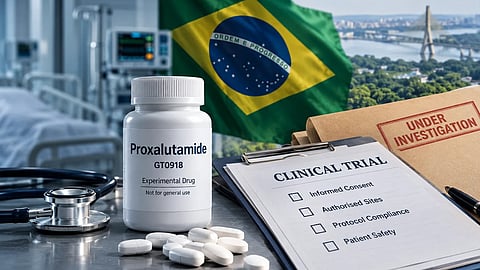
In 2021, patients were desperate to get involved in clinical trials in order to try and save their lives using experimental treatments. Some patients fell victim to a devastating medical ethics scandal due to taking part in a clinical trial looking at the effects of an experimental treatment, proxalutamide, which was claimed to be a potential treatment for COVID-19.
This clinical trial, which took place in the Amazonas region of Brazil, gained international attention when researchers claimed to achieve remarkable decreases in mortality rates. However, it was soon discovered that these claims were not as beneficial as they seemed, as there were reports of unethical practices.
Concerns regarding informed consent, unregulated research and management of patient deaths were raised by research ethics authorities in Brazil. Regulators issued warnings that the trial may have resulted in approximately 200 deaths, with this number referring to reported deaths during the study, rather than deaths conclusively linked to proxalutamide.1
This raised some key questions. Were the patients adequately informed on the treatment they were receiving? Were they protected? How can a study offering hope for a deadly disease fall under extreme ethical concerns?
While the trial first gained attention as it was seen to greatly reduce mortality, the National Research Ethics Commission (CONEP) later expressed concerns over ethical violations, lack of participant protections and the number of deaths. This resulted in the case being called "one of the most serious breaches of medical research ethics in Brazilian history" by the National Health Council (CNS).1
In early 2021, Brazil was hit with a deadly wave of infections. Hospitals in the Amazon region, such as Manaus, had increasing numbers of admissions, a lack of oxygen and increasing mortality.
During this time, endocrinologist Dr Flávio Cadegiani and colleagues investigated proxalutamide, a non-steroidal anti-androgen drug developed by Kintor Pharmaceuticals based in China.
The drug had previously been investigated to treat diseases such as prostate cancer. It was hypothesised that by blocking androgen signaling it would affect TMPRSS2 (a protein found in host cells that is part of SARS-CoV-2 entry). However, this biological rationale did not establish that it was effective to treat those with COVID-19.
Initial reports claimed a significant reduction in mortality, between 77-92%, which gained lots of attention. The findings attracted considerable attention while then-President, Jair Bolsonaro, openly promoted proxalutamide as a potential treatment of covid despite no proof that the drug could actually cure the condition.
The claims emerged at a time when there was an urgent need for effective treatment. However, the extraordinary results still needed to be independently verified.
According to The BMJ, the hospital based trial included 645 patients from nine hospitals in the Amazonas region of Brazil. Out of these, 317 patients received proxalutamide whilst 328 received a placebo.
The study reported a 14 day recovery rate of 81.4% for those on the drug and 35.7% for those on the placebo. The trial also showed an overall mortality rate of 11.0% after 28 days for those on proxalutamide and 49.4% for those on the placebo.1
The results were reported on medRxiv, a preprint server, and had not undergone peer review when The BMJ reported on the trial in November 2021. The reported figures should therefore be understood in the context of the unresolved concerns about the study's methods and conduct. 1
While these were impressive results due to the large differences in the data, the study invited further debates around these results.
There were issues with interpreting the results of this study. It was difficult to tell if the deaths that occurred during the trial were caused by the drug being investigated or due to COVID-19. This caused some controversy around whether the study followed the appropriate regulations.
Many organisations in Brazil including CONEP and Anvisa (National Health Surveillance Agency) looked into some aspects of the research. These authorities raised concerns questioning compliance of Brazil’s Resolution 466/2012, which encompasses ethical standards for research involving human participants.
The researchers were questioned on whether patients were fully informed about the experimental nature of the treatment. Informed consent means patients have a full understanding of what the study involves. Simply having them sign a form does not mean they consented.
During a congressional hearing on November 4, 2021, CONEP's coordinator reported that a consent form submitted by a participating hospital in Amazonas differed from the version approved by the commission. According to the coordinator, the version used in Amazonas did not include information about participants' rights or refer to the provision of contraceptives. This was a reported regulatory concern, not a judicial finding.6
Concerns were raised regarding where the drug was given to patients and whether all research activities had received the necessary approvals. If the research did not follow proper processes, then it may reduce the oversight of the research, and therefore, patient safety.
CONEP's coordinator told the Brazilian Chamber of Deputies that the original research request concerned a clinic in Brasília, but the study was subsequently expanded to other states, including Amazonas and Rio Grande do Sul, without the commission's authorisation.6
Anvisa clarified on July 28, 2021, that it had authorised two separate clinical studies of proxalutamide for COVID-19. However, the agency said that data from an independently initiated Brazilian study cited in the documentation had not been made available for regulatory evaluation. The authorisation of those two studies should not be interpreted as approval of every study involving proxalutamide in Brazil.4
There were investigations into whether the research followed the approved protocols. Any deviation from the protocol must be recorded and reported. This includes the administration of treatment, eligibility of patients and any safety issues.
The Federal Public Prosecutor's Office (MPF), in a civil action announced on April 29, 2026, alleged that the trial in Amazonas differed from the originally approved protocol and was conducted in hospital settings without the required authorisation for that context. The allegations form part of an ongoing legal claim. 5
There were concerns regarding the severe complications reported by patients. These included kidney and liver issues. Whilst these may not have been caused by the drug, as those with severe forms of COVID-19 are at risk of organ damage, the researchers were required to record and report any serious adverse events.
These concerns placed the trial’s ethical oversight and participant safety at the centre of the controversy.1
On September 2, 2021, Anvisa unanimously decided to suspend the import and use of proxalutamide in scientific research involving humans in Brazil as a precautionary measure. The agency cited concerns that some facilities might have been using the drug outside studies approved through the country's research ethics system. The suspension did not apply to clinical studies approved by Anvisa for drug registration.4
One of the most shocking aspects of the investigation was the number of deaths reported.
In its November 2021 report, The BMJ described how Brazilian authorities raised concerns regarding the almost 200 deaths out of a pool of 645 patients. The investigation also highlighted questions regarding the documentation and reporting of these outcomes.
Determining if a drug caused the death would need detailed clinical investigation. Those on the trial had severe forms of COVID-19, meaning they were at risk of respiratory failure and multiple organ complications. It was therefore important to determine whether the deaths were related to the research or the treatment.
However, uncertainty about causation, did not remove the researchers’ responsibility to properly report the deaths.
The controversy highlighted the vulnerability of those with severe illnesses. When a promising treatment is being offered in relation to a public health emergency, it can be difficult for patients and their families to make their own judgments. Therefore, it is important to ensure patients know the risks involved in the research and that they provide informed consent.
In a civil action announced on April 29, 2026, the MPF alleged that the trial may have contributed to the deaths of approximately 200 participants. However, this does not still establish that proxalutamide caused those deaths.
This case impacted the literature.
Another study on was published in Frontiers in Medicine in 2021 regarding proxalutamide. This showed a reduction in hospitalisations in males with outpatient COVID-19. This was written by McCoy and colleagues.
However, after a statement of concern, the article was retracted on 10 June 2022. The journal's retraction notice stated that the study's conclusions were not adequately supported by its methodology. An external expert found that the allocation of participants to the treatment and control groups was not sufficiently random.. The authors disagreed with the retraction.
Although this was a different study to that being investigated by the authorities in Brazil, this highlights the importance of looking into the methods of the research and the quality of the data. The results made dramatic claims regarding the treatment.
In 2023, a protocol was published regarding an exploratory study of proxalutamide in those with severe or critical forms of COVID-19.
On April 29, 2026, Brazil's Federal Public Prosecutor's Office (MPF) announced that it had filed a civil public action against the federal government, a hospital and two doctors over the proxalutamide trial conducted during the COVID-19 pandemic. The action seeks to establish responsibility for alleged ethical, scientific and regulatory violations.5
The MPF is seeking R$85 million in compensation for individual and collective damages. It has also requested measures intended to support affected people and prevent similar incidents. These are demands made in the lawsuit, not compensation awarded by a court.5
The legal action represents a significant development in the case, which first attracted international attention in 2021 over the reported deaths, questions about informed consent and concerns about compliance with research protocols.
References:
Taylor, Luke. 2021. “Covid-19: Trial of Experimental ‘Covid Cure’ Is among Worst Medical Ethics Violations in Brazil’s History, Says Regulator.” The BMJ 375: n2819. https://doi.org/10.1136/bmj.n2819.
Frontiers Editorial Office. 2022. “Retraction: Proxalutamide Reduces the Rate of Hospitalization for COVID-19 Male Outpatients: A Randomized Double-Blinded Placebo-Controlled Trial.” Frontiers in Medicine 9: 964099. https://doi.org/10.3389/fmed.2022.964099.
Yang, Dawei, et al. 2023. “Efficacy and Safety of Proxalutamide (GT0918) in Severe or Critically Ill Patients with COVID-19: Study Protocol for a Prospective, Open-Label, Single-Arm, Single-Center Exploratory Trial.” BMC Pharmacology and Toxicology 24: 38. https://doi.org/10.1186/s40360-023-00678-7
4. Agência Nacional de Vigilância Sanitária (Anvisa). 2021. “Esclarecimentos sobre estudos com proxalutamida aprovados pela Anvisa.” July 28, 2021. https://www.gov.br/anvisa/pt-br/assuntos/noticias-anvisa/2021/esclarecimentos-sobre-estudos-com-proxalutamida-aprovados-pela-anvisa.
Ministério Público Federal (MPF). 2026. “MPF Move Ação por Irregularidades em Ensaio Clínico no Amazonas Durante Pandemia de Covid-19.” April 29, 2026. https://www.mpf.mp.br/o-mpf/unidades/pr-am/noticias/mpf-move-acao-por-irregularidades-em-ensaio-clinico-no-amazonas-durante-pandemia-de-covid-19
Agência Câmara de Notícias. 2021. “Conep Relata Irregularidades em Estudo Feito com o Uso da Proxalutamida contra Covid-19.” Câmara dos Deputados, November 4, 2021. https://www.camara.leg.br/noticias/823832-conep-relata-irregularidades-em-estudo-feito-com-o-uso-da-proxalutamida-contra-covid-19/
OG/MF
