

Edwards Lifesciences is a US-based Med-tech company that develops devices to treat serious heart conditions particularly diseases affecting heart valves.
It specializes in making artificial heart valves, minimally invasive valve replacement systems and surgical heart valve technologies used in conventional heart-valve surgery.
The company is under regulatory scrutiny over failure of its delivery system used to implant a heart valve. According to Reuters, reports of balloon ruptures during procedures led to an alert, followed by one reported death and one serious injury
On Thursday, the US FDA flagged a potentially high-risk issue involving certain Edwards Lifesciences delivery systems after the company reported one serious injury and one death associated with the issue on 5 October.
The affected devices are one of the Commander M delivery systems, that are generally used with Edwards' SAPIEN M3 transcatheter mitral valve replacement system. The Commander M delivery systems received US approval in December 2025.
As per the FDA, balloon bursts could block blood vessels or prevent retrieval of the device. Such incidents result in the requirement of additional procedures, including surgery. The delivery systems are usually prescribed to patients that are generally considered unsuitable for conventional open heart surgery. Thus, balloon ruptures in these delivery systems raise serious patient safety concerns and may increase the risk of mortality.
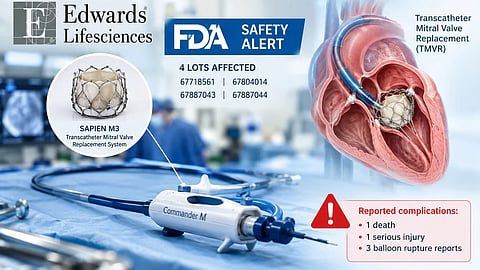
The US Food and Drug Administration (FDA) has flagged four batches of Edwards Lifesciences' Commander M delivery system following reports of balloon ruptures during procedures.
The device is used to implant the company's SAPIEN M3 artificial heart valve in patients undergoing transcatheter mitral valve replacement (TMVR), a procedure that allows doctors to replace a damaged heart valve without conventional open-heart surgery.
The affected batches are identified by lot numbers 67718561, 67804014, 67887043 and 67887044. FDA has advised healthcare facilities to not use the identified affected products listed above. It has also clarified that the units with other lot numbers are not impacted by this recall and can continue to be used.
Patients who undergo transcatheter mitral valve replacement often have other serious health conditions that make open-heart surgery a less suitable option.
Balloon rupture in these devices results in embolism in blood vessels preventing the delivery system from being withdrawn safely. This intimates doctors to intervene urgently and perform emergency surgery, prompting additional risks for these medically fragile patients.
The FDA's alert was followed by reports of three balloon ruptures including one serious injury and one death. The reported outcomes have highlighted the need to understand the precise circumstances of each event. The FDA is currently reviewing the issue and carrying out a relevant investigation to establish a reasonable explanation behind the ruptures.
(Rh/MF/MSM)
