HbA1c Isn't Really a 3-Month Average: Here's What It Actually Measures

From the chemistry of glycation to why anemia and kidney disease can make the result unreliable, here's what the test is really tracking, explained in plain language.
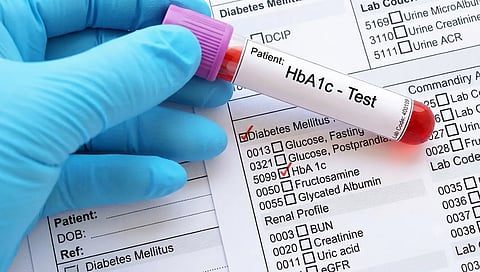
An HbA1c blood sample tube shown alongside a lab requisition form listing related tests
HbA1c remains the standard glycemic test to measure glycated hemoglobin over a period of timeAI image
Published on
Updated on

Can I have a normal HbA1c and still have diabetes? Key Takeaways

  • HbA1c measures sugar (glucose) permanently stuck to hemoglobin, not the sugar currently in your blood.

  • It's weighted toward your last 4-8 weeks, not an even 90-day average.

  • The eAG formula translates it into everyday sugar units, but it's a population average, not a personal guarantee.

  • Steady sugar and wildly swinging sugar can produce the identical HbA1c.

  • Anemia, inherited blood disorders, and kidney disease can push it falsely high or low, sometimes hiding real diabetes.

HbA1c is often plainly understood as the average sugar (glucose) over 3 months. It's also understood as the number doctors want below 7%, and the one used to diagnose diabetes.

But the surprising part is that the test does not measure the sugar circulating in your blood at all. It measures how much sugar has permanently attached itself to a protein in your red blood cells (hemoglobin).

That difference matters, because it explains why the same HbA1c number can mean very different things for different people.

What Does HbA1c Actually Measure?

Close-up illustration of red blood cells, the cells that carry glycated hemoglobin measured by the HbA1c test
Sugar molecules attach to hemoglobin inside red blood cells, a process called glycation.Anirudh via unsplash

To understand HbA1c, it helps to start with hemoglobin. Hemoglobin is the protein inside the red blood cells whose main job is carrying oxygen around the body.

The sugar (glucose) in your bloodstream can also attach itself to hemoglobin, without needing any enzyme or biological "helper" to make it happen. This process is called glycation, and once it happens, the sugar molecule stays attached. It does not become free again.

This bond lasts for as long as that particular red blood cell survives, which is roughly 120 days (about 4 months) before your body replaces it with a new one.

Because the attachment is permanent for the life of the cell, doctors can look at the percentage of hemoglobin that has sugar (glucose) attached, and use that to estimate how high your blood sugar has generally been.

This is different from a finger-prick glucose test, which only shows your sugar level at that exact moment.

What results of HbA1c mean:

  1. Normal: Below 5.7%

  2. Prediabetes: 5.7% to 6.4%

  3. Diabetes: 6.5% or higher

Is HbA1c Really a 3-Month Average?

Mentioning HbA1c a "3-month average" makes it sound like every single day over that period counts approximately toward the final number. But in reality, the body is constantly making new red blood cells and retiring old ones, so at any given moment, your blood contains a mix of new cells and much older ones.

The newest cells, formed in roughly the last 30 days, contribute about half of the final HbA1c result. The month before that contributes about a quarter. The remaining quarter comes from the two to three months before that.

In plain terms: the most recent month of blood sugar control has roughly twice the influence on the result compared to a month from further back.

So, if someone recently improved their diet or medication routine, the next HbA1c test will likely already show meaningful improvement, even though the full 4-month window hasn't passed yet.

On the other side, a rough few weeks recently will move the number more than a rough patch two months ago.

Can an HbA1c Test Be Wrong? When the Result Isn't Reliable

Beyond averaging, red blood cell lifespan itself can throw off HbA1c, regardless of your actual sugar levels.

A falsely low HbA1c can occur with conditions such as:

  • hemolytic anemia (a condition where red blood cells break down faster than normal)

  • recent transfusion

  • sickle cell anemia (an inherited blood disorder where red blood cells become sickle shaped rather than round and flexible)

  • thalassemia (also called hemoglobinopathies, meaning conditions that affect the structure of hemoglobin itself)

  • erythropoietin therapy (given to stimulate bone marrow to produce red blood cells)

  • pregnancy

In all of these conditions red blood cells are replaced faster, leaving less time for sugar to build up.

A 2026 case report shows a woman's undiagnosed sickle cell disease and thalassemia masked years of high blood sugar because her HbA1c consistently read too low.³

A falsely high HbA1c usually points to iron deficiency, which both speeds up glycation directly and slows new red-cell production, leaving older, longer-exposed cells in circulation. Doctors typically treat the deficiency first, then retest. B12 or folate deficiency and a removed spleen (splenectomy) act similarly.

Kidney disease is more nuanced: HbA1c usually stays reliable in patients with hemoglobin at or above 10 g/dL, but not below it.⁴ It's the accompanying anemia, not the kidney disease itself, that may lead to false values.

HbA1c, fasting glucose, and fructosamine (which reflects blood sugar over a shorter 2 to 3 week window, using a different blood protein called albumin instead of hemoglobin) disagreed substantially in a Senegalese study, especially with sickle cell trait⁵, a relevant caution in India as well.

Are There Better Alternatives to HbA1c?

A person checking blood sugar with a glucometer, which measures a single moment rather than an average
A glucometer reading and an HbA1c result can both be accurate, yet tell you different thingsPavel Danilyuk via Pexels

HbA1c stays the default test since it's simple and predicts complications well. But three blood-based alternatives exist for conditions when HbA1c can't be trusted.

  • Fructosamine measures sugar attached to blood proteins (mostly albumin), covering the last 2 to 3 weeks instead of months. It struggles when overall protein levels are off, as in liver or kidney disease.

  • Glycated Albumin is a more refined version, measuring sugar attached specifically to albumin. Same 2 to 3 week window, but it reacts faster to treatment changes, useful in pregnancy or right after starting insulin, though it can read falsely low in obesity.

  • 1,5-Anhydroglucitol (1,5-AG) works differently. It's a naturally occurring compound that normally stays steady in the blood, but drops sharply whenever glucose spikes high enough to spill into urine, making it the best of the three at catching short-term, after-meal sugar surges. It doesn't work in advanced kidney disease, pregnancy, or with certain diabetes medications (SGLT2 inhibitors).

A Continuous Glucose Monitoring (CGM) with Time in Range doesn't replace these blood tests but complements them, tracking real-time swings a single averaged number can't.

Conclusion

HbA1c remains one of the most valuable tools in diabetes care, precisely because it captures a longer-term picture that a single glucose reading can't. But it's important to remember it's a proxy built on red blood cell biology and an average, not a direct measurement of the sugar in the blood, and can sometimes be thrown off or misleading. Understanding what the test is really measuring, and what can interfere with it can help to interpret the number correctly instead of taking it at face value. If your HbA1c doesn't seem to match how you feel, or what your glucometer shows day to day, that mismatch is worth bringing up with your doctor rather than brushing aside.

For a broader look at why the same blood test can read differently across different people and labs, see MedBound Times' guide to interpreting divergent lab results

Frequently Asked Questions (FAQs)

Q

Does HbA1c measure the sugar currently in my blood?

A

No. It measures how much sugar has permanently attached to hemoglobin over the past several weeks. It's a record of past sugar exposure, not a live reading like a glucometer gives you.

Q

Is HbA1c really a 90-day average?

A

No. It leans more heavily toward your last 4 to 8 weeks. Recent changes in your sugar control affect the value more than changes from two or three months back.

Q

Can I have a normal HbA1c and still have diabetes?

A

Yes, in certain cases. If you have anemia, an inherited blood disorder, or anything else affecting how long your red blood cells last, HbA1c can read normal or even low despite genuinely high blood sugar.

Q

If two people have the same HbA1c, does that mean their blood sugar control was the same?

A

Not necessarily. Someone with steady sugar levels and someone whose sugar swings wildly between very low and very high can both land on the exact same HbA1c, because the test only shows the average, not the ups and downs behind it.

Q

Why is my blood sugar high but my HbA1c normal?

A

Usually because HbA1c only shows an average which may hide variability. Frequent highs can be balanced out by other readings across the day, or the dawn phenomenon can push up a single fasting number without meaningfully shifting the overall average. A Continuous Glucose Monitor is the best way to see what's actually happening between tests.

Q

What can cause a falsely high HbA1c?

A

Iron deficiency is the most common cause, through two mechanisms: it speeds up glycation directly, and it slows new red blood cell production, leaving older cells that have built up more sugar over time. Vitamin B12 or folate deficiency, a removed spleen, and kidney disease with milder anemia (hemoglobin at or above 10 g/dL) can also push HbA1c higher than actual blood sugar would suggest.

References

  1. Nathan, D. M., J. Kuenen, R. Borg, H. Zheng, D. Schoenfeld, R. J. Heine, and A1c-Derived Average Glucose (ADAG) Study Group. "Translating the A1C Assay into Estimated Average Glucose Values." Diabetes Care 31, no. 8 (2008): 1473–1478. https://doi.org/10.2337/dc08-0545.

  2. Balti, E, C. N. Nganou-Gnindjio, B. E. Nouthe, et, al. "Interpretation of A1C Measurement in Sub-Saharan Africa Beyond the Global A1C-Derived Average Glucose (ADAG) Equation." Pan African Medical Journal 44 (2023): 8. https://pmc.ncbi.nlm.nih.gov/articles/PMC9935656/

  3. Toperzer, K., and A. Moon. "Diagnostic Limitations of Hemoglobin A1c in the Setting of Compound Hemoglobinopathy: A Case Report of Sickle Cell Disease, Alpha Thalassemia, and Occult Diabetes." Cureus 18, no. 1 (January 15, 2026): e101623. https://doi.org/10.7759/cureus.101623.

  4. Kuo, I. C., H. Y. Lin, S. W. Niu, J. J. Lee, Y. W. Chiu, C. C. Hung, S. J. Hwang, and H. C. Chen. "Anemia Modifies the Prognostic Value of Glycated Hemoglobin in Patients with Diabetic Chronic Kidney Disease." PLoS One 13, no. 6 (2018): e0199378. https://doi.org/10.1371/journal.pone.0199378.

  5. Skinner, S., M. Diaw, M. Ndour Mbaye, et, al. "Evaluation of Agreement Between Hemoglobin A1c, Fasting Glucose, and Fructosamine in Senegalese Individuals with and without Sickle-Cell Trait." PLoS One 14, no. 2 (2019): e0212552. https://doi.org/10.1371/journal.pone.0212552.

  6. Rifai N, Wittwer C, Horvath AR, eds. Tietz Textbook of Clinical Chemistry and Molecular Diagnostics. 6th ed. St. Louis, MO: Elsevier; 2018.

An HbA1c blood sample tube shown alongside a lab requisition form listing related tests
Low Glycemic Control in Diabetes Patient can be Predicted by Information Systems in Machine Learning
logo
Medbound Times
www.medboundtimes.com