Viral Video: “This Is a Public Hospital?” Indian Medical Student in China Stuns Internet With High-Tech Tour

An Indian MBBS student in China shares viral videos revealing AI, automation and digital monitoring used in Chinese public hospitals.
Screenshots from Pari's Instagram reels
Viral videos reveal how public hospitals in China use AI, automation and digital monitoring in routine patient care.@_parified/Instagram
Published on
Updated on

Chinese public hospitals have come under global attention after a series of viral videos showed widespread use of automation, artificial intelligence and digital monitoring in routine patient care. The videos were recorded by Pari, a fourth year Indian MBBS student studying in Suzhou, China, and have crossed more than three million views across social media platforms.

Her recordings offer a detailed look at how hospital operations are managed through automated systems, from surgical preparation and medicine distribution to emergency response and real time patient monitoring. The hospital featured in the videos is a government run facility, highlighting the scale of digital infrastructure being deployed in public healthcare settings. Several of the technologies seen in the clips have been previously reported by national and international media outlets covering hospital digitisation in China.

Automation in Patient Preparation & Infection Control in Chinese Hospitals

Screenshots from Pari's Instagram reels
China Hospitals Embrace Robotics, AI and Automation — Viral Videos Show High-Tech Public Healthcare in Action@_parified/Instagram

The videos show that patients and staff entering the surgical preparation area scan their identification cards to receive clean, sterile shoes through automated dispensers. Hospital attire is also dispensed automatically without human handling. According to media reports, these systems aim to maintain hygiene and reduce the time needed for surgical preparation.

Inside outpatient and inpatient sections, patients collect prescribed medicines by scanning a digital code at automated dispensing machines. These systems reduce queue lengths and limit direct contact during medication distribution.

Digital Doctor Selection Systems and Smart Ward Displays in China

Screenshots from Pari's Instagram reels
An Indian MBBS student in Suzhou recorded viral videos from inside a public Chinese hospital.

Hospital lobbies feature large digital touch screens displaying doctor profiles, specialisation areas, credentials and photographs. Patients select their preferred doctor before registration. Outside each ward, digital boards list attending doctors and nurses, patient identifiers and bed numbers, allowing staff and families to track patient location and care responsibility.

Real-Time Patient Assistance Systems and Emergency Alert Technology

Screenshots from Pari's Instagram reels
Inside China’s AI-Driven Hospitals: Indian Student’s Viral Tour

One of the most widely shared segments in the videos features a ward based emergency alert system installed next to each patient bed. Each bed has a call button and a microphone. When the button is pressed, a red light flashes outside the room, and the bed number is announced repeatedly in the hallway. The nursing station receives the alert simultaneously and the notification continues until a staff member responds.

This system allows patients to request help without leaving their beds and supports faster emergency response within wards.

AI-Powered Surgical Logistics and Live OR Monitoring in Chinese Hospitals

Screenshots from Pari's Instagram reels
An Indian MBBS student in Suzhou recorded viral videos inside a public hospital, revealing automated shoe dispensers, AI powered trolleys, digital ward displays and continuous monitoring of patient vitals.

In the surgical wings, automated trolleys move instruments and medicines between departments without manual handling. Live digital dashboards display real time information about surgeries in progress, anaesthesia duration and operating room temperatures. These systems are designed to reduce delays and support safer perioperative workflows.

The level of automation in perioperative logistics is unusually integrated, which is why the segment gained widespread traction online.

Continuous Digital Patient Monitoring and Centralised Vital Tracking

During rotations in respiratory medicine and infectious disease departments, the student observed centralised monitoring screens displaying vital signs and electrocardiogram readings of multiple patients at the same time. Medical teams continuously monitor these displays to detect early signs of deterioration.

This distributed monitoring approach allows clinicians to oversee several patients simultaneously, reducing manual rounds.

Patient data also appears on screens placed in hallways, ward stations and doctors’ rooms, allowing distributed oversight of clinical status across departments.

How Traditional Chinese Medicine (TCM) Is Digitally Integrated in Hospitals

Alongside modern clinical services, hospitals continue to provide Traditional Chinese Medicine treatments through the same digital infrastructure used for contemporary care. Registration, monitoring and documentation for these patients follow the same electronic systems.

Digital Infrastructure in Public Hospitals & High-Tech Maternity Monitoring

The student confirmed that the hospital featured in the videos is a public facility. Her recordings include departments such as surgery, internal medicine, respiratory medicine, infectious diseases and obstetrics. In maternity wards, digital fetal heart rate and uterine contraction monitoring systems track pregnancy parameters in real time during patient evaluations.

AI-Assisted Healthcare Systems in China: Growth, Models & 2025 Updates

Beyond the systems seen in public hospitals, China has also developed AI based virtual hospital models. Tsinghua University researchers launched Agent Hospital, a simulated medical environment that includes AI doctor and nurse agents designed to process large volumes of virtual clinical cases for training and system testing. Published reports state that the system achieved more than 93 percent accuracy on a medical knowledge assessment and processed thousands of virtual patient cases within a few days.

In physical hospitals, AI adoption has continued to expand. In May 2025, Beijing Tsinghua Chang Gung Hospital added 500 beds and integrated AI support across admissions, infusion management, diagnostics and mobile nursing stations, according to Med Tech World. These systems support patient flow management, clinical monitoring and hospital logistics.

China’s national healthcare policy documents have outlined plans to expand AI assisted diagnostic tools across primary care facilities by 2030, with routine use of AI for medical imaging analysis and clinical decision support in secondary and tertiary hospitals.

China’s Hospital Digitisation: What the Viral Video Reveals
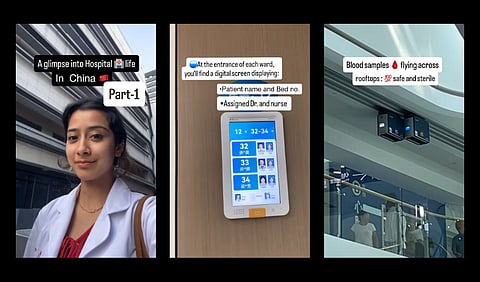
The viral content has highlighted the level of automation present in major hospitals in China. Features such as automated shoe dispensers, AI driven trolleys, digital ward displays and continuous patient monitoring demonstrate the direction of hospital digitisation in large urban centres.

While these systems aim to reduce staff workload and improve response time, clinical decisions continue to remain under human supervision. Researchers and regulators continue to emphasise the importance of system validation, data security and clinical accountability as digital tools expand in healthcare delivery.

(Rh/MSM)

Screenshots from Pari's Instagram reels
MBBS in China: Dr. Priyanshi Shares Her Journey, Challenges & Advice for Indian Students

Related Stories

No stories found.
logo
Medbound Times
www.medboundtimes.com