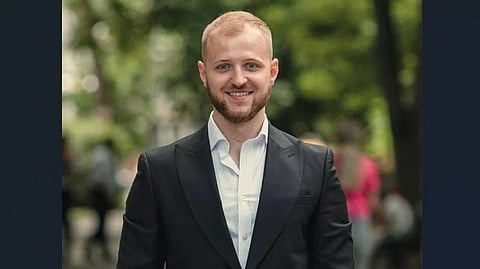
By Olga Glasson
A physician who handled a hundred surgical consultations a week in Czech hospitals, assesses wounds for housebound New Yorkers, and has consulted remotely in frontline Ukraine explains which measurements and photographs let a remote doctor act the same day.
The surgical wound is leaving the hospital before it heals. A prospective study published in Bioengineering in June 2026 followed 113 patients discharged after laparoscopic surgery at Benazir Bhutto Hospital in Rawalpindi: 81.4% were managed entirely through wound photographs sent over WhatsApp, and 18.6% were called back for an in-person review. The wound once checked on a ward round is now checked in a living room, and the surgeon is rarely the one standing over it.
Liubomyr Hlynka has examined postoperative wounds on both sides of that shift. A graduate of Ivano-Frankivsk National Medical University, he worked in general surgery at Masaryk Municipal Hospital in Jilemnice and at Strakonice Hospital after the Czech Republic recognized his diploma. There, he handled more than 100 consultations a week in a team of 20 physicians, with over 5,000 patients and their families in his care. Since 2023, he has worked in New York with ZiphyCare as an onsite care coordinator and phlebotomist, driving to two to four homebound patients a day between Brooklyn, Long Island, Buffalo and Syracuse, and for part of that period taking the other seat as well, consulting remotely for patients in Ukraine and elsewhere in Europe. On the ward, he could act on what he saw. In a bedroom, he can observe and document, and the decision belongs to a physician on a screen, a distance that, he argues, raises the standard for the report above anything the ward asked of
What a Home Visit Can and Cannot Establish
Wound scales and infection surveillance criteria agree on what a wound is judged by: dimensions, tissue in the bed, edges, exudate, surrounding skin, pain, warmth and temperature. A visiting clinician with a tape measure and a camera can capture nearly all of it, and Liubomyr Hlynka adds what changes a wound's meaning, such as a glucose reading or the anticoagulants the patient takes. What he cannot do at the bedside is probe the depth, open the incision, change the dressing, remove sutures, or prescribe. Everything on the first list goes into his report; everything on the second waits for a physician with the authority to act on it.
“The physician sees exactly what I show and reads what I write, nothing more. A finding I leave out arrives as missing information, and the doctor cannot tell whether I forgot it or whether there was nothing to find. So the report says both what I measured and what I looked for and did not find,” says Liubomyr Hlynka, who runs those visits as ZiphyCare's onsite care coordinator.
The Photograph Is a Measurement
Liubomyr visits follow one sequence. History and complaints come first, then the medication check, then the wound itself, measured with a tape and photographed, swabbed if there is exudate. An EKG and a blood draw follow when the physician wants them, and everything goes into the record system before he leaves, while the wound is still in front of him. The photograph gets the same discipline as the tape, not a snapshot but a measurement: a fixed distance, a scale in the frame, the same light and the same angle at every visit, so that two images taken a week apart can be compared without guesswork. For an early-stage pressure sore on a bed-bound patient, his photographs and written report are often the only close examination the wound receives between physician reviews. An international cohort study in Annals of Surgery found in 2023 that remote assessment misses infections an in-person review would catch, which is why his picture never travels alone: a swab result and the day's vital signs go with it.
Three Ways a Visit Can End
A visit without the authority to treat ends in a decision about where care continues. Most patients stay at home with recommendations. Some are referred for in-hospital wound monitoring, and a few visits end with an emergency call. The supervising physician chooses between the first two on what reaches them; the third starts at the bedside, because a handover delay would defeat its purpose. One of his own cases was a blood glucose so high that the ambulance was called before anyone discussed the wound. Another was a neglected wound of advanced severity that needed inpatient monitoring rather than another home visit.
“The first question in the doorway is the postoperative day. The second is the last measurement. Serous fluid and a little redness on day three, I write down and move on. The same picture on day fourteen, or a wound that has grown since last week, the physician hears about within the hour,” Liubomyr Hlynka explains.
When Nobody Reaches the Wound
The two situations that delayed a decision were both about access. In one home, relatives refused to let him in, and the visit produced no wound data at all. In another, far from the city, there was no stable connection, so the record entry and the images waited until the signal returned. Liubomyr's answers are organizational: a refusal is logged and a repeat visit scheduled, offline notes are synchronized later, and an interrupted transmission means a phone call, so the escalation does not wait for the network. Language does part of the same work; he speaks Ukrainian and Russian and works in English, Czech, and Slovak, so older Eastern European patients in New York hear medication and diet instructions in their first language. In the team's quality-improvement work, he pushed for accurate specimen labeling, which spares frail patients a repeat blood draw and a second visit.
Those languages also put him on the other side of the screen. For part of his time with ZiphyCare, Liubomyr says, he took part in remote consultations for patients located in Ukraine, the Czech Republic and other European countries, care delivered into the jurisdictions where his Ukrainian training and Czech diploma recognition apply rather than under a New York license. Many of those patients were in the east of Ukraine, among them Kostiantynivka, a Donetsk-region city under sustained bombardment where the hospitals that remain run on reduced staff. A consultation by video is frequently the only clinical contact a patient there can reach.
The constraints invert the ones in a Brooklyn bedroom and leave the same requirement. In a home visit, someone else holds the authority, and he supplies the measurements; in a cross-border consultation, the authority is his and the measurements are whatever the patient or a relative can produce, often without a tape, a scale in the frame, or a glucose meter. Both end in a written record precise enough for the next clinician to act on, and both punish anything left out.
Hlynka also assisted in the care of Ukrainian service members who traveled to the United States for defined periods of treatment, working alongside the licensed U.S. clinical team on patients whose records, injuries, and medication histories arrived in Ukrainian.
“On a video call to Kostiantynivka, I am the doctor, and I still cannot touch the patient. No tape, no scale in the photograph, sometimes a relative holding the phone. So I ask narrower questions, and I write down what I could not establish, the same as I do in a bedroom in Brooklyn. The roles swap, the record does not,” Hlynka says.
A Record That Outlasts the Job Title
The same habit serves Liubomyr's own path. Each of the three health systems he has worked in has its own standard of proof, so alongside the patient records he has kept a competency log of his own since he started in New York. It follows the six core competencies that U.S. residency programs grade: patient care, medical knowledge, practice-based learning and improvement, interpersonal and communication skills, professionalism and systems-based practice, and holds dates and findings, never patient identifiers. A licensed physician periodically reviews and confirms it. He shares the routine with colleagues, and his research on surgical outcomes and patient safety grows out of the same entries.
The pathway Liubomyr is watching most closely is New York's own. Assembly bill A7319, amended in February 2026 and before the Higher Education Committee, would let internationally trained physicians work toward full licensure under supervision in shortage areas. The guidance the Federation of State Medical Boards and its partner bodies issued for such routes in February 2025 is plain about what they rest on: a license held abroad and years of practice, with a supervised provisional period in which a licensed physician attests to what the applicant can do.
“None of these routes scores a medical assistant's shifts. What they all come down to is a supervising doctor putting a name under what I can do, and a log with dates and findings that a physician has already checked makes that an easy signature. I tell colleagues to start it on their first day, whatever the job title says,” Liubomyr Hlynka notes.
MBTPG/ARC