
- Home
- About Us
- Contact Us
- Biography
- MedBound Hub
- InternshipInternship
- Daily Pulse
- Medicine
- Physical Therapy
- InterviewInterview
- Pharmacy
- Biotechnology
- College/InstituteCollege/Institute
- Dentistry
- Blog
- Wellness & Nutrition
- Nursing
- Opinion

New investigational therapy 77A is an antibody that converts a cancer survival protein (HSP70) into an immune system trigger
Targeting HSP70 in this way activates T cells and natural killer (NK) cells to reshape the tumor environment and support long-lasting immune responses
In laboratory models, 77A boosted the effects of chemotherapy, radiation and immunotherapies in multiple tumor types
ORLANDO, DECEMBER, 2025
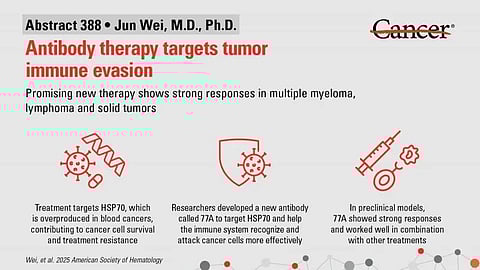
In a new preclinical study, researchers from The University of Texas MD Anderson Cancer Center developed an antibody therapy called 77A that showed an ability to overcome treatment resistance in blood cancers, such as myeloma and lymphoma, as well as solid tumors.
The study was led by Jun Wei, M.D., Ph.D., assistant professor of Lymphoma & Myeloma, and principal investigator Robert Z. Orlowski, M.D., Ph.D., professor of Lymphoma & Myeloma. Wei presented the results today at the 67th American Society of Hematology (ASH) Annual Meeting and Exposition (Abstract 388). All ASH content from MD Anderson can be found at MDAnderson.org/ASH.
“There is tremendous promise in the way 77A is capable of rewiring the immune system, enabling it to respond effectively against multiple cancers,” Wei said. “Our findings offer a new pathway to immunotherapy and patient treatment.”
The 77A antibody targets HSP70, a heat shock protein that helps tumors evade the immune system. HSP70 often is overproduced in certain blood cancers and solid tumors, contributing to a hostile tumor environment by suppressing immune responses and promoting cancer cell survival.
In laboratory models, 77A demonstrated strong antitumor effects by enhancing the activity of both innate and adaptive immune cells, including natural killer (NK) cells and T cells. The antibody improved the ability of immune cells to detect and destroy cancer cells, and it worked well in combination with other treatments, such as chemotherapy, radiation therapy and immune checkpoint blockade. It also showed potential to pair with adoptive T cell therapy, a cutting-edge approach where patients receive lab-grown immune cells to target cancer cells.
Importantly, 77A was effective in laboratory models of multiple cancer types, and early tests with human immune cells showed it could enhance immune responses in healthy donors. These findings pave the way for clinical trials and suggest 77A could become a versatile new therapeutic option that warrants further investigation.
"These results give us confidence that 77A could become a versatile immunotherapy.”
Robert Z. Orlowski, Principal investigator, M.D., Ph.D., professor of Lymphoma & Myeloma.
“Our next step is to advance a humanized version of this antibody into clinical trials to evaluate its potential in patients across multiple cancer types,” said Orlowski.
The 77A humanized antibody is under development and expected to move into clinical trials.
(Newswise/HG)
