What Your Gut Microbes Reveal About Ancient Human Migration: Stanford Study Finds 1,231 Shared Species Across African and South American Groups

Your stress levels are directly linked to your gut microbes that have evolved and passed down to you by your ancestors
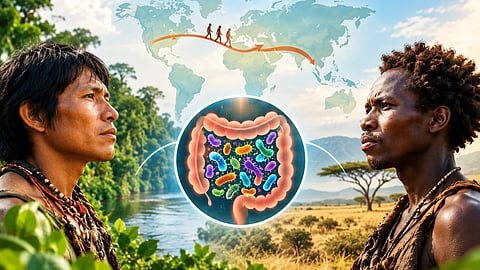
Illustration of human migration across continents
Modern lifestyle changes impacted our microbiota which further impacted our body’s physiology.AI Image
Author:
Mariyam F.
Published on: 
Updated on: 

A recent study published in Nature explains how human evolution is directly interlinked with gut microbiome biodiversity. The gut microbiome of a population has evolved with it through the years and may influence aspects of human health and physiology. However, the consequences of losing microbial diversity remain uncertain.1,2

Previous studies have established that certain gut microbes were common in populations with less exposure to industrialization. However, the same microbes were observed to be less common in industrialized societies. Modern lifestyle changes impacted our microbiota which further impacted our body’s physiology.

However, less was known about the relationship of these microbes with humans. Researchers wanted to determine whether these microbes had accompanied human populations across generations for thousands of years or had been acquired more recently through factors such as environmental exposure and contact between populations.

What was the Objective of Conducting the Study on Gut Microbiome Evolution?

The main objective of the study was to determine gut microbiome ancestry, whether gut microbial populations diverged alongside human populations after their ancestors became geographically separated.

The study also aimed to investigate the persistence of these microbial populations. It examined whether these species have been maintained in human populations across generations and whether they face a risk of biodiversity loss, particularly whether microbes with long evolutionary histories have become rare or disappeared from industrialized populations.

What Was the Study Design and Methodology Involved?

The study compared microbial genomes from the two populations, whose ancestors had been geographically separated for tens of thousands of years.

Population 1: The Tsimane of Bolivia

85 adults, 133 stool samples

The Tsimane are Indigenous forager-horticulturalists living in the Bolivian Amazon. Researchers performed deep genetic sequencing on stool samples collected in 2009 and 2012–2013. The sequencing enabled researchers to identify microbial species by analyzing DNA recovered from the samples.

Population 2: The Hadza of Tanzania

137 adults, previously collected microbiome data

The researchers compared the Tsimane data with previously generated, deeply sequenced microbiome data from the Hadza, a hunter-gatherer population in Tanzania. Although the two populations have different diets and lifestyles, their ancestors became geographically separated tens of thousands of years ago. This made the comparison useful for investigating whether their gut microbes shared ancient evolutionary histories.

The researchers used population-genetic analyses to examine genetic differences between microbial populations and estimate when their strains last exchanged DNA. Because microbes can exchange genetic material as well as inherit it from their ancestors, the researchers used complementary analyses to distinguish patterns consistent with ancient separation from those associated with more recent genetic exchange. 1,2

Results:

  1. 1,231 (87.4%)  shared microbial species were detected in both populations

  2. 636 of these shared species were analyzed in depth using population-genetic analyses. The analyses revealed patterns of microbial divergence and gene flow consistent with prehistoric human co-migration.

  3. 848 (60.2%)  species were found to be absent in industrialized populations

  4. Among the 636 shared species examined in depth, 545 showed no detectable strain sharing between the Tsimane and Hadza populations.

  5. 12,746 microbial genomes were recovered from Tsimane samples. These metagenome-assembled genomes represented 1,408 bacterial and archaeal species.

Scientific illustration of human intestines
Gut microbes travelled and evolved with their human hosts.AI Image

What Gut Microbial Genetics Reveal About Human Evolution

Finding 1

The finding helped the researchers conclude that our gut microbes travelled and evolved with their human hosts during prehistoric migrations. The ancestors of the Tsimane eventually settled in the Americas, while the Hadza remained in Africa. 

One of the study’s most important findings was that 1,231 microbial species were shared between the Tsimane and Hadza datasets, accounting for approximately 87.4% of the 1,408 species identified in the Tsimane analysis, despite the populations living on different continents. 

Finding 2

Many ancient microbes are now uncommon in industrialised populations. A key outcome from this study was that the researchers could distinguish 848 shared species of microbes that were rare or absent in the industrialised population datasets they examined. The researchers compared the microbial data with datasets from industrialized populations, including those in Europe, Asia and North America. These comparisons helped them identify microbial species whose present-day distribution differed from that observed in the Tsimane and Hadza populations.

One thing to remember here is that industrialization has not simply replaced every traditional gut microbe with a modern one. Different microbial species have followed different evolutionary and ecological paths.

Finding 3

The researchers also compared genetic differences between microbial strains within and across populations. They examined 636 shared species out of which 545 showed no detectable strain sharing between the Tsimane and Hadza. This suggests that most of these species had experienced very limited recent genetic exchange between the two populations.

Through their additional genetic analyses, the scientists were able to estimate a median separation time of approximately 17,090 years for the Tsimane and Hadza gut microbial populations. 

This estimate broadly fits within the long period of human migration from Africa to the Americas, although the precise timing is uncertain. The researchers also found that genetic exchange between microbial populations from industrialized regions was more recent than that between the Tsimane and Hadza populations, supporting the interpretation that many of the shared microbes have long evolutionary histories.

What Does the Study’s Findings Mean for Human Health?

Gut microbes contribute to digestion, metabolism and other immune functions that further contribute to various interactions in the intestinal environment. 

Losing microbial diversity or particular microbial functions could therefore have consequences for health.

The authors note that the disappearance of certain microbial species is associated with increased risks of certain chronic metabolic and inflammatory disorders. 

Researchers believe that restoring some of these microbes in our gut microbiome could potentially help recover microbial functions that have been lost. However, it is important to note, this study does not demonstrate that losing these microbes causes chronic disease, nor does it show that reintroducing them will improve health.

What Are the Study's Limitations?

The study was based on two principal populations for evolutionary comparison. The study of samples obtained from the Tsimane and Hadza provides valuable insights, but its findings cannot be generalized to every Indigenous, rural or industrialized population.

The researchers decoded the past using present-day genomes. It is important to note that they did not have continuous microbial samples spanning tens of thousands of years. Evolutionary dates were estimated on the basis of genetic models and assumed mutation rates. 

Rare or absent does not necessarily mean extinction. There is a possibility that a microbial species might be present at low abundance or in populations that were not sampled.  Similarly, the absence of a species from the datasets examined does not establish that it has disappeared from every industrialized population.

The study did not identify the causes of microbial loss. It does not tell us how much of the observed pattern is attributable to diet, antibiotics, sanitation, urbanization or other factors.

The health consequences remain uncertain. The analysis does not tell us whether the loss of particular microbes caused disease or whether their restoration would improve health.

References: 

1. Carter, Matthew M., et al. “Prehistoric Global Migration of Vanishing Gut Microbes with Humans.” Nature, October 7, 2026. https://doi.org/10.1038/s41586-026-11106-1 

2. Hadhazy, Adam. “Gut Microbes Across Continents Trace Ancient Human Migration.” Stanford Medicine, October 7, 2026. https://med.stanford.edu/news/all-news/2026/10/gut-microbiome-migration.html 

3. Schlebusch, Carina M., and Maja Vukovikj. “Gut Microbes That Trace Ancient Human Journeys.” Nature, October 7, 2026. https://www.nature.com/articles/d41586-026-02969-5 

(OG/MF/MSM)

Illustration of human migration across continents
New Study Maps How Gut Bacteria Help And Hinder Each Other's Growth
logo
Medbound Times
www.medboundtimes.com