

In Keralam, which became the first state in India to provide free and comprehensive treatment for rare diseases, a major row erupted regarding the distribution of drugs for the treatment of Spinal Muscular Atrophy.
A state-level decision to introduce a wider range of medicines available to Keralam’s population resulted in a significant outcry from the general public. It started after a delivery of a drug with a label indicating it was a clinical trial sample and a physician’s sample.
The controversy was raised in the state’s most prominent tertiary care children’s and maternal health hospital, the Sri Avittom Thirunal (SAT) Hospital, in Thiruvananthapuram. The matter was raised by parents who had received free treatment for their children and members of the opposition party.
The row began when parents, who received free drugs for the treatment of Spinal Muscle Atrophy (SMA), discovered the label on the drug bottle. Cure SMA Foundation of India and the opposition parties have expressed concern that the trial drug was administered to children with a deadly genetic disease.
This issue has caused serious concerns among the parents of SMA patients. The main reason for this is the fear of having an unknown medicine with a label stating that it is a clinical trial.
The main cause of the dispute was the labels on the medicine bottles, namely ‘For Clinical Trial’ and ‘Physician Sample’. Parents raised concerns that their children were given an unnamed trial drug. Various organizations, including the Cure SMA Foundation of India, demanded an explanation. One of the concerns expressed by parents is related to whether children with this life-long, degenerative, and potentially fatal disease were used as guinea pigs in medical trials without consent. It is noteworthy that the fear of parents, who entrust their children to the care of doctors, is fully justified.
According to SAT Hospital Superintendent Dr I. Riaz, the sample-labelled medicine was supplied as an interim measure during a temporary shortage while the hospital awaited its regular supply of Natsmart, Natco Pharma’s generic risdiplam. The National Health Mission, through the Kerala Medical Services Corporation Limited (KMSCL), arranged the sample medicines to prevent disruption in treatment. The New Indian Express reported on October 22 that the government-supplied stock arrived the following day. Hospital authorities then contacted the families and administered the regular supply.
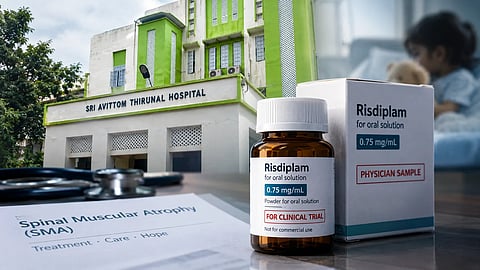
SAT Hospital and health authorities have responded to the controversy by denying that children were given an unproven experimental drug. The main arguments in the response to the controversy are as follows:
Regulatory approval: SAT Hospital and State authorities responded to the controversy by denying that children were given an unproven experimental drug. SAT Hospital Superintendent Dr Riyas stated that the decision to provide Natco Pharma’s Indian-manufactured drug, Natsmart, as a lower-cost alternative to Roche’s Evrysdi was based on the recommendations of a government-appointed expert committee.
Clarification of the labeling: Authorities stated that the reason for the dispute was the special labels on the drug bottles. The labels were removed from the medicine, which had already been approved by CDSCO.
Natco Pharma also explained that the labels appeared on bottles supplied free of charge under its Patient Assistance Program. According to the company, the free bottles carried the markings ‘Physician Sample’ and ‘Clinical Trial Only’, but were supplied under the state procurement arrangement rather than for use in a clinical trial. The company said its arrangement provided one free bottle for every three bottles purchased.
The quality of the medicine: The heads of the hospital and the representatives of the state government emphasized that the drug was of high quality and had received approvals from the relevant drug regulatory authorities, and urged people not to spread misinformation by describing it as an experimental drug.
The regulatory position was also clarified in reporting by The Times of India on October 22. CDSCO officials told the newspaper that Natco’s risdiplam powder for oral solution had been approved by the Telangana State Food and Drug Administration, while the bulk drug had received CDSCO approval on April 7, 2025. The report also stated that additional clinical trials were not considered necessary before patients could be switched to the generic formulation.
However, the labelling controversy and the concerns about switching treatments are separate issues. India Today reported that parents wanted reassurance about whether the generic formulation was bioequivalent to Roche’s medicine and whether children already receiving the branded treatment could continue with it. The labels alone do not establish that an unauthorized clinical trial took place, but the reasons for supplying medicine with those labels required clarification.
SAT Hospital Superintendent, Dr Riyas, rejected allegations connecting Natco Pharma’s financial assistance for the renovation of a paediatric ward to the medicine controversy around generic Risdiplam drug.
He said the hospital’s charitable society, SATHHES, had sought corporate social responsibility (CSR) funding from the company on 25 March to renovate Ward 14, an isolation ward for children with infectious diseases.
The company subsequently transferred an initial instalment of ₹25 lakh to the society’s account.
Hospital authorities maintained that the CSR contribution was intended for the ward renovation and was unrelated to the decision to procure generic risdiplam. The reported meeting between Natco representatives and the Health Minister, however, became part of the wider controversy surrounding the medicine switch.
The IMA Kerala State branch has applauded the Health Department’s initiative to scale up SMA treatment and bring down its exorbitant cost.
The association felt that the availability of a cheaper generic version of the drug Risdiplam would help the government provide treatment to a larger number of children and make it affordable and sustainable.
However, the association pointed out that while making the drug affordable, due care and caution must be exercised in ensuring quality and standards, and the treatment should be evidence-based and properly monitored by experts.
The IMA has asked the Health Department to reveal details about the source of the drug, its quality assurance measures, and its distribution, after some parents received the medicine in ‘sample packs’.
The association has also called for an efficient distribution mechanism and sustainable arrangements so that treatment is available without any disruption to every eligible child, irrespective of their economic status.
Patient safety and service delivery should be the prime focus, rather than the competition between pharma majors, said IMA.
One of the issues raised by the opponents of the state’s decision was related to the fact that Kerala’s Health Minister K. Muraleedharan held a meeting with the representatives of Natco Pharma on August 5. However, the Minister’s office released a clarifying statement following the meeting with the opposition.
The controversy also intensified after a copy of a complaint submitted by parents of children with SMA to the Health Minister emerged in local media reports. The complaint challenged the claim that no concerns had been raised about the medicine switch. Manorama News reported that the meeting involved Natco representatives, the Health Minister and the SAT Hospital superintendent, while the Health Department maintained that the meeting concerned corporate social responsibility.
It was reported that the representatives of the pharmaceutical company came to the hospital with a certificate, which proved a Corporate Social Responsibility donation. It was noted that the donation was made in aid of the hospital.
Moreover, the hospital director stated that the company donated 25 lakhs to the hospital. This sum was used to finance the renovation of Ward 14, which is an infectious disease ward at SAT Hospital. The hospital denied any allegations connecting the donations and the treatment allotted to SMA patients.
The cost difference between the two medicines was another important part of the debate. According to The Times of India, Natco launched Natsmart at a maximum retail price of ₹15,900 per bottle, compared with approximately ₹6 lakh for Roche’s Evrysdi. Under the state procurement arrangement, Natco said its Patient Assistance Programme provided one free bottle for every three purchased, bringing the effective cost to around ₹8,500 per bottle. Onmanorama had earlier reported that KMSCL negotiated a price of ₹8,000 per bottle for government procurement. These figures refer to different pricing arrangements and should not be treated as interchangeable.
Rh/MF/MSM
