Update (October 24, 2026): Subsequent legal reporting documented post-trial motions challenging the convictions. Court-record listings also show further hearing-related entries in October. The latest rulings and sentencing outcomes have not been independently confirmed in the records available for this update.
A US federal jury convicted two Indian-origin brothers in a healthcare and H-1B visa fraud case linked to dental clinics.
Prosecutors said the Savani Group obtained more than $32 million from Pennsylvania’s Medicaid program through fraudulent billing.
The scheme also involved fraudulent H-1B visa petitions and alleged wage kickbacks from foreign workers.
Authorities said unapproved dental implants labeled “Not for Human Use” were placed in patients without proper disclosure.
Bhaskar Savani and Arun Savani could face maximum sentences of over 400 years in prison, with sentencing scheduled for July 2026.
Post-trial motions seeking relief from the verdicts were reported in 2026. The latest rulings and sentencing outcomes require confirmation from court records.
A federal jury in the United States has convicted Indian-origin brothers Bhaskar Savani and Arun Savani, along with Savani Group executive Aleksandra “Ola” Radomiak, in a racketeering conspiracy involving healthcare fraud, H-1B visa fraud, money laundering and other offences. The case involved more than $32 million in losses to Pennsylvania's Medicaid program, according to federal prosecutors. Bhaskar Savani was also convicted of conspiring to distribute adulterated and misbranded dental implants.
The case involves Bhaskar Savani, a dentist, and his brother Arun Savani, who ran a network of dental practices and related companies known as the Savani Group. On March 9, 2026, a jury in the U.S. District Court for the Eastern District of Pennsylvania found the brothers guilty after a trial that examined more than a decade of fraudulent activities tied to their business operations.
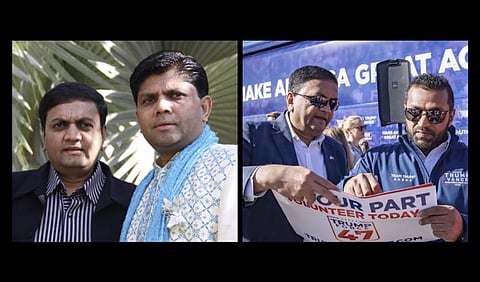
According to reports, the brothers had previously attracted attention after they allegedly bragged about meeting Kash Patel, in social media posts that received attention after their convictions. The brothers had been charged in January 2023, before Patel became FBI director in 2025. The available reporting does not establish a connection between the meeting and the investigation. Kash Patel has previously held leadership positions in US federal law enforcement. Currently, he is the Director of the Federal Bureau of Investigation.
The charges included violations under the federal Racketeer Influenced and Corrupt Organizations Act (RICO), which targets organized criminal enterprises.
Federal prosecutors said the group operated a complex enterprise that generated tens of millions of dollars through multiple illegal schemes connected to dental clinics across several U.S. states.
According to the U.S. Department of Justice, the Savani Group controlled numerous dental clinics and business entities in Pennsylvania, New Jersey, Iowa, South Carolina, and other states.
Investigators found that the organization caused more than $32 million in losses to Pennsylvania's Medicaid program through fraudulent billing schemes. Authorities said the Savani Group continued to access Medicaid funds even after its original Medicaid provider agreements were terminated.
Prosecutors said the group used nominee owners and newly created dental entities to continue billing Medicaid. These arrangements allowed the organization to maintain control of dental clinics while concealing its involvement from regulators.
Court evidence showed that claims were submitted for dental services that were performed by different dentists than those listed on the claims or by dentists who were not present when the procedures took place.
Prosecutors also presented evidence that Bhaskar Savani participated in a conspiracy to distribute dental implants that had not received approval from the U.S. Food and Drug Administration.
Authorities said the implants were labeled “Not for Human Use” and were meant for research or development purposes. Investigators said the implants were nevertheless placed in patients without informing them that the devices had not been cleared for clinical use.
The DOJ described the devices as prototype dental implants that were adulterated and misbranded and had not been cleared by the FDA. The jury convicted Bhaskar Savani of conspiring to violate the Federal Food, Drug, and Cosmetic Act. The DOJ's conviction announcement does not identify Arun Savani as having been convicted of this specific medical-device conspiracy.
The U.S. Food and Drug Administration Office of Criminal Investigations participated in the investigation into the device-related offenses.
The case also involved fraud connected to the H-1B visa program, which allows U.S. employers to hire foreign workers in specialized occupations.
Prosecutors said the Savani Group filed fraudulent visa petitions to bring foreign workers, including dentists and other professionals, to the United States. Many of the workers were recruited from India.
According to court testimony, some workers were required to pay kickbacks or return part of their wages to the organization after arriving in the United States. Authorities said this arrangement allowed the company to maintain control over workers whose immigration status depended on their employment.
Investigators said the Savani brothers used numerous bank accounts and financial transfers to conceal the proceeds generated from the fraudulent healthcare schemes.
The government also presented evidence of tax-related offenses, including filing false tax returns and misrepresenting business expenses and payroll information to reduce tax obligations.
According to the DOJ, the tax scheme involved approximately $1.6 million in unreported personal income and $1.1 million in employees' unreported income. Prosecutors also said personal expenses, including college tuition, personal property taxes, and pool and lawn maintenance at the brothers' homes, were improperly claimed as business expenses.
Aleksandra “Ola” Radomiak, an executive who worked with the Savani Group, was also convicted by the jury. Prosecutors said she helped manage aspects of the enterprise and assisted in carrying out healthcare fraud schemes involving the dental clinics.
Several federal agencies participated in the investigation. These included the Federal Bureau of Investigation, Homeland Security Investigations, the Internal Revenue Service Criminal Investigation division, the U.S. Department of Health and Human Services Office of Inspector General, and the Food and Drug Administration Office of Criminal Investigations.
Officials said the case involved extensive coordination among federal investigators because the schemes covered healthcare billing, immigration processes, financial transactions, and medical device regulations.
Authorities stated that the prosecution reflects efforts to address fraud involving government healthcare programs and the misuse of employment visa systems.
The DOJ also credited the Department of Labor Office of Inspector General, the Pennsylvania Office of Attorney General, the State of Iowa Medicaid Fraud Control Unit, and the Diplomatic Security Service among the agencies involved in the investigation.
Following the March 2026 convictions, post-trial motions seeking relief from the jury's verdicts were reported. Law360 reported on April 27, 2026, that Bhaskar Savani sought acquittal or a new trial, arguing that prosecutors had failed to prove his involvement in the alleged offences. A later legal overview also reported post-trial motions by Arun Savani.
A docket aggregator for the case lists further hearing-related entries and orders resetting hearings and motion deadlines in October 2026. However, the accessible records do not establish the purpose or outcome of those proceedings. The latest rulings on the post-trial motions have not been independently confirmed for this update. Filing a post-trial motion does not itself overturn a conviction.
Bhaskar Savani, 60, faces a statutory maximum sentence of up to 420 years in prison based on the penalties for the charges on which he was convicted.
Arun Savani, 58, faces a statutory maximum sentence of up to 415 years in prison.
Radomiak faces a potential prison sentence of up to 40 years.
The US Department of Justice originally scheduled sentencing hearings for Bhaskar Savani on July 8, 2026, Arun Savani on July 9, 2026, and Radomiak on July 14, 2026. Those dates have passed. The latest sentencing outcomes and any revised hearing dates could not be independently confirmed from the court records available for this update.
The statutory maximum penalties are not the same as sentences actually imposed. The final sentences, if imposed, should be reported only after confirmation from the court docket or an official court announcement.
U.S. Department of Justice. “Savani Group Owners and Associate Convicted of Racketeering Conspiracy.” Accessed March 12, 2026.
https://www.justice.gov/usao-edpa/pr/savani-group-owners-and-associate-convicted-racketeering-conspiracy
U.S. Department of Health and Human Services Office of Inspector General. “Pennsylvania Brothers Convicted of Decades Long Racketeering Conspiracy.” Accessed March 12, 2026.
https://oig.hhs.gov/fraud/enforcement/pennsylvania-brothers-convicted-of-decades-long-racketeering-conspiracy/
(Rh/MSM/UpMSM)