Do you feel drained out during the summer season? Yes, there is a reason behind it, and Ayurveda recommends following Greeshma Ritucharya, a seasonal lifestyle and diet changes tailored according to the summer season. In this article, you will explore a detailed summer season routine along with the scientific reasons behind it.
As per Ashtanga Hridaya sutrasthana,
मधुरं शीतलं स्निग्धं द्रवमन्नं प्रयोजयेत् ।
Madhuram sheetalam snigdham dravannam prayojayath
Consume foods that are sweet, cooling, unctuous, and liquid in nature.
दिवास्वप्नं भजेत् तत्र शीतलेषु गृहेषु च ।
Divaaswapnam bhajeth tatra sheethaleshu gruheshu cha.
Recommended day sleep in the cool surroundings because of excessive heat.
व्यायामं चातितीक्ष्णोष्णं मद्यं चैव विवर्जयेत् ।
Vyayamam chaatiteekshnoshnam madhyam chaiva vivarjayeth.
Ayurveda recommends avoiding excessive exercise, exposure to intense sunlight, and consuming alcohol during the summer season to prevent dehydration.
Just as the five fingers of our hand are not the same, the diet and lifestyle for each ritu cannot be the same. We use one finger to point, another to hold, and all together to clap — each has a unique role. Similarly, Ayurveda advises specific food and habits for each season to maintain balance with nature.
Dr. Vidhya H S, Ayurveda Doctor, Clinical Nutritionist, Yoga instructor, Infertility specialist, Founder of Ved Ayur Arogyam
Mid-May to mid-July
Falls under Uttarayana, also called adanakala.
During the summer months, intense sunlight increases environmental heat and dryness. Leafless trees, dry land, and reduced water levels in rivers are commonly observed.
Greeshma Ritu is considered the hottest season of the year.
Days are long and nights are short.
Hydration, drinking more water, keeps the body cool.
During Greeshma Ritu, intense summer heat increases fluid loss through sweating and can contribute to dehydration if adequate fluids are not consumed. This aligns with Ayurveda's recommendation to prioritize hydration and cooling foods during the season.
According to the World Health Organization (WHO), individuals should maintain adequate hydration during hot weather by drinking water regularly and increasing fluid intake when exposed to heat or engaging in physical activity.³
Drinking water stored in earthen pots with jeera keeps the body naturally cool. Abhyanga with cooling oils balances aggravated vata caused by summer heat. Thus, by following seasonal Ritucharya, we harmonize with nature and maintain inner balance.
Dr. Vidhya H S
According to Ayurveda, Greeshma Ritu influences the doshas in specific ways. Kapha gradually decreases due to the drying effect of intense heat. Vata begins to accumulate because of dryness and depletion in the body. Pitta generally remains relatively subdued during the season but may aggravate later if excessive heat exposure continues. Understanding these seasonal changes helps guide appropriate dietary and lifestyle choices during summer.¹
Ingredients
Chincha(tarmarind),Vrikshamla(kokum),Munakka(prunes),Kharjura(dates),Amlaki(Indian groseberry),Dadima(pomegranate).
Preparation
Take all the above in equal proportion and add 4 times the water, soak it for 4 hours, then churn and macerate until the juice is extracted, then filter it. To this filter, add more water to dilute it further.
Recommended for
Daha(burning sensation),Trushna(thirst),Daurbalya(weakness).
Ingredients
Godhuma(wheat),Chanaka(Bengal gram),Jowar
Preparation
Clean, dry, roast, and then grind them into a powder. To this sattu, add guda (jaggery) or candy sugar, and add water to reach a paste-like consistency. Sattu panaka can also be prepared using this sattu flour.
Benefits
Light for digestion, good appetizer, stomach fullness, and relieves fatigue.
Ingredients
Draksha(Raisins) 2 tbsp, Kharjura(Dates) 2tbsp, Madhuka 1tbsp(dried mahua flowers-a small sweet flower), Parushaka 1/2tbsp(a small purple berry, mix of grape and blueberry fruit), Kashmarya 1/2tbsp(a small yellow fruit).
Madhuka can be found in Ayurvedic medical stores, where it is available as dried flowers. Parushaka can be substituted with black grapes. Kashmarya can be skipped or used in powder form, available in Ayurvedic medical stores.
Preparation
All the above ingredients are soaked in water for 2 hours, then macerated and filtered. Add a pinch of Karpoora and cinnamon at last, and store it in an earthen pot. Add jaggery as per the requirement, but it is optional.
Avoid this drink if you are diabetic, as all ingredients are natural sweeteners.
Benefits
Energy booster, Hydrating, Cooling effect. According to Ayurveda, Panchasara Panaka helps balance aggravated Pitta and provides a cooling effect.
Ingredients
Ananta (a type of cooling root), Kamala (lotus petals), Gulab (rose petals), Amra(mango), Draksha(raisins), Jambhira(lemon), Chandana(sandalwood), Ushira(cooling and aromatic root/fragrant grass).
Raga is basically a summer cool drink that tastes sweet and sour, prepared using herbs, flowers, and fruits.
Preparation.
Soak Ushira and Ananta roots for 2 to 3 hours, extract juice from all the above ingredients, filter, and store. Use water for dilution and add jaggery for more sweetness.
Benefts
Acts as a refreshing and energizing drink, cools the body, and improves digestion.
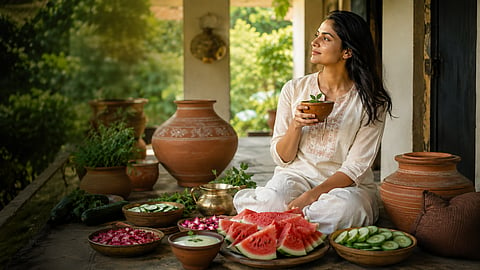
According to Ayurvedic principles, the following foods and beverages should be minimized during summer:
• Excessively spicy foods
• Deep-fried foods
• Alcohol
• Excess fermented foods
• Excessive caffeine consumption
These may contribute to increased body heat, dehydration, or digestive discomfort during the season.¹
In Greeshma Ritu, the intense heat depletes strength and weakens digestion. To counter this, I advise patients to take buttermilk with hing and shunti to aid digestion. Including cooling vegetables like bottle gourd, pumpkin, and cucumber helps pacify pitta. Daily intake of ghee is essential as it builds ojas and prevents excess dryness.
Dr. Vidhya H S
Consume Lehya (paste-like preparation)prepared by Sakthu (roasted barley powder) and jaggery soon after a cold water bath.
Consume Sali dhanya (variety of rice) to take along with jangala mamsa(meat of desert animals).
Consume Mamsa rasa (meat soup), which is not very concentrated.
Consume Rasala (curd lassi mixed with jaggery and pepper).
Consume Raaga (sweet, sour, and salty syrup).
Consume Shadava or Khadava (juice prepared with various fruits).
Consume the Panchasara panaka stored in an earthen pot.
Consume Sheetala ambu (cold water), add a pinch of karpoora.
During nighttime, consume Shashanka Kirana (Talisa Choorna vataka) along with mahisha ksheera (buffalo milk) mixed with jaggery.
Common signs associated with excessive summer heat exposure include:
• Excessive thirst
• Fatigue
• Burning sensation
• Dizziness
• Dry skin
• Reduced appetite
Recognizing these signs early may help prevent dehydration and other heat-related illnesses.³
Children are more prone to dehydration as they indulge in outdoor play more. You will notice reduced urine output, extreme thirst, and fatigue. Hence, drink more liquids in the form of water, coconut water, and buttermilk.
Avoid exposure to the sun's rays from 11 am to 3 pm, as the sun’s rays are more intense during this time. You notice reddish skin and blister formation on the skin. Use sunscreen 15 minutes before going out.
Heat stroke is a medical emergency caused by prolonged exposure to high temperatures or strenuous activity in hot environments. You will experience High temperature, dizziness, rapid breathing, and increased heart rate. Hence, restrict outdoor activities to early morning and late evening hours.
Excessive sweating leads to sweat gland blockage, which can be seen more in children as sweat glands are still under development stage. You will notice tiny raised spots over the body surface associated with itching and minimal redness. Wash the affected area with lukewarm water and keep it cold.
Exposure to high-intensity heat causes eye irritation and dryness. Use large-brim and UV-protection sunglasses.
Due to high temperatures, the food gets spoiled easily, and consuming this contaminated food leads to food poisoning and diarrhea. Always prefer consuming well-cooked and freshly prepared food.
These viral infections can spread through contaminated food and water and may become more common when sanitation and food hygiene practices are inadequate. Jaundice may occur as one of the symptoms of these infections.
It is a bacterial infection caused by Salmonella Typhi and spreads through food or water contaminated with the bacteria.
More common in children due to more heat, children like to spend more time in the pool; therefore, the chances of collecting water in the ear are higher, leading to bacterial growth in the ear and causing an ear infection. Use a swimming cap that covers the ears.
Ritucarya explains the concept and mode of living in different seasons. During every seasonal transition, there will be changes in both the external environment and the human body. Every ritu influences our doshas differently, and our ahara-vihara must align accordingly. This is how we sync with the universal rhythm and preserve our health throughout the year. To get aligned with changes in nature, you need to follow some regimens that are explained clearly in Ayurveda. By following the above routine, your body balances the tridoshas naturally, promotes overall well-being, and keeps you healthy.
What is Greeshma Ritucharya in Ayurveda?
Greeshma Ritucharya a food and lifestyle guidelines recommended by Ayurveda to follow during the summer season.
Which doshas are affected during Greesham Ritucharya?
During Greeshma Ritucharya, kapha dosha decreases due to excessive heat,vata dosha gradually accumulates due to dryness.
How much exercise and physical activity advised during summer season?
Ayurveda recommends to reduce excessive exercise and physical exertion during summer season to prevent dehydration and exhaustion.
B. S. and Y. Mishra, "Greeshma Ritucharya: A Review," International Journal of Research in Ayurveda and Pharmacy 12, no. 6 (2022): 61–63, https://doi.org/10.7897/2277-4343.1206171.
V. M. Sreekanth, "Greeshma Ritu in Ayurveda and Modern Perspective with Its Utility in Present Era," World Journal of Pharmaceutical and Medical Research 3, no. 10 (2017): 313–317.
World Health Organization, "Heat and Health," accessed June 2026, https://www.who.int/news-room/fact-sheets/detail/climate-change-heat-and-health.