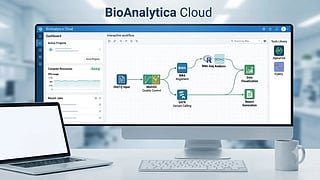
Alongside lab equipment such as microscopes, computers are also used in life sciences to analyze data. Frequently, vast amounts of data can be collected relating to DNA and protein, so computers are often used to analyze this data.
Computers, computer science and statistics, are all used in bioinformatics data analysis.
Below are a number of key bioinformatics tools which are relevant for both life science students and scientists.
DNA can be further analyzed by comparing it to a range of online sequences using the NCBI (Basic Local Alignment Search Tool).
As well as comparing sequences, this program can also analyze gene locations and evolutionary relationships. It is highly useful.
Prior to further data analysis, scientists often investigate the quality of the sequenced DNA.
FastQC can analyze data and identify low-quality, contaminated or anomalous sequences.
MultiQC can do data quality analysis for a range of samples. Differences between samples can then be identified and highlighted using this tool.
As mentioned above, these programs are particularly relevant to next-generation sequencing (NGS).
After DNA has been sequenced, an individual is usually presented with numerous short DNA segments.
These should be accurately aligned to a genome. The Burrows-Wheeler Aligner (BWA) can be used for this. As with many bioinformatics programs, sequence analysis is widely used for investigating genomic and genetic diversity.
Although individuals can often have similar DNA, there can also be genetic variation between people. Occasionally, this can be related to genetic conditions.
Genetic diversity can be analyzed using the Genome Analysis Toolkit (GATK). This can assess, for example, single-nucleotide polymorphisms (single-letter changes in a person’s DNA) and minor insertions or deletions in DNA. GATK is frequently used to investigate genomic and genetic diversity.
Generally, people want to investigate, for example, variations in gene expression in healthy and unhealthy tissues or in differing experimental groups.
Both the statistical computer programming language R and a range of bioinformatics programs called Bioconductor can be used for data analysis.
Within Bioconductor, DESeq2 can be used to analyze differentially expressed genes.
Within a particular tissue, there can be cells from different sections of the body and also cells which have diverse functions.
Seurat can analyze single-cell RNA sequencing data. Therefore, it can investigate gene expression at a single-cell level. It can also identify different cell types and can help to investigate how cell function may be altered in conditions such as cancer.
Proteins play essential roles, and their 3D structure is significant in terms of function.
Google DeepMinds’ AlphaFold employs artificial intelligence to analyze a protein’s amino acid sequence. From this, it can predict the 3D structure of a protein. This can then be analyzed to investigate both the function of a protein and whether it has the potential to be targeted by drugs.
It is important to correctly evaluate the reliability of the 3D structures that are predicted for proteins, as not all of these will necessarily have been experimentally confirmed.
After a protein’s structure has been analyzed, further analysis can then be performed.
PyMOL can be used to analyze proteins in 3D. Specific regions can be highlighted and then analyzed. Often, this program is used to create images which can then be shared scientifically.
As not all life scientists are proficient in coding, Galaxy allows graphical online bioinformatics data analysis to be conducted.
In addition to offering a range of bioinformatics data analysis facilities, Galaxy is web based too. It allows a scientist to store and share work. Hence, it is particularly advantageous for students and new scientists.
Python is widely used as a computer programming language and is often employed for scientific data analysis. Biopython is specialized for bioinformatics and can be used to both organize and automatically analyse bioinformatic data.
While students do not necessarily need to be highly proficient in all bioinformatics programs, they can firstly use NCBI BLAST to compare sequences. It can also be used to investigate genome databases. Students can also be introduced to coding in either Python or R using this program.
Students aiming to enter a genomics career can analyze data quality and investigate genetic diversity. Likewise, students interested in structural biology can initially use AlphaFold and PyMol.
As well as gaining proficiency in bioinformatics programs, it is crucial to understand relevant biological topics and to identify appropriate methods of analysis. Life science scientists can investigate novel scientific areas by combining knowledge of both biology and bioinformatics.

OG/MF/MSM