
- Home
- About Us
- Contact Us
- Biography
- MedBound Hub
- InternshipInternship
- Daily Pulse
- Medicine
- Physical Therapy
- InterviewInterview
- Pharmacy
- Biotechnology
- College/InstituteCollege/Institute
- Dentistry
- Blog
- Wellness & Nutrition
- Nursing
- Opinion

Many students interested in research and innovation are aware of clinical pathways but remain unfamiliar with the institutional systems that support biotechnology careers in India. The Department of Biotechnology plays a central role in building this ecosystem by funding research, supporting startups, and training scientific manpower. Established in 1986 under the Ministry of Science and Technology, DBT has contributed to the growth of biotechnology across healthcare, agriculture, and industry.¹
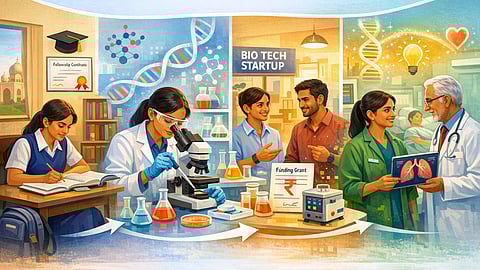
DBT India fellowships and funding programs support research training, innovation, and entrepreneurship across multiple stages of scientific development, making them relevant for both early-career researchers and experienced professionals.
India’s bioeconomy has expanded significantly, growing from about 10 billion US dollars in 2014 to over 130 billion US dollars by 2024, with a national target of reaching 300 billion US dollars by 2030.² This growth reflects the increasing role of biotechnology in healthcare, diagnostics, and therapeutics, supported by government funding for research and coordinated national programs.
This article explains how DBT supports fellowships, funding pathways, and biotechnology career pathways, and why it is relevant for both medical and life science professionals.
DBT was created to promote modern biology and biotechnology in India. Its mandate includes:
Supporting research and development
Building infrastructure and human resources
Translating research into applications
Promoting collaboration between academia and industry¹
Over time, the Department of Biotechnology has also supported autonomous institutes, research centers, and national programs in genomics, vaccine development, and bioinformatics. DBT also oversees a network of autonomous research institutions that contribute to national scientific capacity and infrastructure development.¹² These efforts contribute to public health biotechnology and translational research in India.
In the broader research ecosystem, DBT works alongside agencies such as the Indian Council of Medical Research, which focuses on clinical and epidemiological research, and the Council of Scientific and Industrial Research, which supports a wide range of scientific and industrial research. Each agency has a distinct but complementary role.
DBT plays an important role in training researchers through fellowships and skill development programs.
DBT supports doctoral and postdoctoral training in biotechnology and allied fields through structured programs and institutional grants. These research fellowships in India aim to strengthen the scientific workforce in areas such as molecular biology, genomics, and immunology.³
These programs represent a key component of the scientific funding ecosystem, particularly in biotechnology and biomedical sciences.
Students often search for how to get DBT fellowships, which typically require academic training in life sciences or medicine along with institutional affiliation.
The National Bioscience Award for Career Development recognizes scientists below 45 years of age for contributions in biosciences.⁴ This award supports early-career researchers and encourages continued work in scientific research.
DBT also funds training programs in:
Bioinformatics
Genomics
Clinical research
Bioprocess technology
These programs are aligned with emerging needs in biotechnology career pathways, including data-driven biology and precision medicine.
DBT-supported programs are open to life science graduates, postgraduate researchers, medical graduates interested in research, and early-stage innovators. This makes them relevant for both life science careers in India and biotechnology careers for medical students.
One of DBT’s key contributions is enabling the transition from research ideas to practical applications through structured biotech funding in India.
BIRAC (Biotechnology Industry Research Assistance Council), a public sector enterprise set up by the Department of Biotechnology, supports innovation and entrepreneurship in biotechnology.⁵ It acts as a bridge between academia and industry and is central to BIRAC funding in India.
DBT funding schemes in India include:
Biotechnology Ignition Grant (BIG)
Provides funding up to ₹50 lakh for early-stage ideas and proof-of-concept research.⁶
Small Business Innovation Research Initiative (SBIRI)
Supports high-risk, early-stage innovation projects.
Biotechnology Industry Partnership Programme (BIPP)
Encourages industry-led research with government support.
BioNEST
Supports bio-incubators and biotech startups in India.
E-YUVA
Focuses on student entrepreneurship in biotechnology.
DBT also supports high-risk and innovative research through the Emerging Frontiers in Biotechnology program, which focuses on advanced and interdisciplinary areas of biotechnology.¹³
Researchers can apply for DBT funding through an online proposal submission system that allows continuous submission throughout the year. This system enables proposal tracking and peer review, improving transparency and accessibility in research funding.¹⁴
DBT supports multiple sectors through its schemes, including infectious diseases, agricultural biotechnology, bio-based artificial intelligence, livestock, and marine biotechnology.¹⁴
These biotechnology grants in India support innovation across stages, from early research to commercialization, strengthening government biotech programs.
According to BIRAC, a large number of startups and innovators across India have received support, contributing to the growth of biotech startups in India and the development of healthcare technologies, diagnostics, and biopharmaceutical products.⁷
See also: Biotechnology, Sustainability, and Startups: Krisha Shah’s Journey at IIT Bombay
Beyond funding, DBT supports infrastructure required to translate laboratory findings into clinical applications. This includes:
Clinical trial networks
Biorepositories
Good Manufacturing Practice compliant facilities
Such infrastructure strengthens translational research in India and enables movement from discovery to patient care, particularly in vaccines, biologics, and diagnostics.
The Department of Biotechnology also runs large-scale national programs that directly influence career pathways and research opportunities.
Launched in 2017 with funding support including the World Bank, this mission focuses on:
Vaccines
Biosimilars
Medical devices
Diagnostics⁸
It promotes collaboration between academia and industry and supports public health biotechnology initiatives.
The Genome India Project is funded by DBT and aims to sequence thousands of Indian genomes.⁹
This initiative has implications for:
Precision medicine
Understanding genetic diseases
Population health research
DBT has also introduced policy frameworks such as BioE3, which focuses on:
Biomanufacturing
Employment generation
Sustainable biotechnology solutions¹⁰
DBT has contributed to public health initiatives including vaccine research and diagnostics. During the COVID-19 pandemic, DBT supported vaccine development platforms, diagnostics, and clinical research infrastructure, while working with industry and research institutions to accelerate development timelines.¹¹
DBT is also involved in national genomic surveillance efforts through the Indian SARS-CoV-2 Genomics Consortium, which monitors variants of the virus across India and supports epidemiological tracking.¹⁵
These efforts demonstrate the role of biotechnology in strengthening public health systems.
DBT enables multiple career routes and supports diverse biotech career options in India:
PhD and postdoctoral research
Faculty positions
Institutional research roles
Vaccine development
Clinical trials
Diagnostics
Biopharmaceutical companies
Medical device development
Research and development units
Startup incubation through BIRAC
Access to biotech funding in India and mentorship
Medical graduates can transition into research fields such as clinical research, genomics, and public health biotechnology, while life science graduates can pursue both academic and industry roles.
Students interested in DBT opportunities typically begin by applying through institutional affiliations, research programs, or BIRAC-supported startup initiatives.
See also: Biotechnology Education in India: Courses, Eligibility, Exams, Careers & Scope Explained
Despite its contributions, certain challenges remain:
Limited awareness about DBT India fellowships and funding opportunities
Delays in translating research into clinical applications
Need for stronger industry-academia collaboration
Addressing these gaps is important for improving access to research funding in India and expanding participation in biotechnology career pathways.
India’s bioeconomy is expanding, with increasing demand for expertise in:
Genomics
Biomanufacturing
Data-driven biology
DBT is expected to continue playing a central role in shaping biotech careers in India through funding, training, and policy support. Continued investment and international collaboration will influence how India competes in the global biotechnology sector.
The Department of Biotechnology functions as a central support system for biotechnology in India. Through DBT India fellowships and funding schemes, it connects research, innovation, and career development.
Understanding DBT’s role is important for those seeking opportunities in research, innovation, and biotechnology careers in India, especially as the sector continues to expand within healthcare and public health systems.
Who can apply for DBT fellowships?
DBT fellowships and training programs are open to life science graduates, postgraduate students, PhD scholars, and medical graduates interested in research and biotechnology careers.
What is BIRAC funding?
BIRAC funding refers to financial and technical support provided by the Biotechnology Industry Research Assistance Council to startups and innovators working in biotechnology and healthcare.
Can MBBS students apply for DBT programs?
Yes, medical graduates can apply for research fellowships, training programs, and certain funding schemes, especially in areas such as clinical research, genomics, and public health biotechnology.
Department of Biotechnology, Government of India. “About DBT.” https://dbtindia.gov.in/about-us/about-department
Department of Biotechnology, Government of India. “India Bioeconomy Report.” https://dbtindia.gov.in
Department of Biotechnology. “Human Resource Development.” https://dbtindia.gov.in/human-resource-development
Department of Biotechnology. “National Bioscience Award for Career Development.” https://dbtindia.gov.in/schemes-programmes/building-capacities/national-bioscience-award
Biotechnology Industry Research Assistance Council (BIRAC). “About Us.” https://birac.nic.in/aboutus.php
BIRAC. “Biotechnology Ignition Grant (BIG).” https://birac.nic.in/big.php
BIRAC. “Overview.” https://birac.nic.in
Press Information Bureau, Government of India. “National Biopharma Mission.” https://pib.gov.in/PressReleasePage.aspx?PRID=1606249
Department of Biotechnology. “Genome India Project.” https://dbtindia.gov.in/initiatives/genome-india-project
Department of Biotechnology. “BioE3 Policy.” https://dbtindia.gov.in
Press Information Bureau, Government of India. “DBT Support for COVID-19 Response.” https://pib.gov.in/PressReleasePage.aspx?PRID=1689929
Department of Biotechnology. “Autonomous Institutions.” https://dbtindia.gov.in/ministry/our-organizations
Press Information Bureau, Government of India. “Emerging Frontiers in Biotechnology Programme.” https://pib.gov.in
Department of Biotechnology. “eProMIS Portal.” https://dbtepromis.nic.in
Department of Biotechnology. “INSACOG.” https://dbt.gov.in/insacogpage
