Summer Training Programs for Biotechnology Students in India: Internships, Research Opportunities, and Lab Skills

Guide to biotech summer internships, research training, lab exposure, and industrial biotechnology programs in India.
A cinematic biotechnology laboratory scene in India showing undergraduate biotechnology students in lab coats performing hands-on experiments & mentor scientist guiding students,
From IIT and IISER internships to faculty-led lab training, biotechnology students now have multiple summer programs to build practical research and industry skills.AI Image
Published on
Updated on

Biotechnology education increasingly emphasizes practical laboratory exposure alongside classroom learning. As biotechnology and life science programs become more research and industry oriented, summer training programs have emerged as an important part of academic and professional development for students.

These short-term training programs are usually conducted during semester breaks and provide exposure to laboratory techniques, biotechnology tools, industrial workflows, bioinformatics applications, and research methodologies. Across India, universities, research institutes, government laboratories, hospitals, and biotechnology companies now conduct structured summer internships and skill development programs for biotechnology students.

According to the Department of Biotechnology (DBT), Government of India, skill development and industry-oriented training remain important priorities in biotechnology human resource development initiatives.

India’s biotechnology sector has expanded significantly across healthcare, diagnostics, pharmaceuticals, agriculture, bioinformatics, and industrial biotechnology, increasing demand for trained biotechnology professionals.

What Are Summer Training Programs in Biotechnology?

Summer training programs are short-term academic, research, or industrial training opportunities designed to provide practical experience to students in biotechnology and related life science disciplines.

These programs may be conducted by:

  • Universities

  • IITs and IISERs

  • CSIR laboratories

  • Biotechnology companies

  • Hospitals and diagnostics laboratories

  • Government research organizations

  • Skill development centers

The duration can vary from:

  • One to two weeks for workshops

  • One to two months for research internships

  • Three to six months for industrial training programs

Some programs provide stipends or certificates, while others focus mainly on skill exposure and laboratory experience.

Why Summer Training Matters in Biotechnology

Biotechnology is a practical and interdisciplinary field that combines biology, chemistry, engineering, computational tools, and laboratory sciences. Several important techniques used in research and industry require hands-on training that cannot be fully learned through theory alone.

Summer training programs often provide exposure to:

  • Polymerase Chain Reaction (PCR)

  • Gel electrophoresis

  • DNA and RNA isolation

  • Cell culture techniques

  • Fermentation technology

  • ELISA

  • Chromatography

  • Bioinformatics tools

  • Industrial microbiology

  • Research data analysis

The DBT has highlighted biotechnology skill development as an important component of strengthening scientific manpower in India.

Biotechnology industries increasingly prefer candidates with practical laboratory and industrial exposure in addition to academic qualifications. According to the DBT Biotechnology Industrial Training Programme (BITP), industry-oriented training initiatives are intended to improve biotechnology students’ employability and prepare them for biotechnology company workflows.

For many students, these programs also provide their first exposure to research laboratories, industrial biotechnology facilities, or interdisciplinary scientific work environments.

Types of Biotechnology Summer Training Programs

Research-Based Summer Training

Research-oriented summer internships are among the most common opportunities available for biotechnology students.

These programs are offered by:

  • IITs

  • IISERs

  • CSIR laboratories

  • Universities

  • National research institutes

Students typically work under faculty members, scientists, or research scholars on short-term projects involving:

  • Genetics

  • Molecular biology

  • Immunology

  • Cancer biology

  • Microbiology

  • Bioinformatics

  • Genomics

These internships are particularly useful for students planning:

  • MSc Biotechnology

  • Integrated PhD programs

  • Research careers

  • Competitive fellowships

Several institutes periodically release summer research fellowship notifications through official portals.

Some of the most recognized annual research internships include:

  • IISER Pune Summer Student Programme

  • IIT Roorkee SPARK Internship Programme

  • IIT Gandhinagar Summer Research Internship Programme (SRIP)

  • IIT Hyderabad SURE Internship

  • IISER Bhopal Summer Internship Programme

Most of these programs generally open applications between January and March every year, with internship sessions conducted during May to July.

The IISER Pune Summer Student Programme offers research exposure in biology, bioinformatics, molecular sciences, and interdisciplinary life sciences. Similarly, IIT Hyderabad’s Summer Undergraduate Research Exposure (SURE) internship provides opportunities in biotechnology, biological sciences, and computational biology.

Industrial Biotechnology Training

Industrial biotechnology programs focus on industry-oriented exposure and manufacturing processes.

Students may receive training in:

  • Pharmaceutical production

  • Quality control

  • Bioprocessing

  • Fermentation systems

  • Regulatory practices

  • Industrial microbiology

  • Biotechnology manufacturing pipelines

One of the major government-supported initiatives is the DBT Biotechnology Industrial Training Programme (BITP), coordinated through the Regional Centre for Biotechnology (RCB). According to DBT, the program aims to improve employability and provide industry-specific biotechnology training.

The BITP program mainly targets:

  • Final-year biotechnology students

  • MSc Biotechnology graduates

  • Biotechnology postgraduates

Notifications are periodically released through the RCB portal.

Bioinformatics Training Programs

With increasing demand for computational biology and genomics, bioinformatics training programs have become more common in biotechnology education.

These programs may include:

  • Sequence analysis

  • Biological databases

  • Genomics and proteomics

  • Data analysis

  • Computational biology tools

  • Programming applications in life sciences

The Bioinformatics Industrial Training Programme (BIITP), supported by DBT and coordinated by Biotechnology Consortium India Limited (BCIL), is one such initiative focused on bioinformatics skill development.

Some universities also offer dedicated biotechnology and bioinformatics summer modules. Jaypee University of Information Technology conducts annual summer training programs in biotechnology and bioinformatics with two-week, four-week, and six-week duration options for BSc, BTech, and MSc students.

Biotechnology Skill Development Programs

Several state and national initiatives now focus specifically on biotechnology skill training.

The DBT Skill Vigyan programme is one example that supports hands-on training in biotechnology and life sciences across partner institutions.

Such programs may include:

  • Laboratory skill modules

  • Diagnostic techniques

  • Instrumentation training

  • Industry-oriented certifications

  • Practical biotechnology workshops

Some programs also provide certification and stipend support depending on the training category.

The Gujarat State Biotechnology Mission (GSBTM) Summer Research Internship Program is one example of a state-supported initiative focused on undergraduate biotechnology and allied life science students. The 2026 internship cycle is listed from 1 June to 31 July 2026 through the India Science and Technology portal.

Institutes and Organizations Offering Summer Training

Biotechnology students commonly apply for training opportunities at:

  • CSIR laboratories

  • IITs

  • IISERs

  • National Centre for Biological Sciences (NCBS)

  • Centre for Cellular and Molecular Biology (CCMB)

  • National Institute of Immunology (NII)

  • Regional Centre for Biotechnology (RCB)

  • Biotechnology Industry Research Assistance Council (BIRAC)

  • DBT-supported institutes

Some institutes currently hosting or announcing recurring biotechnology internships include:

  • CSIR-Indian Institute of Chemical Biology (CSIR-IICB)

  • National Institute of Biologicals (NIB)

  • ICMR-National Institute of Epidemiology (ICMR-NIE)

  • IISER Pune

  • IIT Hyderabad

  • Jaypee University of Information Technology

Research institutes and universities generally release internship notifications through their official websites and academic portals.

For students who miss formal internship deadlines, faculty-led laboratory opportunities can still provide valuable summer exposure.

How Biotechnology Students Can Find Internships Beyond Official Portals

Apart from structured national internship programs, biotechnology students also frequently obtain summer training opportunities by directly approaching faculty members and research laboratories.

In many universities and research departments, lecturers, assistant professors, and principal investigators supervise ongoing laboratory projects during the summer months and may accept students for short-term training or observational internships.

Students can approach:

  • Faculty members in their own college

  • Nearby government universities

  • Central universities

  • Private universities

  • Research institutes

  • Medical college laboratories

  • Biotechnology departments conducting active research

These faculty-led internships may provide exposure to:

  • Laboratory techniques

  • Research methodology

  • Scientific documentation

  • Experimental design

  • Cell culture and molecular biology workflows

  • Instrument handling

  • Research discussions and seminars

In some cases, students may work under PhD scholars, postdoctoral researchers, or faculty supervisors as part of ongoing research projects.

Many institutions do not always advertise such opportunities publicly. Students often contact faculty members directly through email along with:

  • A short introduction

  • Resume or CV

  • Academic details

  • Areas of interest

  • Preferred duration of training

This approach is commonly used by biotechnology and life science students seeking early laboratory exposure, especially after the first or second year of undergraduate study.

Faculty-supervised training programs may be unpaid in many cases, but they can still provide valuable practical exposure and research experience that supports future MSc admissions, dissertation work, competitive fellowship applications, and research careers.

Faculty-supervised internships may also help students build academic networks and identify long-term research interests through mentorship and laboratory interactions.

Students are also encouraged to explore opportunities beyond their own institutions to understand different laboratory environments, research cultures, and interdisciplinary biotechnology applications.

Biotechnology Summer Internships and Training Programs Students Should Track

CSIR-IICB Summer Internship Programme

The CSIR-Indian Institute of Chemical Biology in Kolkata conducts an annual summer internship program for undergraduate and postgraduate life science students.

Students may receive exposure to:

  • Molecular biology

  • Cancer biology

  • Microbiology

  • Biochemistry

  • Drug discovery

Applications generally open between February and April, with internships conducted from May to July.

National Institute of Biologicals Summer Training Program

The National Institute of Biologicals under the Ministry of Health and Family Welfare conducts annual summer training sessions related to:

  • Vaccine quality testing

  • Diagnostics

  • Biomedical laboratory methods

  • Biological standardization

The program is open to students from biotechnology, microbiology, biochemistry, pharmacy, and bioinformatics backgrounds. Training is generally conducted during June and July for four to six weeks.

ICMR-National Institute of Epidemiology Internship Programme

The ICMR-National Institute of Epidemiology offers internships relevant to biotechnology students interested in:

  • Diagnostics

  • Infectious diseases

  • Epidemiology

  • Public health biology

  • Research methodology

Applications are accepted every month from the 1st to 7th through the institute’s internship portal.

Application dates and eligibility criteria may vary each year. Students should regularly check official institutional websites for updated notifications.

Who Can Apply?

Eligibility varies across institutes and programs.

Most summer training opportunities are open to:

  • BSc Biotechnology students

  • BTech Biotechnology students

  • MSc Biotechnology students

  • Microbiology and life science students

  • Bioinformatics students

Institutes may require:

  • Minimum CGPA or percentage

  • Statement of purpose

  • Recommendation letter

  • Basic laboratory knowledge

Certain industrial training initiatives specifically target final-year students or fresh graduates.

Some competitive internships may give preference to students familiar with basic laboratory techniques, biotechnology instrumentation, or introductory bioinformatics tools.

Most biotechnology internship applications also commonly ask for:

  • Updated CV or resume

  • Academic transcripts

  • Preferred research area

  • Statement of Purpose (SOP)

Research-focused internships may additionally require prior laboratory exposure or programming skills for bioinformatics-based projects.

When Should Students Start Applying?

Most biotechnology summer internships begin accepting applications between January and March for programs conducted during May to July. Students are generally advised to start preparing application materials early, especially for competitive research internships at IITs, IISERs, CSIR laboratories, and national research institutes.

Preparing the following documents in advance may help streamline the application process:

  • CV or resume

  • Statement of Purpose (SOP)

  • Academic transcripts

  • Recommendation letters

  • Research interest areas

For research-oriented internships, clearly mentioning laboratory interests, technical skills, and academic goals may help strengthen applications.

Research internships may also help students strengthen future MSc, integrated PhD, and fellowship applications by providing laboratory experience, project exposure, and academic recommendations.

Duration and Training Formats

Summer training programs differ in structure depending on the institution and training objective.

Many institutes now also offer:

  • Hybrid laboratory modules

  • Online bioinformatics training

  • Virtual workshops

  • Project-based internships

The expansion of online learning platforms after the COVID-19 pandemic contributed to the growth of virtual biotechnology training opportunities across institutions.

Are Summer Training Programs Paid?

Some biotechnology summer training programs offer:

  • Monthly stipends

  • Travel support

  • Research fellowships

  • Certificates

DBT-supported industrial training programs have provided stipend support for selected trainees under specific categories.

However, many university-level internships remain unpaid and primarily focus on providing laboratory exposure and skill development.

Laboratory and Research Skills Students Learn During Biotechnology Training

Depending on the program, biotechnology students may gain exposure to:

  • PCR

  • Gel electrophoresis

  • Cell culture

  • ELISA

  • DNA sequencing

  • Chromatography

  • Genomics

  • Biostatistics

  • Fermentation technology

  • Scientific data analysis

Advanced programs may also introduce:

  • CRISPR technologies

  • Artificial intelligence applications in biotechnology

  • Drug discovery workflows

  • Clinical research tools

  • Computational biology platforms

Choosing the Right Program Based on Career Goals

Different summer training programs may suit different academic and career interests.

Why Summer Training Is Becoming More Important

Biotechnology employers increasingly look for candidates with practical laboratory and research experience in addition to academic qualifications.

At the same time, many universities have started integrating:

  • internships,

  • dissertation projects,

  • industry collaborations,

  • and skill-based laboratory training

within undergraduate and postgraduate biotechnology curricula.

As biotechnology expands into genomics, healthcare, diagnostics, pharmaceuticals, agriculture, and computational biology, practical skill development has become increasingly relevant for both higher studies and employment opportunities.

What Students Should Verify Before Applying

Before applying to a summer training program, students should carefully check:

  • Whether the institute is recognized

  • Available laboratory infrastructure

  • Training curriculum

  • Duration of the internship

  • Certification details

  • Faculty or scientist mentorship

  • Whether projects are hands-on or observational

Students are generally advised to apply through official institutional websites rather than unofficial third-party portals.

Final Takeaway

Summer training programs have become an important component of biotechnology education in India. These programs help students develop practical laboratory skills, understand research methodologies, gain industrial exposure, and become familiar with emerging biotechnology technologies beyond classroom learning.

With biotechnology becoming increasingly interdisciplinary and skill oriented, internships and summer training opportunities are playing a growing role in preparing students for research, higher education, diagnostics, industrial biotechnology, and biotechnology industry careers.
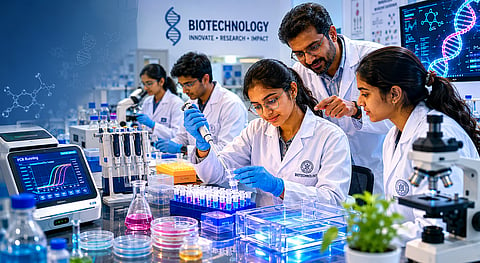

A cinematic biotechnology laboratory scene in India showing undergraduate biotechnology students in lab coats performing hands-on experiments & mentor scientist guiding students,
Biotechnology Education in India: Courses, Eligibility, Exams, Careers & Scope Explained
logo
Medbound Times
www.medboundtimes.com