
- Home
- About Us
- Contact Us
- Biography
- MedBound Hub
- InternshipInternship
- Daily Pulse
- Medicine
- Physical Therapy
- InterviewInterview
- Pharmacy
- Biotechnology
- College/InstituteCollege/Institute
- Dentistry
- Blog
- Wellness & Nutrition
- Nursing
- Opinion

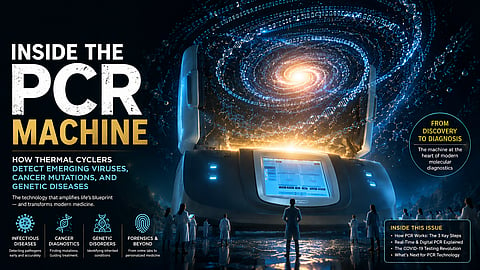
PCR machines amplify tiny amounts of DNA or RNA into millions of copies for analysis.
Thermal cyclers rapidly heat and cool samples through repeated amplification cycles.
PCR became globally recognized during the COVID-19 pandemic because of RT-PCR testing.
Modern PCR systems support cancer diagnostics, infectious disease testing, genomics, and forensic science.
Portable and AI-assisted PCR platforms are expanding molecular diagnostics beyond traditional laboratories.
Every time a patient receives a confirmed diagnosis for diseases such as COVID-19, Tuberculosis, or Human Immunodeficiency Virus Infection, there is a strong chance that a PCR machine played a role somewhere in the diagnostic process. Hidden inside molecular laboratories across hospitals, research institutes, and biotechnology companies, these machines became one of the most influential technologies in modern medicine.
PCR machines, also called thermal cyclers, amplify genetic material. Even an extremely small amount of DNA or RNA can be copied millions to billions of times, allowing scientists and clinicians to study, identify, and analyze it in detail.¹ This ability became central to molecular diagnostics, infectious disease testing, cancer research, genomics, and forensic science.
Although PCR became globally recognized during the COVID-19 pandemic, the technology itself has existed for decades and continues to expand into newer areas of medicine and biotechnology.
The origins of PCR trace back to 1983, when American biochemist Kary Mullis developed the concept while working at Cetus Corporation in California.² Mullis proposed that a specific DNA sequence could be repeatedly copied through cycles of heating and cooling using primers and a DNA polymerase enzyme.
Before PCR, obtaining enough DNA for analysis was often slow, expensive, and technically difficult.³ Researchers relied on labor-intensive cloning methods that were impractical for rapid diagnostics or routine molecular analysis.
PCR changed this entirely.
The later development of automated thermal cyclers transformed PCR from a manual laboratory process into a scalable diagnostic technology.⁸
The technique worked through exponential amplification. With every cycle, the amount of target DNA doubled. After repeated cycles, even a tiny fragment of DNA became large enough to detect and study.⁴
The first paper formally describing PCR was published in 1985 in the journal Science by Mullis and colleagues including Randall Saiki and Henry Erlich.⁴ In 1993, Mullis received the Nobel Prize in Chemistry for the invention of PCR, recognizing the enormous impact the technology had on biology and medicine.²
A PCR machine, commonly called a thermal cycler, is a laboratory instrument used to perform Polymerase Chain Reaction.¹⁰
In simple terms, PCR acts like molecular photocopying. The machine creates the temperature conditions needed to repeatedly copy a selected region of DNA.
The PCR machine itself does not “read” diseases directly. Instead, it enables biochemical reactions that amplify genetic material to detectable levels.
Modern PCR systems can:
process multiple samples simultaneously
rapidly heat and cool reactions
monitor DNA amplification in real time
perform quantitative analysis using fluorescent detection systems⁵
These capabilities made PCR one of the foundational technologies of molecular diagnostics.
At the center of the PCR machine is a metal thermal block containing wells that hold small reaction tubes or plates.⁵ The machine rapidly changes the temperature of this block according to programmed cycles.
Most modern thermal cyclers use Peltier-based heating systems, which allow precise and rapid heating and cooling.⁵
The machine also contains a heated lid that prevents condensation from forming inside the reaction tubes during high-temperature steps.
Inside each PCR tube are several essential components:
Template DNA or RNA
Primers
DNA polymerase enzyme
Nucleotides (dNTPs)
Buffer solution containing magnesium ions¹
Each component plays a specific role in DNA amplification.
PCR works through repeated temperature cycles. Each cycle contains three major stages.¹
1. Denaturation
The reaction is heated to approximately 94°C to 98°C. At this temperature, the double-stranded DNA separates into two single strands.¹
2. Annealing
The temperature is lowered, usually between 50°C and 65°C. Short DNA sequences called primers bind to complementary regions on the target DNA strands.¹
These primers define the specific section of DNA that will be amplified.
3. Extension
The temperature rises again, commonly to around 72°C. During this step, the enzyme Taq polymerase synthesizes new DNA strands by adding nucleotides in sequence.¹
Once the cycle finishes, the amount of DNA has doubled. Repeating the cycle 30 to 40 times creates millions or billions of copies of the target sequence.¹
Did You Know?
A single DNA fragment can become billions of copies after 30 PCR cycles.¹
Early PCR experiments required researchers to manually move samples between water baths set at different temperatures.¹³
Taq polymerase was isolated from Thermus aquaticus, a bacterium discovered in hot spring environments.³
Early PCR experiments faced a major limitation. Standard DNA polymerases were destroyed during the high temperatures required for denaturation.¹ Scientists had to manually add fresh enzyme after every cycle, making the process slow and impractical.
This changed with the introduction of Taq polymerase, a heat-resistant enzyme isolated from the bacterium Thermus aquaticus.³
Because Taq polymerase could survive repeated heating cycles, PCR became suitable for automation. This breakthrough made fully automated thermal cyclers possible and significantly accelerated the growth of molecular biology.
The first PCR experiments did not use modern thermal cyclers.
Researchers manually transferred samples between separate water baths maintained at different temperatures.¹³ The process was time-consuming and difficult to standardize.
Automated thermal cyclers introduced in the late 1980s changed molecular biology laboratories completely. Scientists could now program temperature cycles into a single machine that performed the entire process automatically.⁸
Over time, PCR systems evolved to include:
gradient temperature optimization
real-time fluorescence monitoring
high-throughput processing
multiplex testing
digital PCR platforms
Today’s advanced systems can process large sample volumes while maintaining highly accurate thermal control.
PCR changed medical diagnostics by allowing clinicians to detect disease at the molecular level rather than relying only on visible organisms or slower laboratory methods.
Before molecular diagnostics became widespread, many infections required culture-based testing that could take days or even weeks.¹ PCR significantly improved both speed and sensitivity.
PCR became essential for detecting:
COVID-19
Tuberculosis
Human Immunodeficiency Virus Infection
Hepatitis B
Hepatitis C
sexually transmitted infections
respiratory viral infections
PCR can detect extremely small quantities of pathogen genetic material, even in early stages of infection.⁹
PCR-based assays are also increasingly used to identify antimicrobial resistance genes, helping clinicians detect drug-resistant pathogens more rapidly than conventional culture methods.¹³
During the COVID-19 pandemic, reverse transcription PCR (RT-PCR) became the global standard for detecting SARS-CoV-2 because of its high sensitivity and specificity.⁹
PCR and rapid antigen tests both help detect infectious diseases, but they work differently and serve different purposes.
PCR tests detect the genetic material, or nucleic acids, of a pathogen. Because of this, PCR is generally considered more sensitive and can often identify infections even when only small amounts of viral material are present.⁹
Rapid antigen tests detect specific proteins from a virus rather than genetic material. These tests are usually faster and can provide results within minutes, but they are generally less sensitive than PCR tests, particularly during the early stages of infection or when viral levels are low.⁹
During the COVID-19 pandemic, PCR remained the laboratory reference standard for confirming SARS-CoV-2 infection, while rapid antigen tests became widely used for quick screening and home testing.¹²
The COVID-19 pandemic transformed PCR from a laboratory term into a globally recognized technology. During the peak years of the pandemic, laboratories across multiple countries operated around the clock processing thousands of PCR tests daily.¹⁴ Demand for thermal cyclers, extraction kits, reagents, pipette tips, swabs, and trained laboratory personnel increased dramatically worldwide.
By 2022, billions of COVID-19 PCR tests had been performed globally, making molecular testing one of the largest diagnostic operations in modern public health history.¹⁴ Many healthcare systems faced shortages of PCR reagents and testing supplies during the early phases of the pandemic.¹² Molecular laboratories expanded testing capacity rapidly, while manufacturers scaled production of instruments and consumables to meet unprecedented demand.
PCR testing became central to public health strategies worldwide because it could identify SARS-CoV-2 infections with high sensitivity before many patients became severely ill.¹² For many people, the pandemic marked the first time they encountered molecular diagnostics directly, highlighting how dependent modern healthcare systems had become on PCR technology.
PCR-based testing also became important in oncology. Laboratories use PCR methods to identify mutations associated with cancers and monitor disease progression.¹⁰
PCR-based companion diagnostics are increasingly used to identify patients who may benefit from targeted therapies. In oncology, molecular testing helps detect specific mutations that guide treatment decisions in cancers such as lung cancer and breast cancer.¹⁰
Certain targeted therapies depend on identifying specific genetic alterations through molecular testing.
These approaches became an important part of precision and personalized medicine, where treatment decisions increasingly depend on a patient’s molecular profile.¹⁰
PCR supports testing for inherited diseases by amplifying DNA regions linked to genetic abnormalities.¹
PCR also transformed forensic investigations. Even trace amounts of biological material such as hair roots or dried blood samples can now be amplified for DNA profiling.¹¹
PCR technology has evolved significantly since its invention.
Real-time PCR monitors amplification continuously using fluorescent dyes or probes.⁵
This allows laboratories not only to detect DNA but also to measure how much genetic material is present in a sample.
qPCR became especially important in:
infectious disease diagnostics
viral load testing
gene expression studies
RT-PCR converts RNA into complementary DNA before amplification.¹
This technique is essential for detecting RNA viruses such as:
SARS-CoV-2
influenza viruses
HIV
Digital PCR partitions a sample into thousands of miniature reactions, enabling highly sensitive quantification.⁵
Applications include:
liquid biopsy research
rare mutation detection
oncology
precision medicine
Although COVID-19 brought PCR into mainstream awareness, the technology continues to influence many other areas of medicine and biotechnology.
PCR is widely used in:
molecular pathology
genomics research
food safety testing
agricultural biotechnology
environmental microbiology
pharmaceutical development¹
In biotechnology laboratories, PCR remains a core technique for cloning, sequencing workflows, mutation analysis, and genetic engineering research.
PCR is now considered a foundational skill in biotechnology and molecular biology education.
Students encounter PCR during:
microbiology practicals
genetics laboratories
molecular biology training
biomedical research projects
Understanding PCR systems helps students prepare for careers in:
molecular diagnostics
genomics laboratories
biotechnology industries
pharmaceutical companies
clinical research organizations
As molecular medicine expands globally, familiarity with PCR technology has become increasingly valuable in life-science careers.
Despite its importance, PCR also has limitations.
PCR is extremely sensitive. Even small amounts of contaminating DNA can produce false-positive results.¹ Contamination can occur through improperly handled samples, aerosolized genetic material, or cross-contamination between specimens inside the laboratory.
Strict laboratory workflows and quality controls are therefore essential.
Advanced PCR systems require:
trained personnel
laboratory infrastructure
stable electricity
controlled workflows
This can create accessibility challenges in low-resource settings.
Poor sample collection, degraded samples, or testing too early in infection may produce false-negative results.¹⁵ During the COVID-19 pandemic, diagnostic accuracy was influenced by the timing of sample collection, viral load, transport conditions, and laboratory handling protocols.¹⁵
Cycle threshold values, commonly called Ct values, also became widely discussed during the pandemic. Ct values indicate how many amplification cycles are needed before viral genetic material becomes detectable. Although lower Ct values may suggest higher viral loads, experts cautioned against using Ct values alone to determine infectivity or disease severity outside standardized clinical settings.¹⁶
For this reason, PCR results are interpreted alongside clinical findings and additional investigations.
PCR technology continues to evolve alongside modern biotechnology and molecular medicine.
Current developments include:
portable PCR systems
handheld diagnostics
point-of-care molecular testing
AI-assisted molecular analysis
multiplex testing platforms
automated workflows
faster thermal cycling systems
decentralized molecular testing
AI-assisted analysis may help automate interpretation of amplification curves, improve workflow efficiency, and reduce reporting errors in high-volume laboratories.
PCR systems are increasingly being integrated with automated laboratory workflows, cloud-connected reporting systems, and next-generation sequencing pipelines. These developments may help improve scalability and reduce turnaround times in high-volume molecular laboratories.
Researchers are also developing ultra-fast PCR platforms capable of completing amplification in significantly shorter timeframes than conventional systems.¹⁷
Portable PCR systems may improve access to diagnostics in rural and resource-limited settings. Portable PCR platforms are increasingly being explored for rural and decentralized healthcare settings where access to centralized molecular laboratories may be limited.¹⁷
As precision medicine expands, PCR is expected to remain central to personalized diagnostics, genomics, oncology, and infectious disease surveillance.
The PCR machine transformed medicine by enabling scientists and clinicians to detect disease at the molecular level with speed and precision. What began as an idea developed in the early 1980s became one of the most important technologies in modern diagnostics.
From infectious disease detection to cancer genomics and biotechnology research, PCR continues to shape modern healthcare and laboratory science worldwide.
Although many people first encountered PCR during the COVID-19 pandemic, its influence extends far beyond a single outbreak. Thermal cyclers remain essential tools in molecular biology, biotechnology, genomics, and precision medicine, and their role is expected to continue expanding in the years ahead.
National Human Genome Research Institute. “Polymerase Chain Reaction (PCR) Fact Sheet.” Accessed May 25, 2026. https://www.genome.gov/about-genomics/fact-sheets/Polymerase-Chain-Reaction-Fact-Sheet
Nobel Prize Outreach AB. “The Nobel Prize in Chemistry 1993.” Accessed May 25, 2026. https://www.nobelprize.org/prizes/chemistry/1993/summary/
Thermo Fisher Scientific. “PCR Technology: Key Milestones in Development and Maturation.” Accessed May 25, 2026. https://www.thermofisher.com/us/en/home/brands/thermo-scientific/molecular-biology/molecular-biology-learning-center/molecular-biology-resource-library/spotlight-articles/pcr-landmark-publications.html
Saiki, Randall K., et al. “Enzymatic Amplification of β-Globin Genomic Sequences and Restriction Site Analysis for Diagnosis of Sickle Cell Anemia.” Science 230, no. 4732 (1985): 1350–1354. https://science.sciencemag.org/content/230/4732/1350
Thermo Fisher Scientific. “PCR Thermal Cyclers.” Accessed May 25, 2026. https://www.thermofisher.com/in/en/home/life-science/cloning/cloning-learning-center/invitrogen-school-of-molecular-biology/pcr-education/pcr-thermal-cyclers.html
Thermo Fisher Scientific. “Thermal Cyclers and Real-Time Instruments.” Accessed May 25, 2026. https://www.thermofisher.com/in/en/home/life-science/pcr/thermal-cyclers-realtime-instruments.html
Smithsonian Institution Archives. “Kary Mullis Collection.” Accessed May 25, 2026. https://siarchives.si.edu/collections/siris_arc_217745
Thermo Fisher Scientific. “30 Years of Thermal Cycler Innovations.” Accessed May 25, 2026. https://www.thermofisher.com/blog/behindthebench/30-years-of-thermal-cycler-innovations-1-the-worlds-first-thermal-cycler-and-how-it-advanced-science/
National Cancer Institute. “Polymerase Chain Reaction (PCR).” Accessed May 25, 2026. https://www.cancer.gov/publications/dictionaries/cancer-terms/def/polymerase-chain-reaction
Centers for Disease Control and Prevention. “Overview of Testing for SARS-CoV-2.” Accessed May 25, 2026. https://www.cdc.gov/covid/testing/index.html
Federal Bureau of Investigation. “Combined DNA Index System (CODIS).” Accessed May 25, 2026. https://www.fbi.gov/services/laboratory/biometric-analysis/codis
World Health Organization. “Diagnostic Testing for SARS-CoV-2.” Accessed May 25, 2026. https://www.who.int/publications/i/item/diagnostic-testing-for-sars-cov-2
Centers for Disease Control and Prevention. “Antimicrobial Resistance Threats in the United States.” Accessed May 25, 2026. https://www.cdc.gov/drugresistance/index.html
Our World in Data. “Coronavirus (COVID-19) Testing.” Accessed May 25, 2026. https://ourworldindata.org/coronavirus-testing
Xiao, Ai Tang, et al. “False Negative of RT-PCR and Prolonged Nucleic Acid Conversion in COVID-19: Rather than Recurrence.” Journal of Medical Virology 92, no. 10 (2020): 1755–1756. https://onlinelibrary.wiley.com/doi/10.1002/jmv.25855
Tom, Michael R., and Michael J. Mina. “To Interpret the SARS-CoV-2 Test, Consider the Cycle Threshold Value.” Clinical Infectious Diseases 71, no. 16 (2020): 2252–2254. https://academic.oup.com/cid/article/71/16/2252/5842165
NextGenPCR. “Rapid PCR Technology.” Accessed May 25, 2026. https://www.nextgenpcr.com/
