
- Home
- About Us
- Contact Us
- Biography
- MedBound Hub
- InternshipInternship
- Daily Pulse
- Medicine
- Physical Therapy
- InterviewInterview
- Pharmacy
- Biotechnology
- College/InstituteCollege/Institute
- Dentistry
- Blog
- Wellness & Nutrition
- Nursing
- Opinion

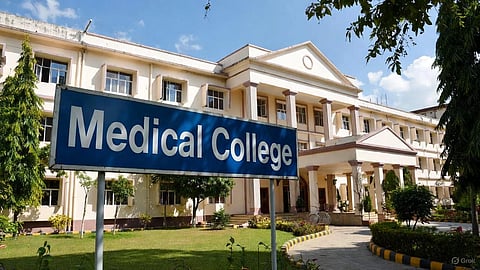
In a major push to expand MBBS seats and strengthen healthcare access in underserved regions, the central government has approved 11 new medical colleges under the Public Private Partnership model. Announced in the Lok Sabha, the decision aims to fast track medical education expansion by upgrading district hospitals instead of waiting for entirely new government campuses to be built.
The announcement in the Lok Sabha highlights a major policy push to quickly add MBBS seats by upgrading district hospitals instead of waiting for new government buildings to come up.
The government aims to speed up medical education expansion by converting existing district hospitals into teaching hospitals. This approach uses available infrastructure to start colleges sooner. Officials believe the PPP model will help avoid long delays that typically slow down government funded projects. The focus is on reaching districts where people still travel long distances for quality healthcare.
The 11 new medical colleges will be set up in several states. Jharkhand gets four projects in Giridih, Dhanbad, Jamtara and Khunti. Arunachal Pradesh will see a college in Namsai. Uttar Pradesh will host six new colleges in Baghpat, Mainpuri, Hathras, Kasganj, Mahoba and Hamirpur.
These locations were chosen because many of these districts have limited medical training facilities and face shortages of qualified doctors. The new colleges are expected to strengthen healthcare access in some of the most underserved regions.
To make the PPP model workable, the Centre has offered Viability Gap Funding. The government can support up to 30 percent of the project cost and up to 40 percent for select pilot projects. It can also cover up to 25 percent of operations and maintenance costs for the first five years, ensuring early financial stability for these institutions. States will need to match these funds. They must also provide land at concessional rates and ensure that the connected district hospital remains available for training and patient care.
This structure clarifies how financial responsibility is shared between the Centre, the states, and private partners, while long term control of the district hospital and its public health role remains with the government.
This structure aims to attract reliable private partners while ensuring that public health services continue without interruption.
The Centre has clarified that PPP medical colleges will follow the same rules and quality benchmarks as government institutions. They must meet the National Medical Commission Minimum Standard Requirements, which define norms for faculty strength, facilities, equipment and clinical training. The assurance is meant to address concerns that private involvement may weaken academic or clinical quality.
The government also noted that all 157 medical colleges planned under the centrally sponsored scheme to upgrade district hospitals have already been sanctioned. This confirms that the PPP medical college initiative does not replace the existing government funded district hospital medical college scheme. Instead, it operates as an additional expansion route to further increase MBBS seats and medical training capacity beyond what the public sector alone is currently delivering.
This means the PPP model is not replacing the earlier plan. Instead, it adds another channel to expand medical training and public health capacity.
(Rh/ARC/MSM)
