Fact Check: Does Gujarat Have Only Six Government Medical Colleges? The GMERS Explanation

A political claim about Gujarat having only six government medical colleges triggered debate. The answer depends on how GMERS institutions are classified.
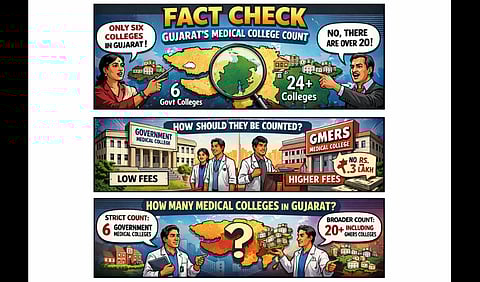
Depiction by comic strip on "Does Gujarat Have Only 6 Government Medical Colleges?"
Confusion over Gujarat’s medical colleges stems from GMERS institutions. This fact check explains the official numbers and why counts differ.
Published on
Updated on

A political claim about the number of government medical colleges in Gujarat recently sparked debate on social media.

On January 26, during a public event in Thanjavur, Tamil Nadu, DMK Deputy General Secretary Kanimozhi Karunanidhi said that Gujarat has only six government medical colleges. The statement drew criticism from BJP Tamil Nadu, which circulated a video disputing the claim. The video referenced a response from an artificial intelligence chatbot suggesting that Gujarat has around twenty four government medical colleges.

Kanimozhi Karunanidhi giving a speech
DMK Deputy General Secretary Kanimozhi Karunanidhi said that Gujarat has only six government medical colleges.Kalaignarist, CC BY-SA 4.0, via Wikimedia Commons

The disagreement raised a larger question: how should government medical colleges actually be counted?

Across India, states have expanded medical education using different institutional models. Some states rely mainly on fully government funded medical colleges, while others have introduced hybrid or self financed institutions to increase training capacity. These differences in governance and funding structures often influence how medical colleges are classified in official lists and public discussions.

How Many Government Medical Colleges Are There in Gujarat?

In March 2024, Gujarat Health Minister Rushikesh Patel told the Gujarat Legislative Assembly that the state has six government medical colleges, thirteen colleges run by the Gujarat Medical Education and Research Society (GMERS), one All India Institute of Medical Sciences (AIIMS Rajkot), which is a central government institution, and about twenty private medical colleges.¹

Official Data on Government Medical Colleges in Gujarat

This distinction is central to the controversy. The answer depends on whether colleges run by the Gujarat Medical Education and Research Society are counted as government medical colleges.

The main types of medical colleges in Gujarat differ significantly in governance and tuition structure.

Medical College Types in Gujarat: Quick Comparison

List of the Six Traditional Government Medical Colleges in Gujarat

If the definition includes only institutions directly funded and operated by the state government, Gujarat has six traditional government medical colleges:

  • B. J. Medical College, Ahmedabad

  • Medical College Baroda, Vadodara

  • Government Medical College, Surat

  • Pandit Deendayal Upadhyay Medical College, Rajkot

  • M. P. Shah Medical College, Jamnagar

  • Government Medical College, Bhavnagar

These colleges were established between the late nineteenth century and the 1990s and form the historical core of Gujarat's publicly funded medical education system.²

Several of these institutions operate large tertiary hospitals. For example, Civil Hospital Ahmedabad, attached to B. J. Medical College, has more than 2,000 beds and treats patients from across Gujarat and neighboring states. ³

What Is GMERS? Gujarat’s Government-Promoted Medical College System

The Gujarat Medical Education and Research Society (GMERS) was established by the state government in 2009 to expand medical education across districts.⁴

The creation of GMERS was intended to increase medical education capacity across districts while linking new colleges with district hospitals.

Many GMERS institutions were established between 2011 and 2019 in districts such as Gandhinagar, Junagadh, Himmatnagar, Vadnagar, Navsari, Valsad, and Porbandar. These colleges usually started with 100 to 150 MBBS seats and were attached to district level teaching hospitals.⁴

GMERS functions as an autonomous society within Gujarat's health and medical education system. Government officials are part of its governing body, and many of its institutions use government land, hospitals, and infrastructure.

However, GMERS colleges operate under a self financed model, meaning operational costs are largely recovered through tuition fees rather than full state funding.

Because of this hybrid structure, GMERS colleges are sometimes described as government promoted institutions rather than fully government funded medical colleges.

See more: Gujarat High Court Stays SHRC Compensation Order Against Doctors

Is There a Similar Medical College Model in Tamil Nadu?
Short answer: No, Tamil Nadu does not have an equivalent system exactly like GMERS.

However, it does have self financing medical colleges, mostly run by private trusts or universities, which is a different structure.

What Makes GMERS Unique

Gujarat Medical Education and Research Society colleges are unusual because they operate as a hybrid model:

  • Created by the Government of Gujarat

  • Run by an autonomous government society

  • Infrastructure often provided by the state

  • Operational costs recovered through student fees

  • Seats filled partly through state NEET counselling

This places GMERS colleges somewhere between government and private institutions.

The model allowed Gujarat to expand MBBS seats relatively quickly without the state government fully funding every new college.

Tamil Nadu’s Model Is Different

Tamil Nadu largely follows a public heavy medical education system.

Medical education expansion in the state has mainly occurred through:

  • fully government medical colleges

  • private self financing colleges

Tamil Nadu does not operate a government promoted society model like GMERS.

Self Financing Colleges in Tamil Nadu

Tamil Nadu does have many self financing medical colleges, but they are usually run by:

  • private trusts

  • deemed universities

  • private educational institutions

Examples include institutions such as:

These institutions operate as private medical colleges rather than government promoted societies.

MBBS Fees in Government, GMERS, and Private Medical Colleges in Gujarat

The funding structure of medical colleges strongly influences tuition fees and operational models.

Government Medical Colleges

Traditional government medical colleges in Gujarat charge relatively low tuition because they receive substantial public funding.

Annual MBBS tuition usually ranges between ₹25,000 and ₹50,000, and the total tuition for the full course generally remains under ₹3 lakh.

GMERS Colleges

GMERS institutions charge higher fees because they rely partly on student tuition.

The total cost of the MBBS course can reach ₹18–20 lakh for government quota seats and ₹50 lakh or more for management quota seats.

Private Medical Colleges

Private medical colleges usually charge significantly higher fees.

In some institutions the total cost of an MBBS degree may reach ₹80 lakh to ₹1.2 crore.

Gujarat and Tamil Nadu Comparison

Government medical colleges in India generally charge much lower tuition because they are heavily subsidized.

Tamil Nadu has one of the lowest government MBBS fee structures in the country, with annual tuition usually around ₹13,000 to ₹20,000, excluding additional charges such as hostel or examination fees.

In Gujarat, traditional government colleges charge about ₹25,000 to ₹50,000 per year, while GMERS colleges charge about ₹3.3 to ₹3.5 lakh per year for government quota seats.

Example: Tuition Paid by Students in Government vs GMERS Colleges

GMERS Medical College Dharpur Patan Building and Baroda Medical College Building
The higher fees reflect the self financed structure of GMERS colleges, where a significant portion of operational costs is recovered through student tuition rather than direct government funding.Prachi246, CC0, via Wikimedia Commons and Drduttaroy (talk) (Uploads), Public domain, via Wikimedia Commons

The difference between traditional government medical colleges and GMERS institutions can be illustrated through a simple example of tuition costs.

Student in a Government Medical College

A student admitted to a traditional state government medical college in Gujarat usually pays about ₹25,000 to ₹50,000 per year in tuition.

For example:

Annual tuition: about ₹40,000
Monthly equivalent: about ₹3,300

Over the full MBBS course of 5.5 years, the total tuition typically remains under ₹3 lakh.

Because these colleges receive substantial government funding, the cost of education for students remains heavily subsidized.

Student in a GMERS Medical College

A student admitted to a GMERS medical college under the government quota usually pays about ₹3.3 lakh to ₹3.5 lakh per year.

For example:

Annual tuition: about ₹3,50,000
Monthly equivalent: about ₹29,000

Over the full MBBS course, the tuition may reach about ₹18–20 lakh.

These higher fees reflect the self financed structure of GMERS colleges, where a significant portion of operational costs is recovered through student tuition rather than direct government funding.

Tuition Comparison

This example illustrates how the funding model of a medical college directly affects the cost of medical education for students.

Cost of Building Medical Colleges

Establishing a medical college with a teaching hospital requires significant investment. Health policy analyses estimate that building and equipping a medical college hospital complex can cost roughly ₹500 crore to ₹1,000 crore, along with recurring operational expenses for faculty salaries, hospital staff, infrastructure maintenance, and clinical equipment.⁶

Because government medical colleges charge heavily subsidized tuition, most operational costs are borne by state governments. Society based models such as GMERS were partly designed to expand medical education capacity while reducing the full financial burden on state budgets.

Role of NEET Counselling

Admissions to MBBS programs in India occur through the National Eligibility cum Entrance Test (NEET).⁵

Many GMERS colleges allocate a large portion of their seats through the state government quota during NEET counselling. Because these seats are filled through the state admission process, some lists classify GMERS colleges as government institutions even though they operate under a self financed model.

In Gujarat, a substantial portion of seats in GMERS colleges are allocated through the state government quota during NEET counselling, while the remaining seats are filled through management quota or institutional categories.

Two Ways to Count Government Medical Colleges

The conflicting claims about Gujarat's medical colleges arise from two different counting methods.

Strict definition

If only fully state funded institutions are counted, Gujarat has six government medical colleges.

Broader definition

If GMERS colleges are included as government linked institutions, the total number of government associated medical colleges becomes much higher.

Expansion of MBBS Seats After GMERS

The creation of GMERS marked a major expansion phase for medical education in Gujarat.

Before 2009, the state had roughly 1,000 to 1,200 MBBS seats, mostly concentrated in a few cities.

After new colleges were established across districts, seat capacity increased significantly.

This represents more than a fivefold increase in MBBS seats within about fifteen years.

National Expansion of Medical Education

Gujarat's expansion is part of a broader nationwide trend.

Around 2005, India had roughly 31,000 MBBS seats across about 220 to 230 medical colleges, according to data from the Medical Council of India, the regulator that preceded the National Medical Commission.

By 2024–2025, the country has more than 1.08 lakh MBBS seats and over 700 medical colleges, reflecting a major increase in training capacity for doctors.⁷

Much of this nationwide growth occurred after the late 2000s, when central and state governments began expanding medical education by opening new colleges and upgrading district hospitals into teaching institutions.

Historical Context

Tamil Nadu built a large public medical education system earlier than many states.

Madras Medical College, established in 1835, is among the oldest medical institutions in Asia.

Between the 1950s and 1980s, Tamil Nadu expanded government medical colleges across cities such as Madurai, Thanjavur, Coimbatore, Tirunelveli, and Salem.

Gujarat also developed important institutions such as B. J. Medical College Ahmedabad, Medical College Baroda, and M. P. Shah Medical College Jamnagar, but large scale expansion occurred later, especially after the creation of GMERS in 2009.

Fact Check Verdict

Illustration showing a large question “6 Government Medical Colleges?” hovering above a map of Gujarat filled with multiple medical college icons.
GMERS colleges operate as government promoted but self financed institutions, placing them between public and private medical colleges.

The claim that Gujarat has only six government medical colleges is accurate under a strict definition that counts only institutions directly funded and operated by the state government.

However, if colleges established by the Gujarat Medical Education and Research Society are included as government linked institutions, the number becomes higher. The difference arises from how these colleges are classified rather than from incorrect data.

References:

  1. Government of Gujarat. Gujarat Legislative Assembly Proceedings. Statement by Health Minister Rushikesh Patel on medical colleges in the state. March 2024.

  2. Gujarat Medical Education and Research Society. “Introduction.” https://gmers.gujarat.gov.in/introduction

  3. Gujarat Medical Education and Research Society. “GMERS Medical Colleges.” https://gmers.gujarat.gov.in/medical-colleges

  4. Civil Hospital Ahmedabad. “Civil Hospital Ahmedabad.” https://civilhospitalahmedabad.gujarat.gov.in

  5. National Testing Agency. NEET (UG) Information Bulletin. https://neet.nta.nic.in

  6. National Medical Commission. “College and Course Search: List of Medical Colleges.” https://www.nmc.org.in/information-desk/college-and-course-search/

  7. Ministry of Health and Family Welfare. Indian Public Health Standards (IPHS) for District and Sub-District Hospitals. National Health Mission. https://nhm.gov.in/images/pdf/guidelines/iphs/iphs-revised-guidlines-2022/01-SDH_DH_IPHS_Guidelines-2022.pdf

  8. Ministry of Health and Family Welfare. Indian Public Health Standards (IPHS) for District and Sub-District Hospitals. National Health Mission.
    https://nhm.gov.in/images/pdf/guidelines/iphs/iphs-revised-guidlines-2022/01-SDH_DH_IPHS_Guidelines-2022.pdf

Depiction by comic strip on "Does Gujarat Have Only 6 Government Medical Colleges?"
NMC Cracks Down on Fake Patients in Medical Colleges, Introduces Digital System to Verify Hospital Patient Load

Related Stories

No stories found.
logo
Medbound Times
www.medboundtimes.com