Former hospital director and infectious disease physician Guo Xiaoping has spent more than two decades supporting students living with HIV through Red Ribbon Primary School in Linfen, Shanxi, widely regarded as China's only full-time school for HIV-positive students. Guo launched the initiative in 2004 after discovering that several children in an AIDS ward had reached school age but were unable to attend regular classes because of HIV-related stigma and the loss of parental support.
Guo Xiaoping, then director of an infectious disease hospital in Linfen, Shanxi, turned an unused hospital ward into a small classroom in 2004 after realizing that several children living with HIV had no access to regular schooling. The South China Morning Post reported that doctors and nurses volunteered to teach pinyin, mathematics, and other basic subjects.
Many of the students had acquired HIV through mother-to-child transmission, while others had lost their parents to AIDS or were left without family support.
"They are rejected by people around them. They have no family, friends or playmates, and they are refused by the local school." Guo told Gilead's Stories project.
As more children came under his care, Guo established Red Ribbon Primary School in 2006 with support from the hospital and public donations. Named after the international symbol of HIV awareness and solidarity, the campus later grew to include dormitories, classrooms, a cafeteria, and on-site medical services.
The school faced significant challenges in its early years. Some teachers declined to work there after learning the students were living with HIV, and several staff members left because of fear and stigma surrounding the virus. Despite these setbacks, Guo continued to recruit committed educators and healthcare workers to support the children.
The South China Morning Post reported that, as of 2025, Red Ribbon School had 46 pupils and supported another 16 children by covering their education and living expenses. Over the years, the school has cared for 127 youngsters from 14 provinces across China.
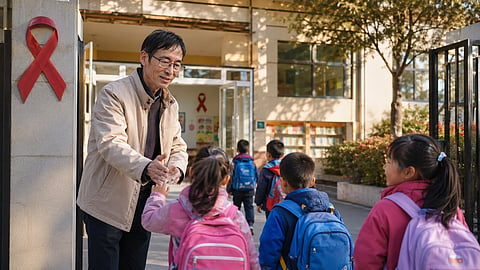
Many students at Red Ribbon School were born with HIV. With early diagnosis and regular treatment, they can remain healthy, continue their education, and build independent lives as adults.
Guo Xiaoping has repeatedly emphasized the importance of medication adherence. According to the South China Morning Post, teachers at the school supervise daily doses because missing treatment can allow the virus to become resistant to medicines and limit future options.
Guo told CGTN, "Medicine is like a daily meal for them. But while meals can be delayed, taking medicine cannot."
The SCMP also reported that students at Red Ribbon School have maintained undetectable viral loads, meaning the amount of virus in the blood is so low that it cannot be detected by standard tests and the risk of transmission is greatly reduced. Reflecting on the children's lives, Guo said, "The only difference between them and other children is that they take one extra pill a day."
Guo also said that "not a single child at the school has died" since it opened, attributing their progress to consistent treatment, careful medical follow-up, and medication adherence.
Despite advances in HIV treatment, stigma and misinformation continue to shape the lives of many children living with the virus. Guo Xiaoping has spoken about instances in which local residents refused to accept money from his students because they wrongly believed HIV could spread through banknotes, SCMP also noted.
Health authorities worldwide have consistently stated that HIV is not transmitted through everyday contact, including sharing meals, hugging, shaking hands, or studying in the same classroom. Misconceptions about transmission remain a major barrier to education, employment, and social acceptance for people living with HIV.
Guo has defended the existence of the Red Ribbon School as a response to that reality. As reported by China Daily and cited by Newsweek, he said, "Without us, many wouldn't even have had the chance to go to school." He has also expressed hope that one day such a school will no longer be necessary because discrimination against people living with HIV has ended.
Although some observers have questioned whether a separate school reinforces segregation, Guo has said the institution exists because many children were denied admission to mainstream schools. He has repeatedly expressed the hope that improved public understanding of HIV will eventually eliminate the need for a separate school.
The experiences of former students highlight how early treatment and community support can change lives.
According to the SCMP, former students have gone on to attend university, build careers, marry, and raise families. Several graduates have also had HIV-negative children through preventive medical care, illustrating how early treatment, HIV prevention strategies, and long-term support can help children living with HIV lead healthy adult lives.
Guo has expressed hope that one day such a school will no longer be necessary, saying he wishes for a future "when there is no discrimination against people living with HIV/AIDS."
(Rh/TP/MSM)