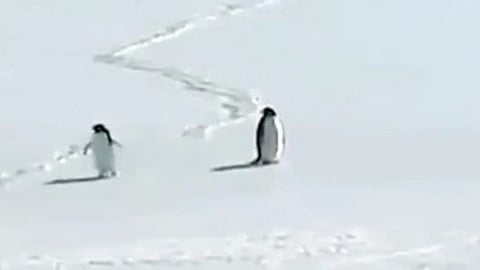
In 2026, social media found its most unlikely symbol of burnout in a waddling Adélie penguin. This was followed by an overflow of memes in which users paired the clip with melancholic music, captions about quitting jobs, emotional exhaustion, loneliness, and even the urge to simply walk away from everything. For a generation going through burnout and uncertainty, the penguin felt deeply relatable.
This viral meme comes from Werner Herzog’s 2007 documentary Encounters at the End of the World, which resurfaced in 2026.
The clip shows an Adélie penguin leaving its group. While the rest of the colony heads toward the ocean for food and survival, this lone bird marches toward the Antarctic mountains in what Herzog himself described as a mysterious, almost existential decision.
Herzog’s distinctive narration adds depth to the scene, noting that any human attempt to redirect the penguin would be futile, the bird would simply turn around and resume its journey toward certain death.
In January 2026, Social media users paired this footage with a dramatic church organ cover of Gigi D’Agostino’s “L’Amour Toujours.” This created an unexpectedly motivational video that resonated strongly with Gen Z and millennials. The meme exploded across platforms, with users declaring “Be that penguin” and sharing their own snow-walking videos in solidarity with the rebellious bird.
Nearly two decades after the original footage was captured, the penguin’s solitary march has become a mirror for modern anxieties and the existential fatigue of living through uncertain times.
Burnout from relentless productivity culture
Detachment from systems that feel increasingly broken
Rebellion against conventional paths
The loneliness of choosing your own way
An AIIMS-trained neurologist, Dr. Rahul Chawla, known online as @neurobraindoctor, offered a compelling explanation that reframes the entire viral moment.
According to him, the penguin’s behavior may not represent rebellion, depression, or an existential crisis at all.
Instead, it may resemble a phenomenon seen in Alzheimer’s disease and other neurodegenerative disorders.
“Maybe that penguin didn’t have an existential crisis. Maybe she didn’t want to leave her people. Maybe her people felt like strangers.”
According to the neurologist, the penguin’s behavior bears a striking resemblance to a phenomenon observed in Alzheimer’s patients: visual-spatial dysfunction.
“Our brain has a navigation system that tells us, this is our home, this is our family, this is the way home,” he explains. “But in Alzheimer’s disease, not only is recent working memory affected, this internal navigation system also becomes impaired.”
In Alzheimer’s patients, this neurological deterioration manifests in deeply distressing ways:
Home feels strange: Familiar places stop feeling familiar
Faces become unfamiliar: Even loved ones may not be recognised
Directional confusion: The mental map needed to navigate home is lost
Anxious wandering: Patients leave in search of something that feels right again, guided only by faint old memories
“They don’t leave because they want to escape or because they’re depressed,” the neurologist emphasizes. “They leave because their environment has become unrecognizable. They’re searching for familiarity that their damaged brain can no longer find in the right places.”
(Rh/VK)