
- Home
- About Us
- Contact Us
- Biography
- MedBound Hub
- InternshipInternship
- Daily Pulse
- Medicine
- Physical Therapy
- InterviewInterview
- Pharmacy
- Biotechnology
- College/InstituteCollege/Institute
- Dentistry
- Blog
- Wellness & Nutrition
- Nursing
- Opinion

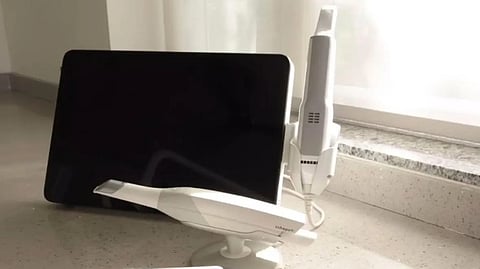
Intraoral scanners (IOS) have emerged as a pivotal innovation in digital dentistry, enabling the acquisition of precise three-dimensional (3D) images of intraoral structures.
These devices are increasingly replacing conventional impression techniques due to their efficiency, accuracy, and integration with digital workflows. This article explores the fundamental principles, mechanism of action, and clinical relevance of intraoral scanners based on current scientific literature.
Intraoral scanners operate on optical imaging principles to capture the geometry of teeth and surrounding oral tissues. The scanner projects a light source, commonly structured light, laser, or confocal imaging onto the dental surface. The reflected light is then captured by sensors and processed into digital data.
Several imaging principles are used:
Triangulation: Measures the angle of reflected light to calculate spatial coordinates.
Confocal microscopy: Captures focused images at different depths to reconstruct 3D surfaces.
Active wavefront sampling: Uses varying focal planes to determine surface topology.
Optical coherence tomography (in some advanced systems): Enhances subsurface imaging.
These techniques allow the generation of high-resolution digital impressions in real time.
The functioning of intraoral scanners involves a multi-step digital workflow:
The scanner emits a light beam onto intraoral surfaces. Reflected light is captured continuously as the operator moves the scanning wand across the dental arches.
Captured images are converted into point clouds using algorithms. These points represent spatial coordinates of the scanned surfaces.
Successive images are aligned and merged using software algorithms to create a continuous 3D model.
The processed data is rendered into a digital model (usually in STL, PLY, or OBJ formats), which can be used for diagnostics, treatment planning, or fabrication.
The digital impressions can be directly integrated with computer-aided design and manufacturing (CAD/CAM) systems for prosthetics, orthodontic appliances, and surgical guides.
Different intraoral scanners employ varying technologies:
Laser-based scanners: Use laser beams for surface detection.
Structured light scanners: Project patterned light for capturing surface geometry.
Confocal scanners: Capture sharp images at multiple depths without requiring powdering.
Hybrid systems: Combine multiple imaging techniques for enhanced accuracy.
Intraoral scanners are widely used across dental specialties:
Digital impressions for crowns, bridges, inlays, and onlays improve precision and reduce turnaround time.
Used for treatment planning, aligner fabrication, and monitoring tooth movement.
Facilitates accurate implant positioning and prosthetic design.
Enhances workflow efficiency for complete and partial dentures.
Reduces discomfort compared to conventional impression materials.
Improved patient comfort (eliminates impression materials)
Real-time visualization
Reduced human error
Enhanced workflow efficiency
Easy storage and transfer of digital data
Despite advantages, certain limitations exist:
High initial cost
Learning curve for operators
Difficulty capturing subgingival margins
Sensitivity to saliva and reflective surfaces
Variability in accuracy depending on system and operator skill
Studies indicate that intraoral scanners provide clinically acceptable accuracy for most dental procedures. Accuracy is influenced by:
Scanner technology
Scanning strategy
Operator experience
Clinical conditions (e.g., moisture control)
Full-arch scans may exhibit more deviation compared to quadrant scans, although advancements continue to improve performance.
Ongoing developments aim to:
Improve scanning speed and accuracy
Integrate artificial intelligence for diagnostics
Enable real-time treatment simulation
Expand applications in teledentistry
Intraoral scanners represent a significant advancement in digital dentistry, offering a reliable and efficient alternative to conventional impression techniques. Understanding their principles and mechanism of action is essential for optimizing their clinical use and improving patient outcomes.
Dhull, K. S., R. Nagar, P. Mathur, M. Shil, S. Jain, R. Dureha, and A. Kapoor. 2024. “Intraoral Scanners: Mechanism, Applications, Advantages, and Limitations.” Journal of Pharmacy & Bioallied Sciences 16 (Suppl 3): S1929–S1931. https://doi.org/10.4103/jpbs.jpbs_1299_23.
Kazemian, M., and M. Kheirati. 2025. “Comparison of Dimensional Accuracy of Digital Models by Intraoral Scanning Method in Comparison with Molding with Alginate.” Dental Research Journal (Isfahan) 22: 18. https://doi.org/10.4103/drj.drj_255_24.
Eggmann, F., and M. B. Blatz. 2024. “Recent Advances in Intraoral Scanners.” Journal of Dental Research 103 (13): 1349–1357. https://doi.org/10.1177/00220345241271937.
Mangano, F., A. Gandolfi, G. Luongo, and S. Logozzo. 2017. “Intraoral Scanners in Dentistry: A Review of the Current Literature.” BMC Oral Health 17 (1): 149. https://doi.org/10.1186/s12903-017-0442-x.
