
- Home
- About Us
- Contact Us
- Biography
- MedBound Hub
- InternshipInternship
- Daily Pulse
- Medicine
- Physical Therapy
- InterviewInterview
- Pharmacy
- Biotechnology
- College/InstituteCollege/Institute
- Dentistry
- Blog
- Wellness & Nutrition
- Nursing
- Opinion

Toothpaste is a fundamental component of daily oral hygiene, yet its formulation varies widely. Ancient Egyptian and Chinese civilisations have reports of using and making toothpastes.
But in the modern world, Colgate introduced the first commercial toothpaste in the 1890s in a collapsible tube, while gel toothpaste emerged much later in the 1960s, notably launched by Close-Up in 1967.
The two primary types, paste and gel toothpaste, differ in composition, texture, and clinical performance. While both are designed to remove plaque, deliver fluoride, and maintain oral health, emerging research suggests differences in their effectiveness, particularly in maintaining salivary pH.2
Understanding these differences is essential for evidence-based oral care recommendations.
Paste formulations are the traditional form of toothpaste. They typically contain:
Abrasives such as calcium carbonate or hydrated silica
Fluoride compounds for remineralization
Humectants like glycerin
Binding agents for consistency
Their thicker consistency allows for better mechanical plaque removal and longer retention on tooth surfaces.
Gel toothpastes are characterized by their transparent or semi-transparent appearance and smoother texture. They often contain:
Silica-based abrasives in lower concentrations
Higher levels of humectants for a gel-like consistency
Flavoring and coloring agents for aesthetic appeal
Gels are generally less abrasive and may be preferred for cosmetic appeal and milder brushing experiences.
See also: Swallowing Toothpaste Is Unhealthy. A Rutgers Professor Developed a Toothbrush With Suction Power
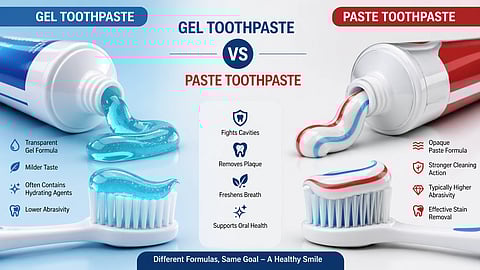
Paste toothpastes are denser and more opaque due to higher abrasive content. Gel toothpastes are lighter, smoother, and often visually appealing due to their translucent nature.
Paste formulations typically provide greater abrasive action, aiding in plaque and stain removal. Gel formulations are comparatively less abrasive, which may be beneficial for individuals with enamel sensitivity.
Research indicates that paste formulations are more effective in maintaining normal salivary pH compared to gel formulations. Maintaining a neutral pH is critical for preventing enamel demineralization and supporting oral microbial balance.2
Both gel and paste toothpastes can effectively deliver fluoride. However, the retention and interaction with saliva may vary depending on formulation consistency and composition.
Gel toothpastes are often marketed for their refreshing taste and visual appeal, while paste toothpastes are traditionally associated with stronger cleaning efficiency.
A comparative study on toothpaste formulations demonstrated that paste toothpaste showed greater stability in maintaining salivary pH within normal ranges than gel formulations.2 This suggests a potential advantage in reducing the risk of acid-mediated enamel damage.
Other studies highlight that while both formulations are effective in plaque control, differences in abrasivity and formulation components can influence outcomes such as stain removal and enamel wear.1
Additionally, clinical evidence suggests that formulation characteristics, rather than the format alone, play a significant role in determining overall effectiveness.
Enhanced plaque and stain removal is required
There is a need for better salivary pH regulation
Patients have higher caries risk
Lower abrasivity is desirable (e.g., sensitive teeth)
Aesthetic or taste preferences influence compliance
Mild cleaning is sufficient for maintenance
When people use electric toothbrushes for less splattering
The effectiveness of toothpaste depends on multiple factors beyond formulation, including:
Brushing technique
Frequency of use
Fluoride concentration
Individual oral health status
Current evidence suggests that while differences exist, both gel and paste formulations can be effective when used correctly.
Gel and paste toothpastes differ in composition, abrasivity, and clinical performance. Evidence indicates that paste formulations may offer advantages in maintaining salivary pH, which is critical for oral health. However, both types remain effective for routine oral hygiene when used appropriately.
Further research is needed to better understand how formulation differences influence long-term oral health outcomes.
References
Meshki, R., L. Basir, N. Rahbar, and M. Kazempour. 2021. “Comparison of the Effect of Fluoride Gel and Two Toothpastes with Different Materials on Remineralization of Initial Carious Lesions in Primary Teeth.” Journal of Family Medicine and Primary Care 10 (9): 3309–3313. https://doi.org/10.4103/jfmpc.jfmpc_1046_21.
Fernandes, Randy. n.d. “Differences in Effectiveness Toothpaste Gel Formulation with Paste in Maintaining Normal Salivary pH.” Andalas Dental Journal. https://doi.org/10.25077/ADJ.V4I2.60.
