
- Home
- About Us
- Contact Us
- Biography
- MedBound Hub
- InternshipInternship
- Daily Pulse
- Medicine
- Physical Therapy
- InterviewInterview
- Pharmacy
- Biotechnology
- College/InstituteCollege/Institute
- Dentistry
- Blog
- Wellness & Nutrition
- Nursing
- Opinion

Flossing is widely recognized as essential for maintaining oral hygiene, helping remove plaque and food debris from areas a toothbrush cannot reach.
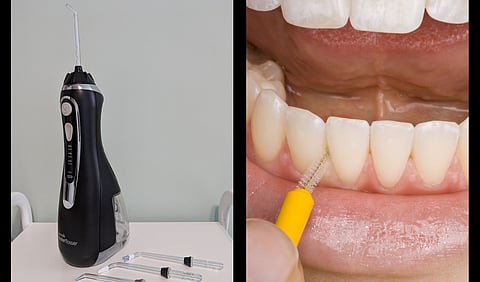
While traditional string floss remains common, alternative tools such as interdental brushes and water flossers have gained attention. However, awareness of these newer methods, remains limited among the general population.
Interdental brushes are small, bristle-based tools designed to physically clean spaces between teeth. They are particularly useful in:
Wider gaps between teeth
Patients with periodontal disease
Areas around dental prosthetics like crown
Water flossers (oral irrigators) use a pulsating stream of water to:
Dislodge plaque and debris
Reduce bacterial load
Clean along the gumline and between teeth
See also: Floss-Based Vaccine: Can Dental Floss Deliver Immunity?
A randomized controlled trial published in the International Journal of Dental Hygiene compared water flossers and interdental brushes in individuals with moderate gingivitis.
Both methods significantly reduced gingival inflammation
However, the water flosser group showed significantly lower bleeding scores after 4 weeks
No difference was observed in gum abrasion between the two methods
This suggests that water flossers may provide improved gingival outcomes in certain populations. 1
Another clinical study comparing the two tools found:
Water flossers were up to 56% more effective in reducing whole-mouth bleeding
Approximately 53% more effective for interdental bleeding reduction2
Additionally, plaque removal studies showed:
Water flossers were more effective across multiple tooth surfaces, including approximal and lingual areas
These findings indicate that water flossers can achieve superior outcomes in both plaque removal and gingival health metrics.3
The difference in effectiveness can be attributed to how each tool works:
Provide mechanical scrubbing
Effective in larger interdental spaces
May not access deeper periodontal pockets
Use pressurized pulsating water streams
Can reach subgingival areas (below gumline)
Help disrupt bacterial biofilms more broadly
This fluid-based mechanism allows water flossers to clean areas that may be difficult to access with rigid tools.
Based on available evidence, water flossers offer:
Better reduction in gingival bleeding
Improved access to hard-to-reach areas
Ease of use for patients with braces or limited dexterity
Reduced risk of improper technique compared to manual tools
Interdental brushes remain useful in specific scenarios:
Effective in wider gaps between teeth
Provide direct mechanical cleaning
Simple and portable without requiring power
However, their effectiveness may depend on correct sizing and technique.
Current evidence suggests that both tools improve oral hygiene when used alongside toothbrushing. However:
Water flossers may provide greater overall improvement in gingival health and bleeding reduction
Interdental brushes may be more suitable for specific anatomical conditions, such as larger interdental spaces
Dental professionals often recommend individualized approaches based on patient needs.
Interdental cleaning remains a critical component of oral hygiene. While both interdental brushes and water flossers are effective, multiple clinical studies indicate that water flossers may offer enhanced benefits in reducing gingival bleeding and improving overall gum health.
References
Mancinelli-Lyle, Deborah, Fridus G. A. Van der Weijden, and Dagmar E. Slot. “Efficacy of a Water Flosser Compared to an Interdental Brush on Gingival Bleeding and Gingival Abrasion: A 4 Week Randomized Controlled Trial.” International Journal of Dental Hygiene 23, no. 1 (2025): 176–185. https://doi.org/10.1111/idh.12817.
Lyle, Deborah M., C. Ram Goyal, Jimmy G. Qaqish, and Reinhard Schuller. “Comparison of Water Flosser and Interdental Brush on Plaque Removal: A Single-Use Pilot Study.” Journal of Clinical Dentistry 27, no. 1 (2016): 23–26. https://pubmed.ncbi.nlm.nih.gov/28390213/
Kumar, et al. “Comparative Evaluation of Interdental Cleaning Aids on Plaque Removal and Gingival Health.” Journal of Pharmaceutical Research International, 2023. https://journaljpri.com/index.php/JPRI/article/view/6490
MSM
