
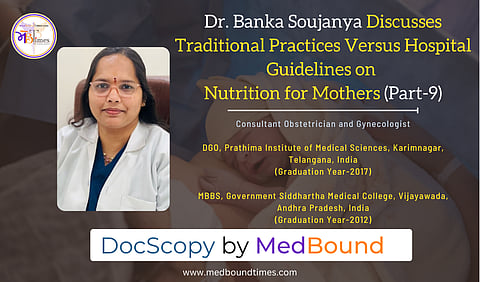
Dr. Banka Soujanya Discusses Traditional Practices Versus Hospital Guidelines on Nutrition for Mothers (Part-9)

Dr. Banka Soujanya is a Consultant Obstetrician and Gynecologist. She completed her MBBS in 2012 from Government Siddhartha Medical College, Vijayawada, Andhra Pradesh, India. Later, she completed her post-graduation in DGO (Diploma in Gynecology and Obstetrics) in 2019 at Prathima Institute of Medical Sciences, Karimnagar, Telangana, India. She holds a Fellowship in Minimal Access Surgery (FMAS) and a Diploma in Minimal Access Surgery (DMAS). She also has a Diploma in ART (Germany, online).
She has a total of 9 years of experience. She is currently working at Reach Hospitals, Bachupally, and Dr. Vivaswan's Indira Clinic, Pragathinagar, Hyderabad, Telangana, India.
Dr. Banka Soujanya specifically deals with obstetrics and high-risk pregnancies, gynecological issues, laparoscopic surgeries, infertility issues, adolescent and menopausal issues, contraceptive advice, family planning, cervical cancer screening, and vaccination.
In this interview with MedBound Times, Dr. Banka Soujanya discusses conflict that exists between hospital dietary guidelines and cultural beliefs
Dr. Tanneru venkata Lakshmi Sahithi: There are many opinions regarding post-C-section nutrition, especially related to consuming spicy foods and restricting water intake to promote healing. In some areas, garlic mixed with spices is recommended. However, hospital dietary guidelines and cultural beliefs often conflict, resulting in about half the people following the medical advice. For instance, some believe that eating dishes with garlic and spice promotes faster healing of sutures. What are your thoughts on these practices?
Dr. Banka Soujanya: Let me come up with the situation that I have faced after C-section. We discharged a patient with proper nutritional counseling to all family members, including husband, wife, the mother, and mother-in-law. We advise and instruct the mother-in-law and mother, because they are the ones who feed the patient for the next couple of days and advise to give fruits, dal, egg, rice, a proper protein food.
Despite all this counseling, the lady has come to the OPD after 11 days of her Cesarean section, and her sutures are completely open. The scar is completely open, and a foul-smelling discharge, red in color. So I asked her personally sending all attenders to go out of the chamber while i was examining dressing. Then she replied that her mother-in-law gave her only tea morning one cup and night, one cup of tea, and garlic and Mirchi powder with some sesame oil and rice.
Then where is the protein for the lady, and she is not allowed to eat any fruits, any dal, any egg? She literally survived with 2 cups of tea, and 2 times little amount of rice with garlic and chili powder, because her mother-in-law's concept is that eating all this will lead to wound infection.
The primary belief behind restricting the diet was the assumption that fruits would cause the baby to get cold or develop a cough such as with citrus or banana which are demonstrating deeply rooted myths. This situation still occurs even in well-educated, professional families.
I keep all the family members and give counseling to the patient, or the husband and wife. They say, ma'am, despite our repeated warnings, my mother-in-law doesn't give me any protein, and they are still stuck with the myth. To my bad luck my family also the same and now my sister got delivered, despite repeated strictly saying to feed with Dal, nice boiled egg, give some chicken they don't feed. I don't know how it should be removed from the society, the myth. So, I started prescribing protein biscuits, tablets, or powders, which will at least help to some extent.
Dr. Tanneru venkata Lakshmi Sahithi: This belief has been handed down for generations, leading many to accept it as fact. What are your thoughts on how these cultural traditions strongly influence these nutrition practices after C-sections, even though modern medical advice may differ?
Dr. Banka Soujanya: Garlic will act as a galactagogue, increasing milk production, but not like spicy things. I advise that whatever curries you are giving to your daughter or daughter-in-law, add 2 or 3 garlic, just chop them, and put them in your curries. Don't give only garlic and Chili powder nicely. You give her garlic, whatever vegetables you give, for example, I prefer mostly like rich gourd, bottle gourd, and beans. These are all fiber-containing foods and some spinach, which will increase the calcium intake, and more of like fluids, buttermilk curd. So whatever curry you are preparing, put, how much garlic you want in that, with no extra spice in that.
Dr. Tanneru venkata Lakshmi Sahithi: In the present scenario, most of the women during that 9 months of pregnancy have complaints of bleeding, and are being subjected to a lot of hormonal injections. Do these hormonal injections have an effect on postpartum depression or psychosis? How much impact does it have on the patient?
Dr. Banka Soujanya: Whatever the injections or the hormonal support that we give to the patient in the 9 months of pregnancy, 50 to 60% happens to be in the first 3 months. The injections that we use are also called natural micronized progesterones, similar to whatever our body produces during these 9 months of pregnancy. Micronized progesterone, the same component will be given externally.
If you have come across the PCODS, polycystic ovarian diseases, this has been on high in resent scenario because of a lack of exercise, lack of physical activity. Everyone is sitting working in front of systems, and no proper control over the food and body shows a condition of PCOD? There are some deficiencies in the hormones, and due to the deficiency of progesterone all they might experience.
These bleeding miscarriages or threatened miscarriages, we call it as so to protect the pregnancy, to continue the pregnancy, we will give these progesterone injections or progesterone tablets, but as such no direct relationship with any of the future baby developmental abnormalities or complications during delivery. Nothing as such.
Dr. Tanneru Venkata Lakshmi Sahithi: Is there a certain time period for postpartum depression for a woman after the delivery? is there any scenario like it prolongs to 2, 3 years? Most people are subjected to hormones and even during a normal menstrual cycle.
Dr. Banka Soujanya: Postpartum depression which can be considered till 1st one year of delivery. It might prolong. But you have to be more aware of this postpartum depression or postpartum blues. In the one year of your delivery period, we will be anticipating. If it is still continuing after one year of your delivery, then she might be having depression prior to the pregnancy or prior to the delivery. There are some trigger factors that might be missed that should be announced.
Stay tuned for Part-10 about some misconceptions, including persistence of backache, as a result of spinal anesthesia during C-section.
