
- Home
- About Us
- Contact Us
- Biography
- MedBound Hub
- InternshipInternship
- Daily Pulse
- Medicine
- Physical Therapy
- InterviewInterview
- Pharmacy
- Biotechnology
- College/InstituteCollege/Institute
- Dentistry
- Blog
- Wellness & Nutrition
- Nursing
- Opinion

Imagine recognizing a loved one’s face but feeling certain that the person standing in front of you is an impostor or a double. This unusual and distressing experience characterizes Capgras syndrome, a rare psychiatric disorder in which individuals believe that a familiar person, often a spouse, parent, or close friend, has been replaced by an identical double.
Capgras syndrome is classified as a delusional misidentification syndrome, a group of psychiatric conditions involving altered perception of identity. Although the affected individual can visually recognize someone, the emotional connection associated with recognition appears disrupted, leading them to conclude that the person is a replacement or impostor. This condition has been reported in association with psychiatric disorders, neurological diseases, and brain injuries.¹
Capgras syndrome, also called Capgras delusion, is characterized by the fixed belief that someone close to the patient has been replaced by an identical impostor. The disorder was first described in 1923 by French psychiatrist Joseph Capgras.
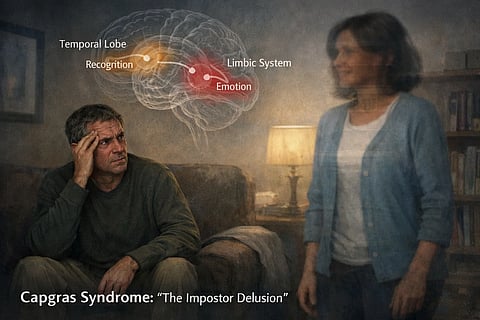
Researchers believe the condition may arise from a disconnect between the facial recognition system in the brain and the emotional response system, particularly involving neural pathways connecting the temporal lobe and limbic system.²
Because of this disruption, patients may recognize a face but lack the emotional familiarity usually associated with that recognition.
The hallmark symptom of Capgras syndrome is delusional misidentification, where the patient believes a familiar person has been replaced.
Persistent belief that a spouse, family member, or friend is an impostor
Suspicion or paranoia toward the perceived “double”
Emotional distress, fear, or anger toward the individual believed to be an impostor
Social withdrawal or avoidance of the misidentified person
In some cases, aggression due to perceived threat
Capgras syndrome may occur alone or alongside other psychiatric or neurological symptoms. It is most frequently associated with conditions such as schizophrenia, dementia, Alzheimer’s disease, Parkinson’s disease, and traumatic brain injury.²
The exact cause of Capgras syndrome is not fully understood, but several factors have been identified.
Brain injuries, neurodegenerative diseases, or structural abnormalities can disrupt the neural pathways involved in facial recognition and emotional processing.
Capgras syndrome is commonly reported in individuals with schizophrenia or other psychotic disorders, where delusions and misinterpretations of reality are common.³
Research suggests the condition may result from impaired integration between:
Visual recognition pathways
Emotional processing centers
When these systems fail to communicate properly, the brain may interpret familiar faces as unfamiliar, leading to the delusion.
Capgras syndrome is diagnosed through clinical psychiatric and neurological evaluation. There is no single diagnostic test.
Doctors typically assess:
Medical history
Psychiatric symptoms
Cognitive function
Brain imaging results when neurological causes are suspected
Brain imaging techniques such as MRI or CT scans may help identify structural or neurological conditions contributing to the disorder.
Treatment focuses on addressing the underlying cause of the delusion.
Common treatments include:
Antipsychotic medications for psychotic disorders
Antidepressants or mood stabilizers when mood disorders are involved
Cognitive-enhancing drugs for dementia-related cases
Supportive therapy and cognitive behavioral approaches may help patients manage distress and improve coping strategies.
In cases linked to neurodegenerative diseases or brain injury, treatment is directed toward managing the primary condition.
The prognosis of Capgras syndrome varies depending on its underlying cause.
Cases associated with psychiatric disorders may improve with medication and therapy.
When linked to neurodegenerative diseases, symptoms may persist or progress alongside the underlying condition.
Early recognition and treatment may improve outcomes and reduce distress for both patients and caregivers.
Because the delusion often involves close family members, the condition can significantly affect relationships and caregiving dynamics.
Although rare, Capgras syndrome provides insight into how the brain integrates recognition, emotion, and perception of identity. Studying this disorder has helped researchers better understand the neurological mechanisms behind familiarity and emotional attachment.
In clinical practice, awareness of Capgras syndrome can help healthcare professionals identify unusual delusional patterns and guide appropriate psychiatric or neurological evaluation.
References
Capgras Syndrome UK. Capgras Syndrome. Accessed March 2026. https://syndrome.co.uk/capgras-syndrome.
StatPearls Publishing. 2023. Capgras Syndrome. National Center for Biotechnology Information. https://www.ncbi.nlm.nih.gov/books/NBK570557/.
Ellison-Wright, I., and D. Bullmore. 2021. “Capgras Syndrome: A Systematic Review.” Psychiatry Research. https://pubmed.ncbi.nlm.nih.gov/34033319/.
Ranjan, A., et al. 2023. “Characteristics, Treatment and Outcomes of Capgras Syndrome: A Systematic Review of Case Reports and Case Series.” ResearchGate. https://www.researchgate.net/publication/369325812.
