- Home
- About Us
- Contact Us
- Biography
- Column
- MedBound Hub
- InternshipInternship
- Daily Pulse
- Medicine
- Physical Therapy
- InterviewInterview
- Pharmacy
- Biotechnology
- College/InstituteCollege/Institute
- Dentistry
- Blog
- Wellness & Nutrition
- Nursing
- Opinion

Cupping therapy is a traditional healing practice that involves placing cups on the skin to create suction. It has roots in ancient Chinese, Middle Eastern, and Egyptian medicine.
Cupping therapy gained renewed global visibility during the 2016 Rio Olympics when American swimmer Michael Phelps appeared with multiple, purple-colored circular bruises on his shoulders and back, drawing widespread media attention. In India, the therapy has also been promoted by several professional cricketers, contributing to its increased popularity, particularly during the Indian Premier League (IPL) season when athletes appeared across social and mainstream media platforms with the circular marks.
According to WebMD, cupping is primarily used for pain relief and musculoskeletal conditions, 1though it is also promoted for other health concerns. Scientific studies indexed on ScienceDirect have explored its physiological effects and clinical applications.
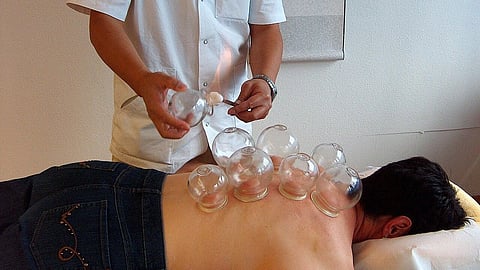
Cupping involves placing glass, silicone, or plastic cups on the skin. A vacuum is created either by heat (fire cupping) or mechanical suction. The negative pressure draws the skin and superficial muscle layer upward into the cup.
There are two main types:
Dry cupping – Suction is applied without making cuts on the skin.
Wet cupping (Hijama) – Small superficial incisions are made before suction to draw out a small amount of blood.
Sessions typically last 5–15 minutes. Circular marks often remain on the skin temporarily due to capillary rupture and localized blood pooling.
Several mechanisms have been proposed in medical literature:
The suction increases blood flow to the treated area. This may enhance oxygen delivery and nutrient exchange.
Some studies suggest cupping may influence inflammatory mediators and oxidative stress markers.
Cupping may stimulate sensory nerves, activating pain-gating mechanisms in the spinal cord. This can reduce pain perception.
By lifting soft tissue, cupping may reduce muscle tightness and fascial restriction.
Limited research suggests possible effects on immune markers, though evidence remains preliminary.
Despite these theories, researchers note that more high-quality randomized controlled trials are needed to confirm definitive mechanisms.
Cupping therapy has been studied or traditionally used for:
Chronic back and neck pain
Knee osteoarthritis
Headaches and migraines
Fibromyalgia
Musculoskeletal injuries
Herpes zoster (shingles) pain
Acne and certain skin conditions
Respiratory conditions such as asthma
The strongest evidence currently supports its use for certain types of musculoskeletal pain, particularly chronic low back pain and neck pain. For many other conditions, evidence remains limited or mixed.
See also: Safe & Lasting Spine Pain Relief: Your Complete Guide
Some clinical trials have reported:
Short-term reduction in pain intensity
Improved functional mobility in osteoarthritis
Temporary muscle relaxation
Subjective improvement in well-being 4
However, systematic reviews emphasize that many studies have small sample sizes and methodological limitations.
Commenting on the scientific validity of cupping therapy on Instagram, hepatologist Dr. Cyriac Abby Philips, popularly known as “The Liver Doctor,” has described many of its commonly cited principles as biologically implausible.
He notes that claims about “removing toxins” or “extracting dirty blood” are not supported by human physiology. In a healthy individual, blood does not stagnate in isolated areas of the body; it is continuously circulated by the heart. Detoxification, he emphasizes, is performed by the liver and kidneys, which function around the clock to filter metabolic waste. According to him, the dark marks seen after cupping are simply bruises, capillary injury (ecchymosis) similar to hickey, rather than evidence of toxin removal. Similarly, he states that traditional concepts such as “energy meridians” lack anatomical basis in modern medicine.
He explains that the darker color of the blood is because, it is deoxygenated venous blood. And the darker bruise does not mean , more toxins; but more suction was applied or the area has got more blood supply. He questions how skin suction can cure internal diseases like asthma, infertility etc, according to the claims.
Dr. Philips also highlights safety concerns, particularly with wet cupping, which involves skin incisions and blood exposure.
If not performed with strict medical sterilization standards, the procedure may carry risks of bacterial infection, abscess formation, and transmission of bloodborne infections such as hepatitis B, hepatitis C, or HIV. Fire cupping may result in burns, while excessive suction can cause tissue damage or scarring.
He further cautions that repeated bloodletting may contribute to iron-deficiency anemia in susceptible individuals. While some individuals report temporary pain relief, he suggests that this may be explained by placebo responses or counter-irritation mechanisms rather than systemic healing effects. He emphasizes that reliance on cupping for serious illnesses could delay evidence-based medical care.
Individuals who should avoid cupping include:
People with bleeding disorders
Patients on anticoagulant therapy
Individuals with severe anemia
Pregnant women (certain body areas)
Medical consultation is recommended before undergoing treatment, particularly for people with chronic health conditions.
Research published in journals indexed on ScienceDirect indicates that while cupping may provide short-term symptom relief for some conditions, evidence quality varies. Many studies call for larger, well-designed clinical trials.
Major medical organizations do not currently recommend cupping as a first-line treatment for chronic disease, but it is sometimes used as a complementary therapy alongside conventional medicine. Healthcare providers emphasize that cupping should not replace evidence-based treatments for serious medical conditions but may be used adjunctively in certain cases.
References
Cao, Huiling, Xiaorui Han, Baoqiang Li, and F. Lorenzo Cohen. “Clinical Research Evidence of Cupping Therapy in China: A Systematic Literature Review.” Journal of Traditional and Complementary Medicine 8, no. 2 (2018): 282–97. https://www.sciencedirect.com/science/article/pii/S2225411018300191#sec3.
WebMD. “Cupping Therapy: Uses, Benefits, and Risks.” WebMD. Accessed February 2026. https://www.webmd.com/balance/cupping-therapy.
Harvard Health Publishing. “What Exactly Is Cupping?” Harvard Health Blog, September 30, 2016. https://www.health.harvard.edu/blog/what-exactly-is-cupping-2016093010402.
Mohamed, Ahmed A., Xinyu Zhang, and Yih-Kuen Jan. “Evidence-Based and Adverse-Effects Analyses of Cupping Therapy in Musculoskeletal and Sports Rehabilitation: A Systematic and Evidence-Based Review.” Journal of Back and Musculoskeletal Rehabilitation 36, no. 1 (2023): 3–19. https://doi.org/10.3233/BMR-210242.
MSM