
- Home
- About Us
- Contact Us
- Biography
- MedBound Hub
- InternshipInternship
- Daily Pulse
- Medicine
- Physical Therapy
- InterviewInterview
- Pharmacy
- Biotechnology
- College/InstituteCollege/Institute
- Dentistry
- Blog
- Wellness & Nutrition
- Nursing
- Opinion

Prolonged sitting has become an unavoidable part of modern life. Whether working at a computer, attending online classes, or studying for examinations, many people spend hours seated each day. While the effects of sitting on the spine and neck are widely discussed, the role of the feet is often ignored. However, the position of the feet can influence the alignment of the entire body, affecting the hips, pelvis, lower back, muscles, nerves, and even blood circulation.
While footrests are commonly marketed as tools for comfort, their benefits extend beyond convenience. Recent ergonomic and biomechanical research suggests that footrests may help reduce lower-limb discomfort and promote movement during prolonged sitting and standing.1,2
Understanding the anatomy behind footrests reveals why supporting your feet may be more important than you think.
The human body is designed for movement, yet modern work often requires individuals to remain seated for several hours each day. During prolonged sitting, the hips remain flexed, the knees stay bent, and muscle activity in the lower limbs decreases.
The problem becomes more evident when the workstation is not tailored to the user's anthropometric measurements. Many shorter individuals elevate their chairs to reach the correct desk height, which can leave their feet unsupported for extended periods.
This position can contribute to:
Increased pressure beneath the thighs
Altered pelvic alignment
Reduced lower-limb muscle activity
Venous pooling in the legs
Leg fatigue and discomfort
Research has shown that footrests help improve lower-limb positioning and create a more favorable sitting posture by supporting the feet and reducing pressure on the underside of the thighs.1
The position of the feet directly influences the alignment of the entire lower limb.3
An ergonomic footrest helps maintain:
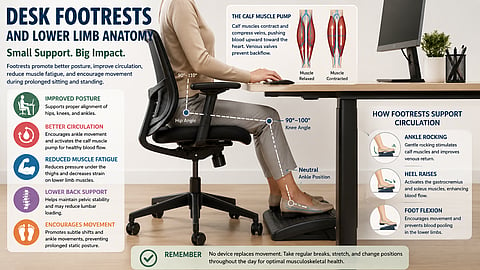
Hip flexion between approximately 90° and 110°
Knee flexion between approximately 90° and 100°
Neutral ankle positioning
When the feet are fully supported, body weight is distributed more evenly throughout the lower extremities. This reduces unnecessary strain on the hip joints, knee joints, and surrounding muscles.
Beyond supporting the ankle, a footrest also supports the anatomical structures of the foot itself. The medial longitudinal arch acts as the primary weight-bearing arch during standing and sitting with the feet on a surface, while the plantar fascia helps maintain arch integrity by resisting excessive flattening. Proper foot support allows body weight to be distributed more evenly across the heel and forefoot rather than concentrating pressure on a limited area. Stable positioning of the subtalar joint and activation of the intrinsic foot muscles also contribute to maintaining balance and foot posture when the feet remain in contact with a supportive surface.⁴
One of the most fascinating anatomical systems affected by foot support is the calf muscle pump.
The gastrocnemius and soleus muscles do more than move the ankle. They play a crucial role in returning blood from the lower limbs to the heart. During walking or ankle movement, these muscles compress deep veins within the calf and propel blood upward while venous valves prevent backward flow.3
Because of this function, the calf muscles are often referred to as the body's "second heart."
When people sit for extended periods without movement:
Calf muscle activity decreases
Venous return slows
Blood tends to pool in the lower limbs
Leg heaviness and swelling may occur
Footrests that encourage subtle ankle movements may help activate the calf muscle pump and support venous circulation throughout the day.3
Research on lower-limb venous hemodynamics has shown that movement of the ankle and calf muscles plays a major role in promoting blood flow back toward the heart.3 This explains why even small movements performed while seated can be beneficial.
By encouraging changes in foot position and periodic ankle motion, footrests may help reduce venous stasis and improve comfort during prolonged desk work.
However, footrests should not be considered a substitute for walking or exercise. Regular movement remains essential for maintaining healthy circulation.
When the feet do not reach the floor comfortably, a significant portion of body weight is transferred to the underside of the thighs.
This increased pressure can affect nearby structures, including:
Popliteal blood vessels
Tibial nerve
Surrounding soft tissues
Over time, individuals may experience:
Tingling sensations
Numbness
Leg fatigue
General discomfort
Supporting the feet allows weight to be distributed more evenly and may reduce pressure on these structures.5
Several studies have demonstrated that footrests used with standing workstations can modify pelvic mechanics, decrease lumbar spinal loading, and lessen fatigue of the back extensor muscles.2 They also encourage periodic shifts in body weight, reducing the tendency to remain in a static position.
However, not all investigations have reported similar benefits. According to a study4, changes in posture achieved through footrest use did not consistently translate into lower levels of back discomfort.
This suggests that workplace discomfort is influenced by factors beyond posture alone, with movement variability likely playing a key role.
Although desk footrests are most commonly associated with seated workstations, they are also widely used with standing desks to encourage alternating leg positions and periodic weight shifting.²
A footrest may be particularly useful for:
Office workers
Remote employees
Students
Healthcare professionals performing desk-based tasks
Individuals with shorter stature
People who experience leg fatigue during prolonged sitting
Individuals using standing desks may also benefit from a footrest that allows periodic elevation of one foot and encourages weight shifting.
Footrests are often viewed as simple ergonomic accessories, but their effects extend into multiple anatomical systems.
By supporting the feet, footrests influence:
Hip, knee, and ankle alignment
Pelvic positioning
Lumbar loading
Muscle activity
Venous circulation
Current evidence suggests that the greatest benefit of a footrest may not be the creation of a perfect posture. Instead, footrests appear to encourage movement, activate the calf muscle pump, improve lower-limb support, and reduce prolonged static loading of muscles and joints.
For individuals who spend hours sitting or standing at work, proper foot support may be a small adjustment with meaningful anatomical benefits.
1. Cregg, Andrew C., Jack P. Callaghan, and colleagues. 2021. “A Biomechanical Evaluation of Different Footrest Heights During Standing Computer Work.” Ergonomics 64 (3): 342–353. https://doi.org/10.1080/00140139.2020.1832261
2. Son, Jae-Ik, Chung-Hwi Yi, Oh-Yun Kwon, Heon-Seock Cynn, One-Bin Lim, Yunjeong Baek, and Ye-Ji Jung. 2018. “Effects of Footrest Heights on Muscle Fatigue, Kinematics, and Kinetics During Prolonged Standing Work.” Journal of Back and Musculoskeletal Rehabilitation 31 (2): 353–360. https://doi.org/10.3233/BMR-170798.
3. Recek, Cestmir. 2013. “Calf Pump Activity Influencing Venous Hemodynamics in the Lower Extremity.” International Journal of Angiology 22 (1): 23–30. https://doi.org/10.1055/s-0033-1334092.
4. Lee, Jeremy, Richelle Baker, Pieter Coenen, and Leon Straker. 2018. “Use of a Footrest to Reduce Low Back Discomfort Development Due to Prolonged Standing.” Applied Ergonomics 67: 218–224. https://doi.org/10.1016/j.apergo.2017.09.009.
