Sex, relationships, intimacy, and changing bodies often bring up questions many people hesitate to ask aloud. From anxiety after unprotected sex to concerns about sexual performance and intimacy after menopause, these experiences are far more common than most people realize.
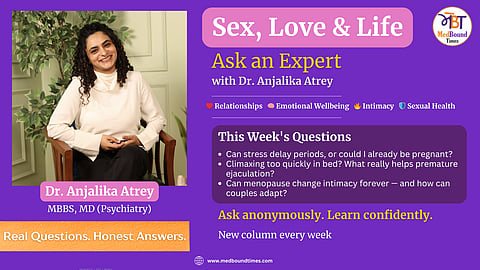
In this edition of Sex, Love & Life – Ask an Expert, Dr. Anjalika Atrey, psychiatrist, sexologist, and therapist, answers three honest questions sent in anonymously by readers, offering science-backed guidance with empathy, clarity, and zero judgment.
Have a question of your own? You can submit it anonymously here:
Your identity will remain confidential. Questions may be edited for clarity, length, grammar, and privacy before publication. This column is intended for educational purposes and does not replace personal medical consultation.
CuriousSoul21 asks:
I am a 21-year-old woman. My boyfriend and I got carried away during a private moment, and we had intercourse without using any protection. It happened only once, but now my period is nearly a week late. I have been extremely anxious ever since, and I don’t know whether stress itself can delay menstruation or if I should be worried about pregnancy. When is the right time to take a pregnancy test, and how reliable would it be this early?
Stress can sometimes influence the hormones that regulate your menstrual cycle, and in some women, intense anxiety alone can delay periods.
However, since there has been unprotected intercourse, pregnancy should also be ruled out rather than assumed or feared.
A home pregnancy test is usually most reliable when taken about one week after a missed period, ideally using the first morning urine sample, when pregnancy hormone levels are typically more concentrated.
If the result is negative but your period still does not arrive within a few days, repeat the test or consult a gynecologist for further evaluation.
Try not to let fear drive you toward endless internet searches. Accurate testing will give you far more clarity than anxious assumptions.
NewlyMarried28 asks:
I am a 28-year-old man, married for eight months. Whenever my wife and I have intercourse, I climax almost immediately, sometimes within half a minute of penetration. She tries to be understanding, but I can sense her disappointment, and it is beginning to affect my confidence. Are there medicines, sprays, or creams that can help delay ejaculation, or should I be looking at some other kind of treatment?
What you are describing is known as premature ejaculation, and it is one of the most common sexual concerns men experience. It is also highly treatable, so there is no reason to feel embarrassed or defeated.
Many men assume medication is the first or only answer, but treatment often begins with understanding the bigger picture. Performance anxiety, anticipation, relationship pressure, unrealistic expectations, and even early conditioning can all contribute.
The most important step is not to self-medicate. Consult a qualified sexologist who can help identify what is driving the issue and create a treatment plan tailored to you.
Sexual confidence is built, not inherited.
MidlifeConnection asks:
I’m 48, and after menopause, my interest in sex has dropped sharply. My husband thinks I no longer find him attractive. How do couples like us deal with intimacy changes during this stage?
Menopause brings hormonal, physical, and emotional changes, and a drop in sexual desire is very common during this stage of life.
Lower estrogen levels may cause vaginal dryness, changes in arousal, disturbed sleep, mood fluctuations, and reduced energy, all of which can affect intimacy. This does not mean love or attraction has disappeared. It often means intimacy needs to evolve.
Open conversations, emotional closeness, affection, patience, healthy lifestyle changes, and medical support when needed can help couples reconnect. Intimacy does not end with menopause. For many couples, it becomes deeper, slower, and more emotionally meaningful.
This is your space to ask, share, and learn. Write to Sex, Love & Life – Ask an Expert with your questions on sex, intimacy, relationships, marriage, emotional wellbeing, or sexual health. Selected questions will be answered in upcoming editions of this column on MedBound Times.