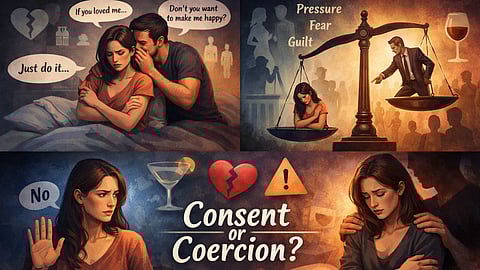
Talks about sex today are more open than ever, yet consent remains one of the most misunderstood concepts in modern relationships.
While sexual violence is often framed through acts of physical force, public health research recognizes that sexual coercion, emotional pressure, manipulation, and situations involving impaired decision-making are important and commonly reported forms of consent violation alongside physical force.¹ ²
Consent is freely given, enthusiastic, specific, continuous, and reversible. But in real life, consent can get blurred by:
Emotional pressure
Imbalance of power
Alcohol
Fear of losing the partner
Social expectations
Emotional pressure can subtly push someone into agreeing, especially when they feel responsible for their partner’s happiness or fear disappointing them.
Power imbalances — whether due to age, status, authority, financial dependence, or even personality dominance — can make it difficult for a person to assert their own boundaries.
Alcohol or substance use further blurs judgment and communication, reducing a person’s ability to evaluate risks or express discomfort.
Many individuals also fear losing their partner, damaging the relationship, or being judged as “cold” or “unloving,” which leads them to suppress their true feelings.
On top of this, social expectations and cultural norms often normalise compliance, especially for women, making it even harder to say “no.” In these circumstances, a person may verbally say “yes” while internally feeling unsure, pressured, or conflicted.
Such an agreement is not informed consent — it is shaped by coercion, fear, or expectation rather than genuine willingness.
Public-health studies reveal a rising trend: situational coercion — where a partner gives in due to:
Repeated persuasion
Threats of breakup
Emotional blackmail (“If you loved me, you would…”)
Fear of relationship instability
Unlike overt violence, this form of coercion may be less visible but can contribute to long-term psychological distress, anxiety, depression, and trauma-related symptoms. ¹
Women report higher levels of emotional coercion.¹
Men often experience pressure to “perform” even when uncomfortable.
LGBTQ+ youth frequently face consent confusion due to a lack of inclusive sex education.
Indian households rarely discuss sexual boundaries. According to India’s National Family Health Survey (NFHS-5), 29 percent of ever-married women aged 18 to 49 reported experiencing spousal violence, highlighting the widespread presence of coercive or non-consensual dynamics within intimate relationships.³
As a result:
Young adults confuse affection with obligation.
Adolescents fear saying “no.”
Married women often don’t realise marital rape is a violation.
With NFHS-5 data showing that a significant proportion of women report spousal violence but do not seek help, reflecting limited awareness, stigma, and normalization of coercive behavior in some settings.³
Alcohol does not erase boundaries, but it significantly impairs cognitive capacity, judgment, and the ability to communicate voluntary decisions.
Medical and legal frameworks recognize that individuals who are unconscious or severely intoxicated cannot provide valid consent, as intoxication may impair their ability to understand, evaluate, or voluntarily agree to sexual activity.²
School- and college-based consent education
Workshops on emotional coercion
Legal reforms
Normalising conversations about “boundary-checks” in relationships
Mental-health support for survivors
Consent must evolve from a legal phrase to a daily relational practice built on respect, clarity, and communication. Only then can societies reduce the silent epidemic of coercion that hides behind closed doors.
References
Basile, Kathleen C., Sharon G. Smith, Matthew J. Breiding, Michele C. Black, and Reshma Mahendra. “Sexual Violence Surveillance: Uniform Definitions and Recommended Data Elements.” American Journal of Public Health 111, no. 4 (2021): 729–736. https://doi.org/10.2105/AJPH.2020.306145
World Health Organization. “Violence Against Women: Key Facts.” World Health Organization. Updated March 2021. https://www.who.int/news-room/fact-sheets/detail/violence-against-women
International Institute for Population Sciences (IIPS) and ICF. National Family Health Survey (NFHS-5), 2019–21: India Fact Sheet. Mumbai: IIPS, 2021. https://dhsprogram.com/pubs/pdf/FR375/FR375.pdf