
- Home
- About Us
- Contact Us
- Biography
- MedBound Hub
- InternshipInternship
- Daily Pulse
- Medicine
- Physical Therapy
- InterviewInterview
- Pharmacy
- Biotechnology
- College/InstituteCollege/Institute
- Dentistry
- Blog
- Wellness & Nutrition
- Nursing
- Opinion

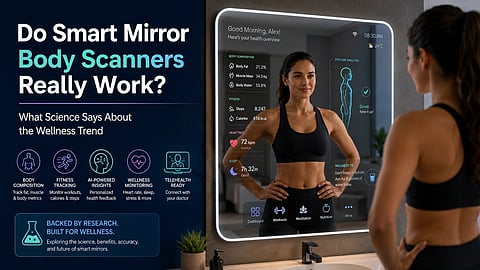
Imagine standing in front of your bathroom mirror and receiving updates about your posture, fitness progress, stress levels, sleep patterns, or even potential health concerns before you start your day.
What once sounded like science fiction is quickly becoming reality through smart mirrors. These connected devices combine traditional mirrors with cameras, sensors, artificial intelligence (AI), and health-monitoring technologies to create personalized wellness experiences.
As smart homes become more common and consumers increasingly prioritize preventive healthcare, smart mirrors are finding a place in bedrooms, gyms, clinics, and wellness centers. Supporters claim they can help users monitor health metrics, improve fitness routines, and encourage healthier habits.
A smart mirror is an interactive mirror equipped with digital displays, sensors, cameras, and computing technology. Unlike a conventional mirror, it can display real-time information while simultaneously collecting and analyzing data about the user.
Depending on the model, smart mirrors can provide the following:
Body composition tracking
Fitness coaching
Skin health analysis
Posture assessments
Sleep and wellness insights
Health reminders
Telehealth connectivity
Personalized health recommendations
Many modern smart mirrors also synchronize with wearable devices and fitness apps, allowing users to view health metrics such as heart rate, calorie expenditure, and activity levels directly on the mirror.
Smart mirrors use a combination of technologies to gather and interpret information.
These systems may include:
High-resolution cameras capture images and videos of the user. Computer vision algorithms analyze body shape, movement patterns, posture, facial features, and other visible characteristics.
AI processes the collected data and compares it with established health parameters. The system can then generate personalized recommendations related to fitness, wellness, or lifestyle habits.
Some advanced smart mirrors incorporate additional sensors capable of measuring physiological signals or integrating information from external devices. These sensors may track metrics such as weight, body composition, temperature, or cardiovascular indicators.
Many smart mirrors connect to smartphones, smartwatches, fitness trackers, and telemedicine platforms, creating a centralized dashboard for personal health information.
While smart mirrors are increasingly marketed as wellness tools, researchers have spent years exploring their potential in healthcare.
One of the most frequently cited academic papers is "Reflecting Health: Smart Mirrors for Personalized Medicine", published in 2019 by researchers including Riccardo Miotto. The paper examined how smart mirrors could serve as health-monitoring platforms capable of supporting personalized medicine and preventive healthcare.
According to the researchers, smart mirrors could eventually monitor:
Facial characteristics linked to health conditions
Behavioral patterns
Physical activity
Medication adherence
General wellness indicators
The authors suggested that smart mirrors may become valuable tools for early detection, remote monitoring, and patient engagement, particularly when combined with AI-driven analysis. However, they also emphasized the need for rigorous validation, privacy protections, and clinical testing before widespread healthcare adoption.
Researchers have also explored smart mirrors specifically as health-monitoring devices.
In the study "Smart Health Monitoring System Using IoT-Based Smart Fitness Mirror", published in the journal TELKOMNIKA in 2020, researchers developed a smart fitness mirror designed to help users track health and fitness status daily. The system incorporated sensors to calculate body mass index (BMI), body weight, height, and body fat measurements.
The goal was not merely to display information but to encourage users to engage with their health data consistently. Researchers concluded that smart mirrors could offer a practical platform for routine health monitoring within the home environment.
This is where the conversation becomes more nuanced.
Most consumer smart mirrors are wellness devices rather than medical devices. While they can provide useful trends and estimates, they typically cannot replace clinical diagnostic equipment or professional medical assessments.
Researchers behind the personalized medicine smart mirror study acknowledged that future smart mirrors may support health monitoring, but emphasized that clinical validation remains essential. Many proposed applications are still being researched and refined.
In other words, smart mirrors can often identify patterns and changes over time, but users should be cautious about treating them as definitive diagnostic tools.
For now, they function best as wellness companions rather than replacements for healthcare professionals.
The latest generation of smart mirrors is expanding beyond physical health.
According to industry reports, some smart mirrors now use facial recognition and AI-powered analysis to identify signs of fatigue, stress, or mood changes. They can then offer wellness suggestions such as mindfulness exercises, meditation guidance, or sleep improvement recommendations.
Although these features remain relatively new, they reflect a broader trend toward integrating mental wellness into everyday consumer technology.
For users who already track sleep, exercise, and nutrition, smart mirrors offer a single interface that brings multiple wellness metrics together.
Current smart mirrors can successfully track certain wellness metrics, integrate data from wearables, provide fitness feedback, and encourage healthier daily habits. Research suggests they hold considerable promise for personalized health monitoring and preventive care.
However, the technology is still evolving. Most consumer devices should be viewed as wellness tools rather than medical-grade diagnostic systems.
References:
1. Miotto, Riccardo, Matteo Danieletto, Jerome R. Scelza, Brian A. Kidd, and Joel T. Dudley. “Reflecting Health: Smart Mirrors for Personalized Medicine.” npj Digital Medicine 1, no. 1 (2018): 62.
https://pmc.ncbi.nlm.nih.gov/articles/PMC6550276/
2. Coherent Market Insights. “How Smart Mirrors Are Revolutionizing Healthcare and Wellness.” Coherent Market Insights Blog, October 4, 2024. Accessed June 2, 2026.
https://www.coherentmarketinsights.com/blog/how-smart-mirrors-are-revolutionizing-healthcare-and-wellness-1303
3. Muneer, Amgad, Suliman Mohamed Fati, and Saddam Fuddah. “Smart Health Monitoring System Using IoT Based Smart Fitness Mirror.” TELKOMNIKA (Telecommunication, Computing, Electronics and Control) 18, no. 1 (2020): 317–331.
