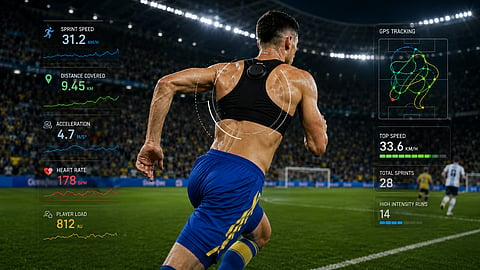
Millions of viewers watching the 2026 FIFA World Cup have noticed footballers wearing black crop-top-like garments beneath their jerseys, leading many to wonder whether the players are wearing sports bras. In reality, these garments are Global Positioning System (GPS) tracking vests that help coaches, sports scientists, physiotherapists, and team doctors monitor player performance, training load, recovery, and injury risk using wearable technology.
These garments are not sports bras. They are GPS tracking vests that hold a small GPS tracking device used to collect real-time data on an athlete's physical performance. The information helps coaches, sports scientists, physiotherapists, and team doctors make evidence-based decisions about training, recovery, and injury prevention.
Because the compression vest resembles a crop top, many fans informally refer to it as a "sports bra." Unlike traditional sports bras, however, the garment does not provide chest support. Its sole purpose is to securely hold the GPS tracking device in the correct position for accurate performance monitoring.
The garments are lightweight compression vests designed to securely hold a small Global Positioning System (GPS) tracker between the player's shoulder blades. This position provides a stable location for the device, allowing it to record movement accurately while minimizing interference caused by excessive motion during play.
Thomas Borchert, an account executive at Sports Performance Tracking, told The Post,
Because the vests are tight and cropped, many viewers think male athletes are wearing sports bras for chest support. The crop-top design is purely functional. It keeps the GPS pod securely anchored between the shoulder blades. This is the optimal anatomical position for satellite signal reception, minimal body movement interference and player safety during collisions.
Thomas Borchert, Account Executive, Sports Performance Tracking
Professional football clubs and national teams commonly use wearable tracking systems developed by companies such as Sports Performance Tracking, Catapult and STATSports. The devices have become a standard component of athlete monitoring in elite football.
Modern GPS tracking vests combine multiple sensors to measure an athlete's movement throughout training sessions and matches. The GPS receiver communicates with satellites to determine the player's position, distance covered, and speed on the field. Alongside GPS, most elite athlete monitoring systems also include inertial sensors such as accelerometers, gyroscopes, and magnetometers, collectively known as an Inertial Measurement Unit (IMU). These sensors detect rapid accelerations, decelerations, changes in direction, impacts, and body orientation, allowing sports scientists to analyze movements that GPS alone cannot accurately capture.¹ ³
Some wearable systems can also integrate heart rate monitoring when paired with compatible chest straps or physiological sensors. Combining movement data with heart rate and workload measurements gives coaches and medical staff a more complete picture of an athlete's physical demands, recovery status, and readiness to train or compete.¹ ³
GPS tracking technology enables support staff to measure these physical demands objectively rather than relying only on visual assessment.3
The wearable devices record several performance indicators, including:
Total distance covered
Sprint distance and maximum speed
Acceleration and deceleration
Number of high-intensity runs
Overall workload during training and competition
Player movement patterns
Indicators of physical fatigue
The collected data allow coaching and medical teams to understand how much physical stress each player experiences during training sessions and matches. By comparing workloads across different sessions and positions, staff can individualize training plans, monitor fatigue, and reduce the likelihood of overtraining.
According to Revolution Soccer, Federico Pizzuto, director of sports performance said,
We use the data to individualize their training load. It’s an external measure of the load that they are doing on the field and on an average level to know how the team is doing and what the average data is of the team. We also go positionally, and individually with each player.
Federico Pizzuto, Director, Sports Performance
The data also help medical and performance staff identify when an athlete may require additional recovery or a reduced training load. Rather than treating every player the same, teams can tailor training according to each individual's physical demands and match workload.
They can know based on the loads if a guy is more tired, if a body part is more affected than others, it allows them to individualize their treatments and recovery in the training room.
Federico Pizzuto, Director, Sports Performance
One of the primary medical uses of GPS tracking is workload monitoring. Sudden increases or decreases in training load may influence an athlete's risk of injury. By monitoring these changes, sports medicine teams can adjust training programs to better match each player's physical condition.3
The data are also valuable during rehabilitation. For example, when a footballer is recovering from a muscle injury, clinicians can compare the athlete's current sprint speed, running distance, and workload with pre-injury performance. If the player has not returned to baseline levels, the medical team may recommend additional rehabilitation before allowing full participation in competition.
Objective GPS data complement clinical assessment and the athlete's own perception of recovery. This helps sports medicine teams make more informed return-to-play decisions by comparing current performance metrics with the player's historical baseline rather than relying solely on subjective feedback.³
An athlete might ‘feel’ 100% ready to return, but GPS data reveals they are only reaching 80% of their maximum pre-injury sprint speed or favoring one leg during high-speed decels. Keeping them in rehab until their high-speed metrics match baseline data prevents immediate re-injury.
Thomas Borchert, Account Executive, Sports Performance Tracking
Wearable monitoring technology has therefore become an important tool for supporting return-to-play decisions following injury.
The GPS tracker is placed between the shoulder blades because this location provides one of the most stable positions on the body during movement. While the arms and legs move independently during running, sprinting, and turning, the upper back follows the motion of the torso more consistently. This stable position allows the device to capture whole-body movement with greater precision during training and matches.¹
The area is also located close to the body's center of mass, allowing the tracking system to better represent the athlete's overall movement rather than the motion of a single limb. This improves the accuracy of measurements such as speed, acceleration, deceleration, and changes in direction.¹
In addition, the upper back is less likely to receive direct impacts during tackles or collisions than locations such as the wrist or waist. Positioning the device between the shoulder blades also minimizes interference with normal arm and leg movement while helping protect both the athlete and the equipment during play.²
Yes. FIFA permits the use of Electronic Performance and Tracking Systems (EPTS) in matches and training, provided the systems comply with the organization's quality and safety requirements. EPTS include wearable technologies such as GPS tracking vests, optical tracking systems, and other performance-monitoring devices used by elite football teams.⁴
According to FIFA's Football Technology & Innovation programme, approved EPTS devices must satisfy standards for safety, durability, reliability, and data quality before they can be used in official competitions. During matches, the GPS tracking device is typically worn inside a lightweight compression vest beneath the player's jersey, allowing performance data to be collected without interfering with play.⁴
GPS performance monitoring is now widely used by professional football clubs and national teams around the world. Advances in sports science have made wearable technology an important component of modern athlete management, helping teams monitor workload, support recovery, and reduce injury risk through objective performance data.
The increased visibility of these tracking vests during the 2026 FIFA World Cup has introduced many fans to a technology that has been part of elite football for several years.
Are football players wearing sports bras?
No. The black garments worn by footballers are GPS tracking vests, not sports bras. Although they resemble crop tops, they do not provide chest support. Their purpose is to securely hold a GPS tracking device that records player movement, workload, speed, and other performance metrics.² ⁴
Do GPS vests work during matches?
Yes. FIFA permits the use of Electronic Performance and Tracking Systems (EPTS), including wearable GPS tracking devices, provided they comply with FIFA's safety and quality requirements. Elite football clubs and national teams routinely use these systems during training and, where permitted under competition regulations, during matches.⁴
Can GPS tracking prevent injuries?
GPS tracking cannot directly prevent injuries. However, it helps coaches, sports scientists, physiotherapists, and team doctors monitor training load, fatigue, and recovery. This information supports evidence-based decisions that may reduce injury risk and improve return-to-play planning.³
Who uses the GPS data?
The data are used by coaches, sports scientists, strength and conditioning staff, physiotherapists, performance analysts, and team doctors to evaluate player workload, individualize training, monitor rehabilitation, and guide return-to-play decisions.³
1. Linke, Daniel, and Martin Lames. “Impact of Sensor/Reference Position on Player Tracking Variables: Center of Scapulae vs Center of Pelvis.” Journal of Biomechanics 83 (2019): 319–323. https://doi.org/10.1016/j.jbiomech.2018.11.046.
2. Catapult One. n.d. “Why Do Football Players Wear GPS Vests?” Accessed July 16, 2026. https://one.catapultsports.com/blog/why-do-soccer-players-wear-gps-vests/
3. Lutz, Julia, Daniel Memmert, Daniel Raabe, Ralf Dornberger, and Lars Donath. “Wearables for Integrative Performance and Tactic Analyses: Opportunities, Challenges, and Future Directions.” International Journal of Environmental Research and Public Health 17, no. 1 (2019): 59. https://doi.org/10.3390/ijerph17010059.
4. FIFA. "Electronic Performance and Tracking Systems (EPTS)." FIFA Football Technology & Innovation Programme. Accessed July 2026. https://football-technology.fifa.com/innovation/standards/epts/epts-1/
5. FIFA Quality Programme for Electronic Performance and Tracking Systems (EPTS). FIFA. Accessed July 2026. https://inside.fifa.com/innovation/standards/epts/fifa-quality-programme-for-epts
(Rh/SS/MSM)