Why Some People Are Choosing to Embrace Gray Hair Instead of Dyeing It: What Psychology Says

More people are choosing natural gray hair over regular coloring. Learn how psychology explains this trend while separating scientific evidence from common misconceptions.
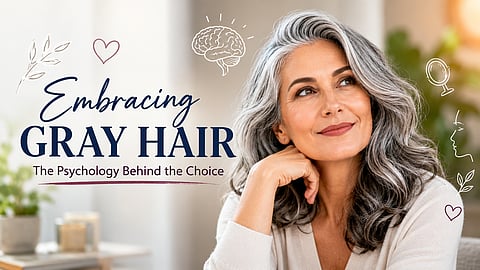
White woman with natural white hair wondering
Does embracing gray hair reflect authenticity? Explore what psychology and scientific research actually say about the decision.
Published on
Updated on

Key Takeaways

  • Psychology suggests that embracing gray hair may reflect changing priorities and personal values.

  • Research does not link natural gray hair to greater confidence or emotional maturity.

  • Social expectations and appearance anxiety can influence the decision to dye gray hair.

  • Gray hair develops naturally as melanin production declines with age.

  • Psychologists and researchers say choosing whether to dye gray hair is a personal choice, not a psychological trait.

For decades, covering gray hair has been a common cosmetic practice, often influenced by cultural expectations that associate youth with attractiveness and vitality. Coloring gray hair has become part of routine grooming for millions of people seeking a younger appearance or attempting to meet societal expectations.

Recent reports in popular media, however, suggest that more people are choosing to stop coloring their gray hair. Rather than viewing this decision as "giving up," psychologists say it may reflect changing priorities, greater acceptance of aging, and a desire to make appearance-related choices based on personal values instead of external expectations.

While several psychological theories may help explain this trend, researchers caution that no single study has demonstrated that people who embrace gray hair are inherently more authentic, emotionally mature, or self-confident. Instead, current evidence suggests that decisions about hair color are influenced by a combination of identity, social expectations, cultural norms, personal preference, and practical considerations.

Why Priorities Change With Age

According to reports published by TOI and 10BM News, many adults decide to stop coloring their hair after years or even decades of maintaining regular coloring routines.

Psychologists note that as people grow older, their priorities often shift. Rather than focusing primarily on how others perceive their appearance, many begin placing greater value on meaningful relationships, life experiences, emotional well-being, and activities they personally find rewarding.

One theory that may help explain this shift is Socioemotional Selectivity Theory (SST), developed by psychologist Laura Carstensen. The theory proposes that as people perceive time as increasingly limited with age, they tend to prioritize emotionally meaningful goals and relationships over pursuits focused on gaining approval or achieving long-term status. Although the theory does not specifically address gray hair, it provides a framework for understanding why some older adults may place less importance on maintaining a youthful appearance and more importance on choices that reflect their own values.

Several psychological theories of aging therefore suggest that people may become more selective about where they invest their time and energy. As these priorities change, some individuals decide that continuing to color their hair no longer provides sufficient personal value.

Many people interviewed in media reports also describe an unexpected feeling of relief after discontinuing hair dye. They no longer need frequent salon appointments or routine touch-ups to conceal new gray growth. Psychologists describe this as a shift away from maintaining an appearance to satisfy perceived social expectations toward making choices that better reflect personal preferences. Although these observations are based on individual experiences rather than controlled research, they are consistent with theories emphasizing autonomy and self-directed decision-making.

Authenticity and the Choice to Embrace Gray Hair

One psychological concept frequently discussed in relation to gray hair is authenticity, which refers to living in a manner that is consistent with one's values, beliefs, and sense of identity.

A 2008 study published in the Journal of Counseling Psychology introduced the Authenticity Scale, which measures three dimensions of authenticity: authentic living, self-alienation, and acceptance of external influence. The researchers found that individuals reporting higher levels of authentic living also reported better self-esteem and greater psychological well-being.

Importantly, the study did not investigate hair color, aging, or cosmetic decisions. Therefore, it cannot be used to conclude that people who stop coloring their gray hair are more authentic than those who continue to dye it.

Another theory discussed in media reports is self-congruity theory, proposed by psychologist Morris Sirgy. The theory suggests that people generally experience greater satisfaction when their outward appearance aligns with how they perceive themselves. Applied to gray hair, this framework suggests that individuals who view aging as a natural part of life may feel more comfortable allowing their natural hair color to show.

However, researchers have not specifically tested self-congruity theory in relation to gray hair, and current evidence does not establish that embracing gray hair itself improves psychological well-being.

Instead, psychologists emphasize that authenticity lies in making appearance-related decisions that genuinely reflect an individual's own preferences, whether that involves coloring gray hair or allowing it to remain natural.

See also: Behind the Beard - Science on Microbes, Skin & Facial Hair Care

How Social Expectations Shape Gray Hair Decisions

an modern Indian man and an modern Indian Woman with natural grey hair
Gray hair in men is frequently described using terms such as "distinguished" or "salt-and-pepper," whereas women may be questioned about why they have stopped coloring their hair or whether they are neglecting their appearance.

Appearance-related decisions rarely occur in isolation. They are often shaped by social norms, cultural expectations, and comparisons with other people.

One explanation comes from Social Comparison Theory, proposed by psychologist Leon Festinger in 1954. The theory suggests that people naturally compare themselves with others to evaluate their appearance, achievements, and social standing. Because youth has long been associated with attractiveness, health, and success in many societies, visible gray hair may trigger concerns about aging or social judgment.

These social comparisons can influence whether individuals continue coloring their hair or decide to let it turn gray naturally.

Women often experience greater pressure than men to conceal visible signs of aging.

Gray hair in men is frequently described using terms such as "distinguished" or "salt-and-pepper," whereas women may be questioned about why they have stopped coloring their hair or whether they are neglecting their appearance. Although these expectations vary across cultures and individuals, researchers have long recognized that appearance-related social norms affect how people evaluate themselves.

How Social Appearance Anxiety May Influence Gray Hair Decisions

Another psychological concept relevant to this discussion is social appearance anxiety, which refers to anxiety about being negatively evaluated because of one's overall physical appearance.

Researchers Trevor A. Hart and colleagues developed the Social Appearance Anxiety Scale (SAAS) to measure these concerns. Their study, conducted among three large samples of university students, found that the scale demonstrated high internal consistency, strong test-retest reliability, and good validity. Higher scores on the SAAS were associated with greater social anxiety, body image dissatisfaction, feelings of unattractiveness, and beliefs that one's appearance is socially unacceptable. The findings suggest that fear of appearance-based evaluation is closely linked to broader social anxiety and negative body image.

The researchers emphasized that the scale measures concerns about one's overall appearance rather than anxiety about specific features such as hair, nose shape, or body weight. Consequently, the study does not demonstrate that gray hair itself causes appearance anxiety, but it does suggest that people who worry more about how others judge their appearance may experience greater concern about visible signs of aging.

Similarly, individuals who feel less dependent on external approval may be more comfortable allowing natural gray hair to grow.

Why Hair Turns Gray: The Science Behind Gray Hair

Hair turns gray primarily because pigment-producing cells known as melanocytes gradually lose their ability to produce melanin, the pigment responsible for hair color. As melanin production declines, newly growing hair gradually loses its natural color and appears gray, silver, or white.

Research indicates that genetics is the strongest predictor of when hair begins to gray. However, oxidative stress, smoking, certain nutritional deficiencies, autoimmune disorders, thyroid disease, and some rare genetic conditions have also been associated with premature hair graying.

Oxidative stress occurs when the production of reactive oxygen species exceeds the body's antioxidant defenses. Over time, this imbalance may damage melanocytes and reduce their ability to produce melanin, contributing to the graying process.

Premature graying is generally defined as graying before the age of 20 years in White individuals, before 25 years in Asian individuals, and before 30 years in African populations, although these research definitions may vary among individuals. 8

Premature graying can occasionally occur alongside deficiencies of vitamin B12, iron, copper, or folate, although these associations are not present in every individual. Most gray hair, however, represents a normal part of the aging process rather than an underlying medical condition.

Seek medical evaluation if gray hair develops unusually early or is accompanied by other symptoms that may suggest an underlying health disorder.

Gray Hair Does Not Reflect Personality

Although recent media reports have linked natural gray hair with authenticity and emotional growth, current scientific evidence does not support the conclusion that choosing to stop coloring gray hair reflects a particular personality type or level of psychological well-being.

Psychologists emphasize that appearance-related choices are influenced by multiple factors, including personal identity, cultural expectations, financial considerations, convenience, lifestyle, professional requirements, and individual preferences. For some people, coloring gray hair remains an enjoyable form of self-expression, while others prefer their natural appearance. Neither choice is inherently healthier or psychologically superior.

The available research instead suggests that well-being is more closely associated with making appearance-related decisions that align with an individual's own values and preferences rather than decisions driven primarily by perceived external pressure.

See also: Can a Single Hair Strand Lead to Amputation of Baby’s Toe?

Gray Hair, Aging, and Changing Beauty Standards

The growing visibility of natural gray hair also reflects broader conversations about aging and beauty standards.

For many years, visible signs of aging, particularly among women, were often viewed negatively in popular culture. As a result, many individuals routinely colored their hair to maintain a younger appearance.

More recently, public discussions around aging have shifted toward greater acceptance of natural appearance. This cultural change has encouraged some people to reconsider long-standing beauty routines and decide whether they still align with their personal preferences.

Psychologists note that these changing attitudes do not necessarily represent rejection of beauty standards. Rather, they may reflect greater flexibility in how people define attractiveness and self-care throughout adulthood.

Choosing Whether to Dye Gray Hair Is a Personal Decision

Psychologists emphasize that choosing whether or not to dye gray hair is ultimately a personal decision.

Some individuals continue coloring their hair because they enjoy the appearance or see it as a form of self-expression, while others prefer their natural hair because it better reflects their identity or reduces the time and expense associated with regular coloring.

Current psychological evidence does not support the conclusion that either choice reflects greater emotional maturity, authenticity, or psychological health. Rather, research suggests that well-being is more closely associated with making appearance-related decisions that align with an individual's own values than with meeting external expectations.

References:

  1. Carstensen, Laura L., Derek M. Isaacowitz, and Susan T. Charles. "Taking Time Seriously: A Theory of Socioemotional Selectivity." American Psychologist 54, no. 3 (1999): 165-181. https://doi.org/10.1037/0003-066X.54.3.165.

  2. Festinger, Leon. "A Theory of Social Comparison Processes." Human Relations 7, no. 2 (1954): 117-140. https://doi.org/10.1177/001872675400700202.

  3. Wood, Alex M., P. Alex Linley, John Maltby, Michael Baliousis, and Stephen Joseph. "The Authentic Personality: A Theoretical and Empirical Conceptualization and the Development of the Authenticity Scale." Journal of Counseling Psychology 55, no. 3 (2008): 385-399. https://doi.org/10.1037/0022-0167.55.3.385.

  4. Hart, Trevor A., David B. Flora, Sarah A. Palyo, David M. Fresco, Christian Holle, and Richard G. Heimberg. "Development and Examination of the Social Appearance Anxiety Scale." Assessment 15, no. 1 (2008): 48-59. https://doi.org/10.1177/1073191107306673.

  5. Sirgy, M. Joseph. Self-Congruity: Toward a Theory of Personality and Cybernetics. New York: Praeger, 1986.

  6. Trüeb, Ralph M. "Oxidative Stress in Ageing of Hair." International Journal of Trichology 1, no. 1 (2009): 6-14. https://pubmed.ncbi.nlm.nih.gov/18258731/.

  7. Tobin, Desmond J. "Aging of the Hair Follicle Pigmentation System." International Journal of Trichology 1, no. 2 (2009): 83-93. https://pubmed.ncbi.nlm.nih.gov/20927229/.

  8. Daulatabad, Deepika, Aastha Singal, Chander Grover, and Nidhi Chhillar. "Premature Graying of Hair: A Concise Review." International Journal of Trichology 11, no. 4 (2019): 146-151. https://pmc.ncbi.nlm.nih.gov/articles/PMC6721903/.

(Rh/MSM)

White woman with natural white hair wondering
How Grey Hair may be a Sign of the Body’s Cancer Defenses
logo
Medbound Times
www.medboundtimes.com