Why Scratching Bug Bites Can Make Itching Worse: Study Reveals How the Immune System Responds

Researchers found that scratching itchy skin activates nerve and immune cells, increasing inflammation while also strengthening the body's defense against certain bacteria
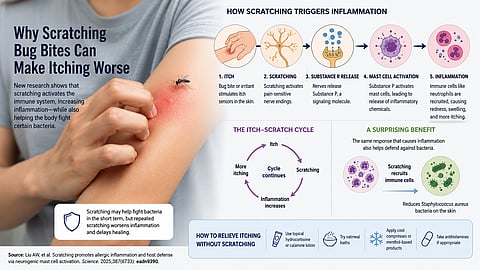
New research shows that scratching bug bites activates nerve cells and immune cells, increasing skin inflammation while also strengthening the skin's antibacterial defenses.
New research shows that scratching bug bites activates nerve cells and immune cells, increasing skin inflammation while also strengthening the skin's antibacterial defenses.AI Image
Published on
Updated on

Scratching an itchy bug bite may feel satisfying, but new research suggests it also activates immune pathways that increase skin inflammation. Researchers found that the same response may also help the body fight certain bacteria.

The findings were published in the peer-reviewed journal Science by researchers from the University of Pittsburgh.1

Why Humans Continue to Scratch Itchy Skin

Itching caused by insect bites, allergic reactions, or skin conditions such as eczema often leads to scratching. Although healthcare professionals have long advised against scratching because it damages the skin and worsens irritation, researchers wanted to understand why this behavior has persisted throughout evolution.

To answer this question, the research team conducted experiments in mouse models to examine how scratching affects the nervous and immune systems.1

How Scratching Activates Nerve Cells, Immune Cells, and Inflammation

Dr. Daniel Kaplan, a dermatologist at the University of Pittsburgh, and his research team investigated how the immune system responds to a common itchy skin condition known as allergic contact dermatitis, which can be triggered by substances such as poison ivy or nickel found in jewelry.

To study the process, the researchers applied an irritant to the ears of mice. The mice scratched the affected area, leading to an influx of inflammatory immune cells and increased swelling. In contrast, genetically modified mice with impaired itch-sensing nerve cells developed much milder inflammation.

To determine whether scratching itself was responsible for the difference, the team fitted normal mice with protective collars that prevented them from scratching while allowing the itch sensation to remain. These mice also showed reduced swelling and fewer inflammatory immune cells, demonstrating that scratching directly contributed to the inflammatory response.

Why Scratching Feels Good Before the Itching Gets Worse

The study also explains why scratching often feels satisfying despite making the condition worse.

According to the researchers, scratching activates pain pathways in the nervous system. These pain signals temporarily suppress itch signals, producing short-term relief. However, because scratching simultaneously triggers inflammation, the itch often returns, encouraging repeated scratching.

In an interview with the New York Post, Dr. Daniel Kaplan said the findings support what many people commonly experience, that scratching an itchy bite can prolong irritation instead of relieving it. He explained that, for most individuals, the itching from a mosquito bite usually subsides within a few minutes if left alone. However, scratching the affected area can intensify the inflammatory response, making the bite itchier and causing symptoms to persist for several days.

How Scratching May Strengthen the Skin's Antibacterial Defenses

One proposed explanation for the evolutionary purpose of scratching is that it helps remove external parasites such as fleas and mites.

However, Dr. Daniel Kaplan and his team also considered previous research showing that mast cells can protect the skin against Staphylococcus aureus, a bacterium commonly associated with skin infections.

To investigate this possibility, the researchers exposed mice to the bacteria and repeated the experiment using protective collars that prevented scratching. Mice allowed to scratch had lower levels of Staphylococcus aureus on their skin than those that could not, suggesting that the inflammatory response triggered by scratching, or other substances released by activated mast cells, may strengthen the skin's antibacterial defenses.

How the Findings Could Lead to New Treatments for Chronic Itching

The researchers identified the interaction between Substance P, a nerve-signaling molecule released during pain and itching, and mast cells as a key neuroimmune pathway responsible for itch-related inflammation. They suggested that therapies targeting this pathway could help reduce chronic itching while preserving normal immune function.

Because the experiments were conducted primarily in mice, additional studies are required to determine whether the same mechanisms occur in humans.

What the Findings Mean for the Itch-Scratch Cycle

Although the study found that scratching may enhance the skin's defense against certain bacteria, the researchers emphasized that this should not be interpreted as a reason to scratch bug bites or itchy rashes. Repeated scratching can prolong inflammation, damage the skin barrier, and increase the risk of skin injury.

Common measures used to relieve itching include topical hydrocortisone cream, calamine lotion, oatmeal baths, cooling products containing menthol, and antihistamines when clinically appropriate.

While scratching may briefly suppress itch signals and even strengthen certain antibacterial defenses, the researchers say its overall effect is to amplify inflammation, reinforcing long-standing medical advice to avoid scratching itchy bites whenever possible.

References

1. Liu, Andrew W., et al. 2025. “Scratching Promotes Allergic Inflammation and Host Defense via Neurogenic Mast Cell Activation.” Science 387 (6733): eadn9390. https://doi.org/10.1126/science.adn9390.

2. National Institute of Allergy and Infectious Diseases. “Mast Cells.” https://www.niaid.nih.gov/research/mast-cells

New research shows that scratching bug bites activates nerve cells and immune cells, increasing skin inflammation while also strengthening the skin's antibacterial defenses.
How Peach Fuzz Could Hold Clues to Develop New Treatments for Chronic Itch
logo
Medbound Times
www.medboundtimes.com