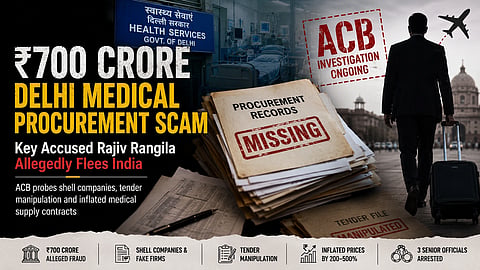
The investigation into the alleged ₹700 crore Delhi medical procurement scam has taken a significant turn after pharmaceutical trader Rajiv Rangila, one of the key accused, allegedly fled India shortly after June 30 while the Delhi Anti-Corruption Branch (ACB) was investigating his role in the case.
According to The Indian Express, ACB officials have conducted multiple searches across Delhi-NCR and Uttarakhand after Rangila failed to respond to repeated summons issued in connection with the investigation. Authorities reportedly found his residence in East Delhi's Laxmi Nagar locked and are now examining his travel records and financial transactions. Officials are also considering issuing a Look Out Circular (LOC) to prevent his re-entry without scrutiny.
The case centres on alleged irregularities in the procurement of medicines, vaccines, surgical supplies, and medical equipment for Delhi government hospitals through the Central Procurement Agency (CPA).
Investigators describe Rajiv Rangila as a pharmaceutical trader and supplier who has reportedly been involved in supplying medicines and medical equipment in Delhi and Uttarakhand for over a decade.
The FIR names him as a central figure in the alleged procurement fraud. According to investigators, he created multiple shell companies using fictitious or proxy owners and used them to participate in government tenders.
The complaint further alleges that Rangila worked with medical equipment manufacturers to predetermine supply prices before tenders were awarded and arranged cash kickbacks linked to procurement contracts.
Authorities claim that companies allegedly operated by Rangila include:
F Med Devices
Technocrats
Raj Shree
Ashi Surgical and Pharmaceuticals
M Sahib and Sons Pvt. Ltd.
Investigators allege these firms appeared to have different registered owners, while Rangila remained their actual operator.
According to the ACB investigation, the alleged fraud relied on manipulating tender conditions rather than open competition.
Officials claim that tender specifications were deliberately drafted to favour selected companies while preventing genuine bidders from meeting eligibility requirements. Investigators further allege that these restrictive specifications were prepared in collaboration with manufacturers before being routed through procurement officials for approval.
The complaint also states that members of tender committees were allegedly pressured to approve these customised eligibility criteria.
Investigators further allege that fake companies were inserted into procurement records, making it difficult to trace the actual beneficiaries and obscuring the money trail.
The ACB alleges that several medical products were purchased at prices ranging from 200% to 500% above prevailing market rates, causing substantial losses to the public exchequer.
The procurement reportedly covered a wide range of healthcare supplies, including:
Medicines
Vaccines
Surgical items
Portable X-ray machines
Anaesthesia workstations
Oral Rehydration Solution (ORS)
C-arm radiological equipment
Other medical devices used in government hospitals
Investigators believe the combination of inflated pricing, manipulated tenders, shell companies, and alleged kickbacks enabled the diversion of hundreds of crores of public healthcare funds
The investigation has already resulted in the arrest of three senior officials linked to the procurement process.
Those arrested include:
Dr. Vatsala Aggarwal, former Director General of Health Services (DGHS)
Dr. Vinod Kumar Ranga, former Head of Office, Central Procurement Agency
Neeraj Chopra, former Deputy Controller of Accounts, CPA
Dr. Vinod Kumar Ranga, former Head of the Central Procurement Agency (CPA), was arrested on June 18, followed by former DGHS chief Dr. Vatsala Aggarwal and former CPA Deputy Controller of Accounts Neeraj Chopra on June 27. All three remain in judicial custody.
Investigators believe Rangila left India shortly after obtaining anticipatory bail on June 30, 2026, in an unrelated criminal case registered at Laxmi Nagar Police Station.
That case involved allegations of wrongful confinement, assault, criminal intimidation, and extortion under the Bharatiya Nyaya Sanhita (BNS). Police have clarified that the criminal case is not connected to the medical procurement investigation.
However, investigators suspect he left the country within days of receiving bail, prompting concerns that he may be attempting to evade questioning in the procurement scam.
The ACB has informed the court that investigators have been unable to recover several key procurement records linked to the alleged scam.
According to the agency, many foundational files related to the procurement process are missing, while only physical payment orders remain available.
Officials have also alleged that several tenders already awarded and fully paid continue to appear on the Government e-Marketplace (GeM) portal as "active," "under process," or at the financial bid evaluation stage.
Investigators believe this may have concealed information about successful bidders and procurement prices from competing firms and the public.
The agency has also alleged that while payments to several long-standing medicine suppliers remained pending for nearly two years, payments linked to tenders allegedly involving Rangila were processed within one or two days. These claims form part of the ongoing investigation and have yet to be tested in court.
The Anti-Corruption Branch continues to search for Rajiv Rangila while examining his financial records, travel history, and possible associates.
Officials are also questioning family members and pursuing additional leads as they attempt to locate him.
(Rh/ARC/MSM)