Pakistan Probes Alleged Human Placenta Smuggling Network Linked to Anti-Ageing Injections

Investigators examined alleged placenta collection from hospitals, illegal processing sites in Islamabad, and cross-border shipments to Vietnam.
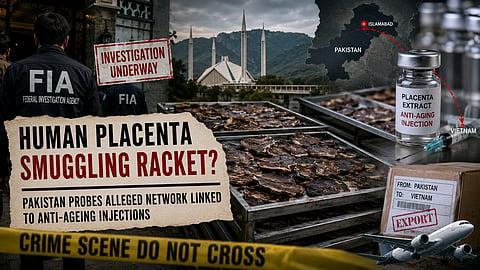
A poster with dried placenta, placenta in medicine bottle
The officials recovered around 500 kilograms of material believed to be human placenta during a raid on an illegal processing facility in Islamabad in the week preceding its report.AI Image
Published on
Updated on

Pakistani authorities are investigating an alleged international network accused of obtaining human placentas from hospitals, processing the biological material at illegal facilities in Islamabad, and exporting it for use in expensive anti-ageing injections. According to investigators, some of the processed material was allegedly exported to Vietnam under the label "She Placenta."

The Federal Investigation Agency (FIA) investigation has reportedly led to the arrest of five suspects, including three Chinese nationals. Authorities are also examining possible links involving hospitals, waste management companies, immigration officials, and operations extending beyond Pakistan’s capital.

According to The Express Tribune, as cited by India Today, the FIA uncovered an alleged placenta processing operation at a residence in Islamabad’s upscale F-7/1 sector after surveillance linked the property to the suspected trade.

The five arrested suspects were identified as Chinese nationals Li Gangcai, Wang Bao, and Peng Fei Gua, and Pakistani nationals Waqas and Qasim Hanif.

FIA Raid Uncovers Alleged Processing Facility in Islamabad

The investigation came into focus after authorities targeted a suspected processing operation in F-7/1, Islamabad.

According to The Express Tribune, as cited by India Today, the FIA raided the property after conducting surveillance and allegedly found a functioning setup used to process placental material. Investigators reportedly recovered machinery, raw biological material, and finished products from the site.

The material was allegedly cleaned, dried, and prepared for export.

During the operation, another Chinese national identified only as Li reportedly arrived at the property and said he knew one of the arrested suspects, according to Arab News, as cited by India Today.

Investigators later searched another property in Islamabad’s E-11 sector, where they reportedly found a similar setup containing refrigerators and biological materials. Two additional Pakistani nationals were detained for questioning. Authorities said both locations contained equipment used for storing, drying, and processing the biological material before it was allegedly prepared for export.

The authorities registered a case under Pakistan’s Human Organ and Tissue Transplantation Act, 2010.

The investigation is ongoing, and authorities have not publicly announced formal charges or convictions against the suspects.

An illustration of a baby and placenta.
Investigators also questioned the suspects about the origin of the biological material.www.kaboompics.com/Pexels

Network Allegedly Bought 200 Kg of Placenta Every Month

The suspected scale of the operation may have extended far beyond a single processing site.

According to BBC Urdu, the FIA accused the alleged network of buying approximately 200 kilograms, or 440 pounds, of placenta every month from different hospitals. Investigators said the group dried and processed the material before shipping it abroad.

The officials recovered around 500 kilograms of material believed to be human placenta during a raid on an illegal processing facility in Islamabad in the week preceding its report.

Photographs shared by the FIA showed trays of dried material arranged on trolley carts inside a house that authorities said had been converted into a facility for storing and processing placenta.

In a separate development, FIA officials intercepted a 100-kilogram shipment of human body tissue at Islamabad airport on Wednesday, which was allegedly bound for Vietnam. Investigators are examining whether the shipment formed part of the same suspected trafficking network.

Placentas Allegedly Bought for 800 Pakistani Rupees Each

Investigators believe the alleged procurement chain reached hospitals in both Islamabad and neighbouring Rawalpindi.

Hina Kanwal, an officer at Pakistan’s Human Organ Transplant Authority, told BBC Urdu that the suspects allegedly bought placentas from hospitals in Islamabad and Rawalpindi for about 800 Pakistani rupees per piece.

The FIA said the material was intended for anti-ageing injections that could cost as much as 700,000 Pakistani rupees each.

The alleged purchase price of each placenta and the reported value of the final anti-ageing injection differed substantially, according to investigators.

While placental tissue can legally be donated for approved medical research or used in regulated tissue-based products with informed consent, it is generally treated as biomedical waste requiring safe disposal because it may carry infectious material when not handled through approved pathways. 1-3

Although placental extracts are marketed in some cosmetic and wellness products, current clinical evidence supporting their anti-ageing benefits remains limited. 4,5

Suspects Initially Claimed They Were Handling Sheep Placenta

Investigators also questioned the suspects about the origin of the biological material.

According to BBC Urdu, the five suspects initially claimed that they were handling sheep placenta. Officials said the suspects later stated during further interrogation that the material was human placenta.

The investigation remains ongoing. Reports have described recovered material as suspected or alleged human placenta in several instances, and authorities continue to examine its source, processing, movement, and intended use.

FIA Investigates Possible Links to Hospitals and Other Cities

Pakistani investigators suspect the alleged operation may extend beyond Islamabad.

According to BBC Urdu, the FIA believes the network’s activities could reach other major cities, including Lahore, Peshawar, and Rawalpindi. Investigators are also examining possible complicity involving immigration officers, waste management companies, and hospitals.

An FIA official told BBC Urdu that the agency had previously taken action against illegal human organ transplantation but described this as its first case involving an alleged organised international network dealing in human placenta.

People found guilty of harvesting human organs for commercial purposes in Pakistan can face up to 10 years in prison and a fine of up to 1 million Pakistani rupees.

Reference:

  1. World Health Organization. Safe Management of Wastes from Health-Care Activities. 2nd ed. Geneva: World Health Organization, 2014. https://iris.who.int/handle/10665/85349.

  2. U.S. Food and Drug Administration. Human Cells, Tissues, and Cellular and Tissue-Based Products (HCT/Ps). https://www.fda.gov/vaccines-blood-biologics/tissue-tissue-products

  3. Pogozhykh, O., et al. "Placenta and Placental Derivatives in Regenerative Therapies." Stem Cells International (2018): Article ID 4837930. https://doi.org/10.1155/2018/4837930

  4. Szendzielorz, E., et al. "Placental Extracts, Proteins, and Hydrolyzed Placenta in Cosmetics and Regenerative Medicine." Applied Sciences 14, no. 22 (2024): 10301. https://doi.org/10.3390/app142210301

  5. Chia, W. K., et al. "A Review of Placenta and Umbilical Cord-Derived Stem Cells and the Immunomodulatory Basis of Their Therapeutic Potential." Frontiers in Pediatrics 9 (2021): 615508. https://doi.org/10.3389/fped.2021.615508

(Rh/ARC/MSM)

A poster with dried placenta, placenta in medicine bottle
Polish Doctor Charged After 34 Human Fetuses Found Buried on Former Property Amid Ongoing Investigation
logo
Medbound Times
www.medboundtimes.com