
- Home
- About Us
- Contact Us
- Biography
- Column
- MedBound Hub
- InternshipInternship
- Daily Pulse
- Medicine
- Physical Therapy
- InterviewInterview
- Pharmacy
- Biotechnology
- College/InstituteCollege/Institute
- Dentistry
- Blog
- Wellness & Nutrition
- Nursing
- Opinion

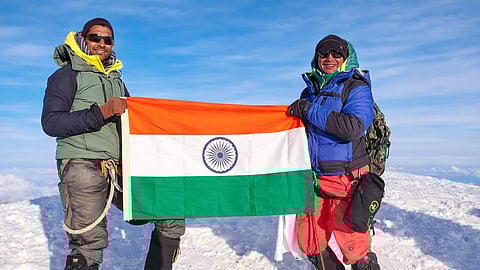
A surgical professor and a chief medical officer from Ahmedabad have achieved a rare global milestone, successfully climbing the Seven Summits, the highest mountain peaks on all seven continents, while maintaining demanding professional medical careers.
On December 15, 2025, Dr. Hemant Leuva and Dr. Surabhi Leuva completed this formidable mountaineering challenge, setting an inspirational example for both the medical and climbing communities.
Dr. Hemant Leuva serves as a Professor of Surgery at NHL Municipal Medical College in Ahmedabad, while his partner, Dr. Surabhi Leuva, works as the Chief Medical Officer at Gujarat Vidyapith.
Dr. Hemant Leuva, began his climbing journey nearly ten years ago. Balancing an intensive surgical career, he strategically planned expeditions around official leave, academic breaks, and holidays. Speaking about his motivation, Dr. Leuva has noted that he views time and financial independence as resources that will peak only after retirement, and until then, he aims to explore the world’s highest peaks while his physical endurance allows.
The couple’s most demanding ascent came in April this year, when they successfully summited Mount Everest after an earlier attempt had to be abandoned due to adverse weather conditions.
In preparation for the second attempt, they climbed Mount Labuche, rising to nearly 20,000 feet, as part of a structured acclimatization and endurance-building phase. Their broader mountaineering portfolio includes successful ascents of Mount Stok Kangri and Mount Deo Tibba in India, Mount Kilimanjaro in Tanzania, and Island Peak in Nepal, reflecting a steady progression toward high-altitude technical climbs.
Their journey was further shaped by personal adversity, having battled Covid-19 twice during the pandemic; despite this, both doctors recovered fully and continued providing medical services, an experience that strengthened their resolve to pursue mountaineering with renewed focus. In 2011, they formalized their passion by founding a mountaineering collective, 'Mountain Movers' primarily comprising doctors and healthcare professionals, which has since grown to nearly 500 members from Gujarat and functions as a platform for organizing expeditions and sharing technical knowledge.
He has also spoken candidly about the financial realities of high-altitude climbing, noting that a single expedition can cost upwards of ₹30 lakh, including permit fees, logistical resources, and agency support.
The Seven Summits represent one of the most iconic challenges in mountaineering: climbing the highest peak on each of the seven continents. Depending on the specific list followed by climbers, the peaks generally include:
Asia: Mount Everest (8,848 m)
South America: Aconcagua (6,962 m)
North America: Denali (6,190 m)
Africa: Kilimanjaro (5,895 m)
Europe: Mount Elbrus (5,642 m)
Antarctica: Mount Vinson (4,892 m)
Oceania: Either Puncak Jaya (Carstensz Pyramid, 4,884 m) or Mount Kosciuszko (2,228 m), depending on geographical definitions.
The list combines extreme altitude, varied climate zones, and diverse terrain into a single overarching mountaineering objective that few individuals worldwide achieve.
Climbing the Seven Summits presents significant physiological and environmental challenges. Lower oxygen levels at high altitudes demand effective acclimatization and carry the risk of altitude sickness, which can cause symptoms ranging from headache and nausea to life-threatening pulmonary or cerebral edema. Extreme cold, unpredictable weather, and steep technical sections on certain peaks further contribute to the complexity of each ascent.
Summiting these peaks typically requires months of physical training, logistical planning, acquisition of specialized gear (such as crampons, ropes, and insulated clothing), and experienced guides or support teams. Success hinges on sustained cardio-respiratory fitness, strength endurance, and the ability to make critical decisions in harsh environments.
Other Indian mountaineers have also contributed to the Seven Summits legacy, including those outside the medical profession. Notable figures such as Colonel Ranveer Singh Jamwal and twin climbers Tashi and Nungshi Malik have also achieved all Seven Summits, each adding unique narratives to this global mountaineering community.
References
Mountain IQ. “The Seven Summits: The Ultimate Mountaineering Challenge.” Mountain IQ, accessed December 2025. https://www.mountainiq.com/guides/seven-summits/
Zuzanna Perlicka, Tomasz Antczak, Gajda-Bathelt,Monika Dąbek. “Rock Climbing as a Health-Promoting Activity: Benefits and Risks Across Populations.” ResearchGate. Accessed [date]. https://www.researchgate.net/publication/393693350_ROCK_CLIMBING_AS_A_HEALTH-PROMOTING_ACTIVITY_BENEFITS_AND_RISKS_ACROSS_POPULATIONS.
