Why Anatomy-Focused Startups Are Gaining Traction in India

How immersive technologies and emerging startups are reshaping anatomy education and bridging critical gaps in India’s medical training ecosystem
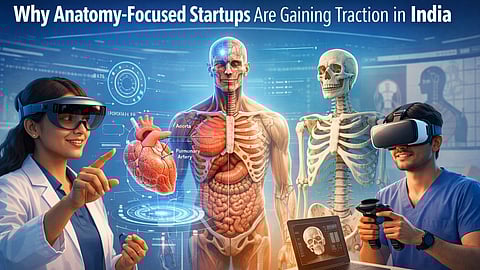
Indian medical students using augmented and virtual reality technology to study 3D human anatomy models in a modern classroom setting, illustrating the rise of anatomy-focused startups in India.
Augmented reality and 3D visualization technologies are transforming anatomy education by enabling interactive, immersive exploration of the human body
Published on
Updated on

India’s health-tech ecosystem is witnessing the emergence of a niche yet rapidly growing segment that places human anatomy at the core of innovation.

Once considered a static and foundational subject taught primarily through cadaveric dissection and atlases, anatomy is now being reshaped by immersive technologies such as augmented reality (AR), 3D visualization, and simulation-based learning tools.

This shift is not merely technological. It reflects deeper educational challenges and evolving learner expectations that have created fertile ground for anatomy-focused startups.

The Persistent Gaps in Traditional Anatomy Education

Anatomy has historically relied on cadavers, physical models, and textbook illustrations. While these methods remain essential, they are limited by restricted accessibility, high operational costs, and variability in learning experiences. More importantly, students often struggle to develop three-dimensional spatial understanding from two-dimensional representations, which is crucial for clinical reasoning.1

With increasing student intake and compressed curricula, there is a growing need for efficient, scalable, and engaging teaching methods that go beyond traditional approaches.

The Rise of AR and 3D Technologies in Anatomy Learning

Emerging technologies such as AR allow the superimposition of digital anatomical structures onto the real world, enabling learners to interact with both simultaneously. This creates a hybrid learning environment that enhances visualization and engagement.1

Evidence from systematic reviews suggests that:

  • AR can reduce cognitive load and improve learner motivation

  • It enables interactive exploration of anatomical structures

  • It enhances the overall learning experience, particularly for complex spatial relationships

However, current meta-analyses indicate that improvements in examination performance are not consistently significant, largely due to heterogeneity in study designs and limited high-quality trials.1

Similarly, broader reviews highlight that while AR is highly engaging, its measurable impact on learning outcomes remains inconclusive, emphasizing its role as a complementary rather than replacement tool.2

Evidence from Systematic Reviews and Emerging Research

Recent systematic reviews and meta-analyses reinforce a nuanced understanding of AR in anatomy education:

  • AR-based learning environments consistently show higher student engagement and perceived learning benefits.3

  • Despite this, objective improvements in knowledge retention or test scores are variable, suggesting the need for better-designed studies.

  • Many studies emphasize that spatial ability and individual learner differences significantly influence outcomes, rather than the technology alone.1

Additionally, research in interactive systems and medical education highlights that 3D visualization tools improve experiential learning and conceptual understanding, even when traditional assessment metrics fail to capture these gains fully.4

Together, these findings suggest that the true value of AR lies in enhancing the quality of learning experience rather than replacing conventional pedagogy.

Why Anatomy-Focused Startups Are Emerging in India

A medical infographic illustrating the hybrid approach to anatomy education, featuring a central dual-toned human anatomy model.
Anatomy has historically relied on cadavers, physical models, and textbook illustrations.

The traction of anatomy-focused startups in India can be attributed to several intersecting factors:

1. Growing Demand for Scalable Medical Education

India trains a large number of medical students annually, yet access to uniform, high-quality anatomy resources remains uneven. Digital platforms offer a scalable alternative that can reach diverse institutions.

2. Need for Experiential and Visual Learning

Modern medical education increasingly emphasizes clinical integration and applied understanding. Technologies like AR enable students to visualize anatomy dynamically, bridging the gap between theory and practice.

3. Infrastructure and Resource Constraints

Cadaver-based teaching requires significant investment and infrastructure. Digital tools provide a cost-effective and repeatable solution, particularly for institutions with limited resources.

4. Shift Toward Technology-Driven Learning

Post-pandemic learning environments have accelerated the adoption of remote and hybrid education models, making virtual anatomy platforms more relevant and widely accepted.

Indian Startups Driving Anatomy Innovation

Several Indian startups are leveraging these trends to transform anatomy education:

Immersive Labz, Cadaviz

Immersive Labz is a medical technology company focused on developing advanced, immersive solutions for medical education. Its flagship product, Cadaviz, is a virtual human dissection table that allows learners to study full-scale anatomy using highly detailed 3D models integrated with real clinical correlations.

Cadaviz enables interactive exploration across disciplines such as gross anatomy, radiology, and histology, helping bridge the gap between theoretical learning and clinical application while supporting modern competency-based education.

Cloudatomy

Cloudatomy supports educators in seamlessly integrating 3D anatomy resources into their teaching. Its online platform provides students with remote access to interactive learning, allowing them to virtually dissect and explore real human anatomy.

By combining structured courses with a digital learning system, Cloudatomy delivers accessible and cost-effective resources that enhance engagement and support effective anatomy education.

Aaradhyai

Aaradhyai represents the emerging intersection of anatomy, simulation, and skill-based medical training, reflecting a broader trend toward integrating foundational sciences with clinical competencies.

The company offers virtual dissection tables built on high-resolution 3D models derived from patient CT and MRI data. These tools are designed to support learners across different academic levels while adhering to established curricular standards.

Its portfolio includes a virtual anatomy dissection table, an AR/VR-enabled medical learning platform, a knowledge management system, and a comprehensive AR/VR-based 3D laboratory and digital library.

Key Drivers Behind Their Growing Traction
Across these startups, several shared advantages explain their rising adoption:

  • Enhanced Visualization: 3D and AR tools improve understanding of anatomical relationships

  • Higher Engagement: Interactive learning environments increase motivation1

  • Repeatability: Digital models allow unlimited practice without resource constraints

  • Accessibility: Learning is no longer confined to dissection halls

  • Clinical Integration: Platforms link anatomy with real-world applications

Importantly, these technologies support active, student-centered learning, which aligns with modern educational frameworks.

The Emergence of an “Anatomy Economy”

Clean infographic showing 5 key drivers: scalability, accessibility, AR/VR adoption, cost efficiency, experiential learning, each represented with modern icon.
Anatomy education in India is undergoing a significant transformation.

The growth of these startups points toward the formation of a distinct segment within India’s health-tech landscape. This segment, which can be described as the “anatomy economy,” integrates:

  • Medical education

  • Digital technologies

  • Simulation-based training

Rather than replacing traditional anatomy teaching, this ecosystem is augmenting it, making learning more interactive, scalable, and aligned with clinical needs.

Conclusion

Anatomy education in India is undergoing a significant transformation. Driven by technological innovation and educational demand, startups such as Immersive Labz, Cloudatomy, and Aaradhyai are redefining how anatomy is taught and experienced.

While current evidence suggests that AR may not dramatically improve examination outcomes, its impact on engagement, spatial understanding, and learning experience is substantial. As research evolves and technologies mature, anatomy-focused startups are likely to play an increasingly important role in shaping the future of medical education in India.

References

1. Bölek, Kerem A., Guido De Jong, and Dylan Henssen. 2021. “The Effectiveness of the Use of Augmented Reality in Anatomy Education: A Systematic Review and Meta-Analysis.” Scientific Reports.

2. García-Robles, Paloma, et al. 2024. “Immersive Virtual Reality and Augmented Reality in Anatomy Education: A Systematic Review and Meta-Analysis.” Anatomical Sciences Education. https://doi.org/10.1002/ase.2397

3. He, X., J. Xue, and H. Xiong. 2026. “A Systematic Review and Meta-analysis of Applying Extended Reality Digital Storytelling for Assisted Learning in Education.” Virtual Reality. https://doi.org/10.1007/s10055-025-01268-0

4. Chiyanika, Chileka, et al. 2025. “Enhancing Gross Human Anatomy Education with Virtual Reality: Assessing Effectiveness, Student Engagement, and the Case for a Blended Approach.” In The AI-Driven Classroom: Global Strategies for Sustainable Education: Proceedings of the 2025 5th Asia Education Technology Symposium, 49–57. https://doi.org/10.1007/978-981-95-8824-4_4

Indian medical students using augmented and virtual reality technology to study 3D human anatomy models in a modern classroom setting, illustrating the rise of anatomy-focused startups in India.
AIIMS Delhi Launches VR Training Centre for Medical Students

Related Stories

No stories found.
logo
Medbound Times
www.medboundtimes.com