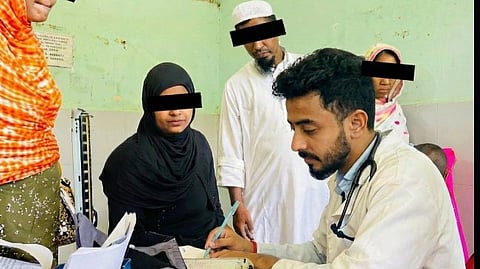
People are often told not to overthink their symptoms, sometimes even when those symptoms persist and point toward something serious. Dr. Priyam Bordoloi shared a similar situation from his first year of residency, when a woman arrived with her family, only to have others dismiss her and speak over her about her own symptoms and problems.
The woman arrived at the outpatient department trembling, clutching her abdomen and struggling to breathe. Instead of support, her husband insisted that nothing serious had happened to her. He told the doctor to simply give her calcium. Her mother in law accused her of being dramatic and lazy. She insisted that the woman only wanted to avoid household work and was pretending to be unwell.
Throughout this, the patient sat on the chair with a tired face, barely able to speak. She looked at the doctor with the kind of helplessness that appears when someone knows they are in danger but no one around them believes it. Her pain was visible, but her family kept interrupting her and refused to let her explain her symptoms.
Dr Priyam Bordoloi, who was handling the case, decided not to rely on what the relatives were saying. He examined her and found that her blood pressure had dropped to 80 over 50. Her pulse was racing, her skin felt cold and her breathing was shallow. These were clear signs that something serious was happening inside her body.
Despite strong objections from her family, the doctor ordered a haemoglobin test. The result shocked everyone in the room. Her haemoglobin level stood at 4.2 grams per decilitre, a dangerously low value that can lead to organ failure or death if untreated.
In that moment the relatives fell silent. The reality of the situation hit them only after the test result appeared.
Anemia happens when your body does not have enough healthy red blood cells or when those cells cannot do their job well. Without enough oxygen carrying cells, your organs and tissues do not get the support they need. Some people are born with anemia while others develop it over time.
People with anemia often feel tired, weak or breathless even during simple activities. Many notice pale skin, dizziness, headaches or a fast heartbeat. Some may fall sick more often because the body struggles to keep up.
Anemia has many causes. The most common one is iron deficiency. Others include a lack of vitamin B12 or folate, conditions that destroy red blood cells, long term illnesses, inherited blood disorders or a drop in the body’s ability to make new blood cells.
Dr. Bordoloi immediately shifted the woman to the emergency unit. She received IV fluids, antibiotics, oxygen support and packed red cell transfusions. An emergency ultrasound and further evaluation revealed that she was suffering from severe anaemia along with early septic shock. These conditions can rapidly become fatal if not treated on time.
The woman looked at the doctor with a mix of fear and relief. Her family stood frozen, finally realising the seriousness of her condition. They had earlier refused to admit her and were even ready to take her home against medical advice. The medical team took a photograph of the family only for documentation and safety, as they genuinely feared she would not survive if removed from care.
Reference:
1. Cleveland Clinic. “Anemia.” Updated 2024. Accessed December 3, 2025. https://my.clevelandclinic.org/health/diseases/3929-anemia.
(Rh/ARC/MSM)