
- Home
- About Us
- Contact Us
- Biography
- MedBound Hub
- InternshipInternship
- Daily Pulse
- Medicine
- Physical Therapy
- InterviewInterview
- Pharmacy
- Biotechnology
- College/InstituteCollege/Institute
- Dentistry
- Blog
- Wellness & Nutrition
- Nursing
- Opinion

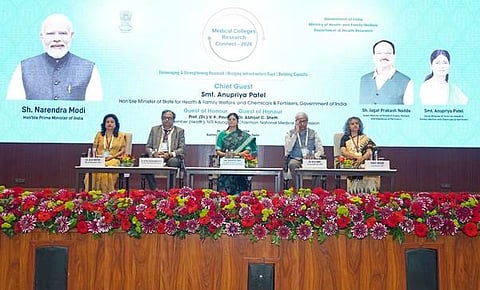
The Department of Health Research (DHR) under the Ministry of Health and Family Welfare has inaugurated the Medical Colleges Research Connect 2026, unveiling a ₹4,800 crore funding commitment to bolster biomedical research across India. The two-day national conference, held from February 26–27, 2026 at Sushma Swaraj Bhawan, Chanakyapuri, brought together representatives from more than 100 medical colleges with multidisciplinary Medical Colleges Research Units (MRUs) established under a central scheme.
Union Minister of State for Health & Family Welfare and Chemicals & Fertilizers Smt. Anupriya Patel inaugurated the event, emphasising the government’s sustained commitment to strengthening India’s health research ecosystem.
The conference provides a platform for researchers to showcase ongoing work, discuss challenges in health research, and participate in workshops, lectures, and collaborative symposia aimed at enhancing research capacity.
Over 100 institutions participating in the conference have established MRUs under the Central Sector Umbrella Scheme, which aims to:
Expand research facilities in teaching hospitals and medical colleges
Promote interdisciplinary investigations
Support investigator-initiated projects on public health-relevant topics
Improve grant proposal writing and technical competency in research design
During the two-day event, representatives are expected to present progress reports from their institutions and engage in collaborative sessions on improving research outcomes.
The ₹4,800 crore allocation reinforces the government’s focus on health innovation, clinical research, and biomedical science as key components of national health security and improved patient outcomes.
Biomedical research in India spans a range of fields, including:
Non-communicable diseases (NCDs) such as cardiovascular disorders, diabetes, and cancer
Infectious disease surveillance and response
Health systems and implementation science
Clinical trials and intervention optimization
Digital health technologies and diagnostics
Improving research capacity in medical colleges is seen as essential to address these priorities and close gaps between clinical practice and evidence generation.
Around the same period, newer data highlighted concerns around lifestyle-associated health issues such as joint ageing and musculoskeletal health in India’s workforce, bringing further attention to the need for research investment. Emerging evidence suggest that prolonged sedentary behaviour such as extended hours sitting in office chairs, may be associated with accelerated joint wear and ageing, resulting in increased risk of joint pain and functional decline.
Although the Scientific Reports article1focuses on sarcopenia (age-related muscle loss) and sedentary time among older adults in an Iranian cohort, such research reflects a global interest in lifestyle, ageing, and musculoskeletal health relevant across populations.
These topics, chronic joint health burdens, physical inactivity, ageing populations, align with areas that expanded research funding in India may support, by enabling high-quality epidemiological studies, intervention trials, and health services research.
India aims to elevate its biomedical research output and contribute evidence for national health policy, prevention strategies, and improved clinical care.
Reference
Amini, Amin, Hoda Javadzade, Ramin Heshmat, Abdolreza Norouzy, Saeid Safiri, Kurosh Djafarian, and Sayed Hossein Davoodi. 2026. “Sarcopenia and Its Association With Physical Activity and Sedentary Time in Older Adults: Findings From the Bushehr Elderly Health Program.” Scientific Reports 16, no. 1 (2026): Article 39520. https://doi.org/10.1038/s41598-026-39520-5.
(Rh)
