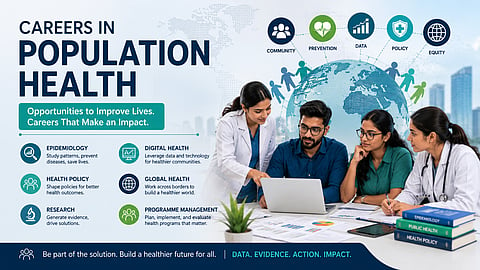
Population health is one of the fastest-growing interdisciplinary fields in healthcare. It focuses on improving the health outcomes of entire populations by combining disease prevention, healthcare delivery, epidemiology, health policy, digital health, healthcare analytics, health systems research, and the social determinants of health. Rather than treating illness in individual patients alone, population health seeks to improve health outcomes at community, national, and global levels through evidence-based and data-driven interventions.¹ ²
For MBBS graduates, life science students, pharmacists, nurses, biotechnology graduates, and allied health professionals, population health offers diverse career opportunities across government agencies, hospitals, research institutes, healthcare consulting, digital health companies, academia, non-governmental organizations, and international organizations. As healthcare increasingly adopts digital technologies, artificial intelligence, and value-based care, professionals with multidisciplinary population health expertise are in growing demand both in India and internationally.¹ ²
Population health is an interdisciplinary approach that aims to improve the health outcomes of entire populations while reducing health inequities among different groups. Unlike traditional clinical medicine, which focuses on diagnosing and treating individual patients, population health examines the broader factors that influence health, including healthcare access, education, income, housing, environmental conditions, nutrition, public policy, and social determinants of health.
The concept extends beyond conventional public health by integrating healthcare delivery, epidemiology, health systems research, healthcare analytics, digital health, quality improvement, and health economics. Rather than focusing solely on preventing disease, population health also seeks to improve how healthcare systems deliver services, measure outcomes, allocate resources, and use data to support evidence-based decision-making.
Globally, population health has become central to healthcare transformation, particularly in areas such as value-based healthcare, digital health, artificial intelligence, precision public health, and health equity. In India, while many careers are still advertised under titles such as public health, community medicine, epidemiology, health systems, or health informatics, these roles collectively contribute to the broader field of population health.
Although the two fields overlap considerably, they are not identical.
In India, the distinction between public health and population health is still evolving. Many positions contributing to population health are advertised under public health, community medicine, health systems research, epidemiology, health informatics, healthcare analytics, and programme management. As India's healthcare system increasingly adopts digital health technologies, health insurance expansion, and evidence-based policymaking, population health is emerging as a broader umbrella discipline encompassing these interconnected fields.
Population health has emerged as one of the fastest-growing areas in healthcare due to increasing emphasis on disease prevention, universal health coverage, digital transformation, ageing populations, chronic disease management, and health equity.
Professionals in this field work at the intersection of medicine, research, policy, technology, and healthcare management to improve health outcomes for entire communities rather than individual patients alone.
Some of the major advantages include:
Opportunities across government, academia, industry, NGOs, hospitals, and international organizations
Growing demand for professionals skilled in epidemiology, healthcare analytics, digital health, and health systems
Competitive salaries in consulting, pharmaceutical, research, and healthcare technology sectors
International career opportunities with organizations such as WHO, UNICEF, the World Bank, and global universities
Meaningful work that directly contributes to improving healthcare access, quality, and equity
One of the defining features of population health is its focus on the social determinants of health—the conditions in which people are born, grow, live, work, and age. Factors such as poverty, education, nutrition, housing, sanitation, environmental pollution, climate change, gender, employment, and access to healthcare significantly influence health outcomes.
Population health professionals work with governments, healthcare providers, researchers, and communities to design interventions that address these broader determinants, helping reduce health disparities and improve overall well-being.
Although professionals from diverse educational backgrounds can enter the field, postgraduate training often enhances career prospects and opens doors to leadership, research, and specialized roles.
A study mapping public health jobs in India found that nearly two-thirds of advertised positions preferred candidates with a master's degree, highlighting the growing demand for advanced public health training.¹
Although the study refers to public health jobs, many of these positions—including those in epidemiology, health systems, programme management, digital health, and health policy—are now recognized as part of the broader population health workforce.
Some of the most recognized educational pathways include:
Master of Public Health (MPH)
The most widely recognized multidisciplinary degree covering epidemiology, biostatistics, health policy, environmental health, health promotion, healthcare management, and population health practice.
MD Community Medicine
Ideal for MBBS graduates interested in preventive medicine, research, teaching, and health programme implementation.
MSc Public Health
Suitable for life science and allied health graduates pursuing careers in research and programme management.
MSc Epidemiology
Focuses on disease surveillance, outbreak investigation, epidemiological research, and outbreak modelling.
MSc Biostatistics
Prepares graduates for careers in statistical analysis, clinical research, health data science, and predictive modelling.
MSc Health Informatics
Combines healthcare, information technology, electronic health records, and healthcare analytics.
PhD Programmes
Best suited for individuals interested in academic research, teaching, health systems research, and leadership.
Professional Certifications
Courses in:
Epidemiology
Health Economics
GIS
Monitoring and Evaluation
Project Management
Clinical Research
Scientific Writing
Health Technology Assessment
Healthcare Analytics
Digital Health
Artificial Intelligence in Healthcare
can strengthen a professional profile.¹ ³
Regardless of specialization, employers increasingly seek professionals with multidisciplinary skills.
Key competencies include:
Epidemiology
Biostatistics
Research methodology
Health policy analysis
Healthcare analytics
Statistical software (R, SAS, SPSS, Stata)
Python for healthcare analytics
Geographic Information Systems (GIS)
Dashboard development and data visualization
Scientific writing
Communication
Leadership
Project management
Critical thinking
Evidence synthesis
As digital health continues to expand, familiarity with Electronic Health Records (EHRs), telemedicine platforms, health information systems, and AI-assisted healthcare tools is becoming increasingly valuable.
Career growth in population health varies depending on educational qualifications, work experience, and area of specialization. Many professionals begin their careers in research, programme implementation, or healthcare analytics before progressing into leadership, policy, consulting, or academic roles. Continuous learning, postgraduate education, and interdisciplinary experience can significantly enhance career advancement.
A typical career pathway may look like:
Career progression is not always linear. Professionals may move between government agencies, hospitals, research institutes, NGOs, digital health companies, pharmaceutical organizations, healthcare consulting firms, and international organizations based on their interests and expertise.
Conduct disease surveillance and outbreak investigations.
Design epidemiological studies and research protocols.
Analyze population health data.
Identify disease risk factors.
Evaluate prevention and control programmes.
Publish scientific findings and technical reports.
Support predictive modelling, pandemic preparedness, and precision public health initiatives using surveillance data.
MBBS + MPH
MD Community Medicine
MSc Epidemiology
MSc Public Health
PhD (research positions)
Indian Council of Medical Research (ICMR)
National Centre for Disease Control (NCDC)
Ministry of Health and Family Welfare
World Health Organization (WHO)
Universities
Pharmaceutical companies
Research organizations
State surveillance units under the Integrated Disease Surveillance Programme (IDSP)
Approximately ₹6–15 lakh per annum, depending on qualifications, employer, and experience.
Develop public health programmes.
Conduct community health assessments.
Monitor programme performance.
Promote disease prevention strategies.
Strengthen health systems through evidence-based interventions.
Use healthcare data to identify health disparities and improve outcomes.
Collaborate with government agencies and community organizations.
Support policy implementation.
Address social determinants of health through multisectoral programmes.
MPH
MD Community Medicine
MSc Public Health
MSc Epidemiology
Ministry of Health and Family Welfare
National Health Mission
State health departments
WHO
UNICEF
Public Health Foundation of India
NGOs
National Health Systems Resource Centre (NHSRC)
Digital health organizations
Approximately ₹7–18 lakh per annum, depending on organization and experience.
Note: As this is an emerging field in India, similar roles may still be advertised as Public Health Specialist, Public Health Consultant, Programme Specialist, or Community Medicine Specialist.
Analyze healthcare datasets.
Develop dashboards and performance indicators.
Evaluate health outcomes.
Identify high-risk populations.
Support strategic healthcare planning.
Present findings to healthcare leaders.
Work with electronic health records, insurance claims data, and population registries to improve healthcare planning.
Develop predictive analytics models that support preventive healthcare and resource allocation.
MPH
MSc Health Informatics
MSc Biostatistics
MBBS with analytics training
Hospitals
Healthcare consulting firms
Health insurance companies
Digital health companies
Pharmaceutical industry
Research institutes
Health-tech companies
Healthcare analytics firms
Approximately ₹8–18 lakh per annum, with higher salaries in multinational healthcare organizations and consulting firms.
Health systems research examines how healthcare is organized, financed, delivered, and evaluated to improve access, quality, efficiency, and equity. Although the exact job title varies in India, professionals work as researchers, consultants, and policy analysts within health systems strengthening programmes.
Conduct health systems research.
Evaluate healthcare delivery models.
Study healthcare financing and service utilization.
Assess health policies and programme implementation.
Develop recommendations for improving healthcare quality and efficiency.
Support Universal Health Coverage initiatives.
MPH
MD Community Medicine
MSc Public Health
Health Policy
Health Systems Management
PhD
National Health Systems Resource Centre (NHSRC)
Indian Council of Medical Research (ICMR)
AIIMS
State Health Systems Resource Centres
Public Health Foundation of India (PHFI)
WHO India
Universities
Approximately ₹8–20 lakh per annum depending on employer and experience.
Design statistical analyses for research studies.
Analyze clinical and epidemiological data.
Interpret research findings.
Support clinical trials.
Develop predictive models.
Prepare statistical reports and publications.
Support artificial intelligence and machine-learning projects using healthcare datasets.
MSc Biostatistics
MPH
MSc Statistics
PhD (advanced research positions)
Clinical Research Organizations
Pharmaceutical companies
Universities
ICMR
Research institutes
International organizations
Approximately ₹6–16 lakh per annum, depending on technical expertise and sector.
Analyze existing health policies and healthcare systems.
Conduct policy and health systems research.
Evaluate the effectiveness of national health programs.
Prepare policy briefs and technical reports.
Support healthcare financing and reform initiatives.
Collaborate with policymakers and stakeholders.
Health policy analysis
Health economics
Research methodology
Critical thinking
Scientific writing
Communication
Data interpretation
MPH
MD Community Medicine
MSc Public Health
Health Economics or Public Policy specialization
Ministry of Health and Family Welfare
National Health Mission
WHO
UNICEF
World Bank
Public Health Foundation of India (PHFI)
Healthcare consulting firms
Approximately ₹8–20 lakh per annum, depending on qualifications, organization, and experience.
As India continues strengthening its healthcare system through initiatives such as Ayushman Bharat, the Ayushman Bharat Digital Mission (ABDM), Universal Health Coverage, and Health Technology Assessment in India (HTAIn), demand for professionals with expertise in health policy, health systems research, healthcare financing, and evidence-informed policymaking is expected to increase.
Health economists evaluate how healthcare resources can be allocated efficiently while improving health outcomes. Their work supports government decision-making, insurance programmes, reimbursement policies, and cost-effective healthcare interventions. In India, this field has expanded through Health Technology Assessment in India (HTAIn), coordinated by the Department of Health Research.
Conduct economic evaluations of healthcare interventions.
Perform cost-effectiveness and budget impact analyses.
Support reimbursement and health financing decisions.
Evaluate new medicines, diagnostics, and medical devices.
Prepare evidence for policy decisions.
MPH
MSc Health Economics
Public Policy
Economics
MD Community Medicine
PhD
Health Technology Assessment in India (HTAIn)
Department of Health Research
NHSRC
WHO
Universities
Healthcare consulting firms
Insurance companies
Pharmaceutical companies
Approximately ₹8–20 lakh per annum.
Plan and coordinate public health programmes.
Manage project budgets and resources.
Monitor programme performance.
Prepare technical and financial reports.
Coordinate multidisciplinary teams.
Liaise with government agencies and funding organizations.
Use population-level data to improve programme outcomes and reduce health disparities.
Monitor programme indicators through digital dashboards and health information systems.
MPH
MD Community Medicine
MBA (Healthcare Management)
MSc Public Health
Government health departments
NGOs
International organizations
Development agencies
Research organizations
Approximately ₹8–18 lakh per annum, with senior programme managers earning significantly more depending on project size and funding.
Healthcare quality improvement specialists focus on improving patient safety, healthcare quality, infection prevention, and hospital performance. While many work in hospitals, they also contribute to broader population health by ensuring healthcare systems deliver safe, equitable, and high-quality care.
Implement quality improvement initiatives.
Support NABH accreditation.
Monitor quality indicators.
Improve patient safety.
Strengthen infection prevention and control.
Evaluate healthcare performance.
MPH
MD Community Medicine
Hospital Administration
MBA Healthcare Management
Nursing
Hospital chains
NABH-accredited hospitals
NHSRC
Quality & Patient Safety programmes
Healthcare consulting firms
Approximately ₹7–18 lakh per annum.
Manage health information systems.
Develop electronic health records.
Analyze healthcare data.
Improve clinical workflows.
Support digital health initiatives.
Ensure data quality and security.
Develop and manage electronic health records (EHRs), health information exchanges, and digital health platforms under initiatives such as the Ayushman Bharat Digital Mission (ABDM).
MSc Health Informatics
MPH
MBBS with informatics training
Computer science with healthcare specialization
Hospitals
Health-tech companies
Government agencies
Healthcare consulting firms
Insurance companies
Approximately ₹8–22 lakh per annum, depending on technical expertise and employer.
Coordinate clinical trials.
Recruit study participants.
Collect and manage research data.
Ensure regulatory compliance.
Monitor study progress.
Prepare research documentation.
Collaborate with epidemiologists, biostatisticians, and public health researchers to generate evidence that informs population-level healthcare decisions.
Support real-world evidence studies and post-marketing surveillance for medicines and vaccines.
MBBS
Pharmacy
Nursing
Biotechnology
MPH
MSc Clinical Research
Clinical Research Organizations (CROs)
Pharmaceutical companies
Hospitals
Medical colleges
Research institutes
Contract research organizations
Global clinical research networks
Approximately ₹5–15 lakh per annum, depending on role and experience.
Write scientific and medical content.
Prepare policy briefs and technical reports.
Develop continuing medical education materials.
Review scientific literature.
Ensure evidence-based communication.
Collaborate with researchers and healthcare organizations.
Translate complex epidemiological, clinical, and health systems research into accessible content for healthcare professionals, policymakers, and the public.
Develop educational content supporting digital health, public health programmes, and health policy initiatives.
MBBS
MD
MPH
Pharmacy
Life Sciences
Medical writing certification (preferred)
Medical communication agencies
Pharmaceutical companies
Healthcare publishers
Research organizations
Digital health companies
Academic institutions
International public health organizations
Approximately ₹5–15 lakh per annum, with experienced freelance and regulatory medical writers often earning considerably more.
Evaluate healthcare systems.
Improve operational efficiency.
Conduct healthcare market research.
Develop strategic recommendations.
Assess healthcare quality indicators.
Support organizational transformation.
Advise hospitals, governments, insurers, and healthcare organizations on population health strategy, value-based care, healthcare analytics, and health systems strengthening.
Support implementation of digital health initiatives, quality improvement programmes, and healthcare financing reforms.
MPH
MBA (Healthcare Management)
MBBS
MD Community Medicine
Health Economics
Health Policy
Healthcare consulting firms
Hospitals
Pharmaceutical companies
Insurance organizations
Government agencies
Global consulting firms
Health technology companies
Approximately ₹10–25 lakh per annum, depending on consulting experience and employer.
Design international health programmes.
Coordinate humanitarian responses.
Conduct global health research.
Support disease control initiatives.
Strengthen health systems.
Promote health equity.
Collaborate on pandemic preparedness, vaccine programmes, maternal and child health, climate and health initiatives, and universal health coverage projects across countries.
MPH
MSc Global Health
MD Community Medicine
WHO
UNICEF
Salaries vary widely depending on the organization and country of employment, with international organizations generally offering highly competitive compensation packages.
Conduct research.
Publish scientific papers.
Teach undergraduate and postgraduate students.
Supervise research projects.
Apply for research grants.
Collaborate on national and international studies.
Lead multidisciplinary research in epidemiology, health systems, digital health, health policy, and implementation science.
MD Community Medicine
MPH
MSc
PhD
Universities
Medical colleges
ICMR institutes
AIIMS
Research organizations
Public Health Foundation of India (PHFI)
Approximately ₹8–20 lakh per annum, depending on institution, qualifications, and academic rank.3,4,5
Healthcare organizations increasingly rely on large datasets to improve patient outcomes, optimize healthcare delivery, identify disease trends, and support policy decisions. Professionals in this field combine healthcare knowledge with statistics, programming, and artificial intelligence to generate actionable insights from health data.
Analyze electronic health records.
Develop predictive models.
Perform healthcare analytics.
Support artificial intelligence projects.
Create dashboards for health programme monitoring.
Identify high-risk populations.
Support evidence-based healthcare planning.
MPH
MSc Health Informatics
MSc Biostatistics
Computer Science
Data Science
MBBS with analytics training
Apollo Hospitals
Manipal Hospitals
IQVIA
Optum
UnitedHealth Group
Health-tech companies
Research institutes
Insurance organizations
Approximately ₹8–22 lakh per annum depending on technical expertise and employer.
While India continues expanding opportunities in population health, several specialized careers are more commonly available in countries such as the United States, Canada, the United Kingdom, and Australia. Graduates may also find opportunities with leading public health agencies, academic institutions, and healthcare systems, including the U.S. Centers for Disease Control and Prevention (CDC), NHS England, Johns Hopkins Bloomberg School of Public Health, Public Health Agency of Canada, and leading universities and research organizations worldwide. These organizations recruit professionals in epidemiology, health systems, healthcare analytics, implementation science, digital health, and global health.
Indian graduates with qualifications such as an MPH, MD Community Medicine, MSc Epidemiology, MSc Health Informatics, or PhD in Population Health can pursue these roles through higher education, international fellowships, or direct employment abroad.
Although these exact job titles are currently uncommon in India, similar responsibilities are often performed by programme managers, public health consultants, healthcare quality professionals, and health systems researchers.
Population health professionals work across multiple sectors beyond government health departments.
Ministry of Health and Family Welfare
National Centre for Disease Control (NCDC)
Indian Council of Medical Research (ICMR)
National Health Systems Resource Centre (NHSRC)
State Health Departments
AIIMS
World Health Organization (WHO)
UNICEF
World Bank
United Nations Development Programme (UNDP)
PATH
Jhpiego
Clinton Health Access Initiative (CHAI)
Public Health Foundation of India (PHFI)
Medical colleges
Universities
Research institutes
Apollo Hospitals
Fortis Healthcare
Manipal Hospitals
Narayana Health
Practo
Eka Care
Innovaccer
IQVIA
Optum
UnitedHealth Group
Star Health Insurance
Niva Bupa
ICICI Lombard Health Insurance
Population health professionals contribute to major national health initiatives such as Ayushman Bharat, the National Health Mission (NHM), the Ayushman Bharat Digital Mission (ABDM), the National Programme for Prevention and Control of Non-Communicable Diseases (NP-NCD), the National TB Elimination Programme (NTEP), and the Universal Immunization Programme (UIP). These initiatives create career opportunities in epidemiology, health systems research, programme implementation, digital health, monitoring and evaluation, healthcare analytics, and policy development, enabling professionals to strengthen healthcare delivery and improve population health outcomes across India.
Digital transformation is reshaping population health across India and globally.
Professionals increasingly work with:
Electronic Health Records (EHRs)
Ayushman Bharat Digital Mission (ABDM) health records
Telemedicine platforms
Health Information Exchanges
Geographic Information Systems (GIS)
Artificial Intelligence (AI)
Machine learning
Digital disease surveillance
Clinical dashboards
Predictive analytics
As healthcare becomes increasingly data-driven, professionals with expertise in digital health and healthcare analytics are expected to play an increasingly important role in improving population health outcomes.
Population health is expected to become one of the fastest-growing interdisciplinary healthcare fields over the coming decade as countries strengthen healthcare systems, expand digital health infrastructure, and shift from reactive treatment to preventive, value-based care.
In India, initiatives such as Ayushman Bharat, the Ayushman Bharat Digital Mission (ABDM), the National Health Mission (NHM), and the National Programme for Prevention and Control of Non-Communicable Diseases (NP-NCD) are increasing demand for professionals with expertise in epidemiology, health systems, digital health, healthcare analytics, programme implementation, and health policy.
Globally, several emerging areas are expected to create new career opportunities:
Digital epidemiology
Precision public health
Healthcare analytics and big data
One Health initiatives
Climate change and health
Pandemic preparedness and outbreak response
Remote patient monitoring
Population genomics
Value-based healthcare
Health equity and social determinants of health
As healthcare increasingly becomes data-driven and interdisciplinary, professionals capable of integrating medicine, public health, health systems, analytics, and technology will be well positioned for leadership roles across government, academia, industry, and international organizations.
Regardless of the career path you choose, employers increasingly value professionals who combine scientific knowledge with analytical, leadership, and communication skills.
To strengthen your career prospects:
Pursue postgraduate education such as an MPH, MD Community Medicine, MSc Public Health, MSc Epidemiology, MSc Health Informatics, or related programmes.
Gain practical experience through internships, research projects, NGOs, hospitals, government programmes, or international collaborations.
Learn statistical software such as R, SPSS, Stata, or SAS.
Develop programming skills using Python or SQL for healthcare analytics.
Build expertise in GIS, digital health platforms, and electronic health records.
Improve scientific writing and presentation skills.
Participate in conferences, workshops, and continuing professional development programmes.
Stay updated with evolving technologies including AI, machine learning, and digital health innovations.
Developing a multidisciplinary skill set will help graduates remain competitive as healthcare continues shifting toward evidence-based, technology-enabled, and patient-centred population health systems.
Population health is emerging as one of the most dynamic and interdisciplinary career fields in modern healthcare. By integrating clinical medicine, public health, epidemiology, health systems, digital health, healthcare analytics, health economics, and policy, it aims to improve the health outcomes of entire populations while reducing health inequities.
For medical and life science graduates, it offers diverse opportunities in research, epidemiology, health policy, programme management, healthcare analytics, academia, and global health.
In India, many of these careers continue to be advertised under public health, community medicine, epidemiology, health systems, health informatics, or healthcare management. Together, however, they form the broader and rapidly evolving population health workforce.
Whether working in government, academia, industry, or international organizations, population health professionals play a vital role in improving community health and shaping evidence-based healthcare.
As healthcare increasingly embraces artificial intelligence, digital transformation, precision public health, and evidence-based policymaking, population health professionals will play a critical role in designing healthier communities and more resilient healthcare systems.
With the right education, skills, and practical experience, graduates can build rewarding careers while making a meaningful impact on population health at local, national, and global levels.
1. Dahal, Shanti, Anjali Sharma, and Sanjay Zodpey. 2018. "Mapping of Public Health Jobs in India—Where Can the Public Health Graduates Be Employed?" Journal of Health Management 20 (1): 13–27. https://doi.org/10.1177/0972063417747725.
2. Employment Opportunities in Public Health: Perspectives from India and Abroad. 2024. Rohtak: Maharshi Dayanand University. https://mdu.ac.in/UpFiles/UpPdfFiles/2024/May/4_05-16-2024_16-15-44_Employment%20opportunities.pdf.
3. Dahal, Shanti, Ritika Tiwari, and Sanjay Zodpey. 2015. "Public Health Job Opportunities in India: Employers' Perspective." Journal of Health Management 17 (2): 195–203. https://doi.org/10.1177/0972063415575808.
4. Moray, Kusum. 2024. “The Road Not Taken: Career Options in Public Health in India.” Nivarana, April 16, 2024. https://nivarana.org/vital-signs/the-road-not-taken-career-options-in-public-health-in-india.
5. National Health Systems Resource Centre (NHSRC). "About NHSRC." Ministry of Health and Family Welfare, Government of India. Accessed July 2026. https://nhsrcindia.org/about-us
6. Kindig DA, Stoddart G. What Is Population Health? American Journal of Public Health. 2003;93(3):380–383. doi:10.2105/AJPH.93.3.380. https://ajph.aphapublications.org/doi/full/10.2105/AJPH.93.3.380
7. World Health Organization. Social Determinants of Health. https://www.who.int/health-topics/social-determinants-of-health
8. National Health Authority. Ayushman Bharat Digital Mission. https://abdm.gov.in
9. Department of Health Research, Government of India. Health Technology Assessment in India (HTAIn). https://htaindia.org
10. National Health Authority. Ayushman Bharat – Pradhan Mantri Jan Arogya Yojana (AB-PMJAY). https://pmjay.gov.in
11. National Centre for Disease Control. Integrated Disease Surveillance Programme (IDSP). https://ncdc.mohfw.gov.in