
- Home
- About Us
- Contact Us
- Biography
- MedBound Hub
- InternshipInternship
- Daily Pulse
- Medicine
- Physical Therapy
- InterviewInterview
- Pharmacy
- Biotechnology
- College/InstituteCollege/Institute
- Dentistry
- Blog
- Wellness & Nutrition
- Nursing
- Opinion

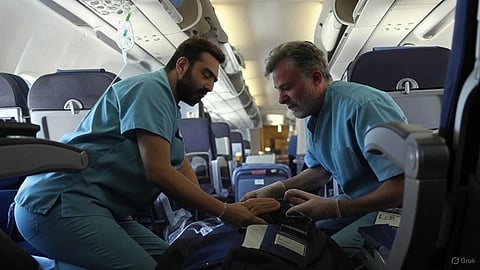
A routine flight turned into a life or death situation on Monday when a young cabin crew member suffered a severe allergic reaction shortly after take off. The Etihad Airways aircraft was about 40 minutes into its journey from Ethiopia when the crew member collapsed with a rapidly worsening allergic shock. His oxygen levels dropped to 80 percent and there was no air entry into his lungs. With the plane already past the point where it could return, passengers and crew were left facing a frightening and unpredictable crisis in the sky.
Among the passengers were two Chennai based doctors who were returning from a medical camp in Ethiopia. Dr Gopinathan M, a consultant in hemato oncology at MGM Cancer Institute, and Dr Sudharshan Balaji, a senior consultant and clinical lead in urology at MGM Healthcare, immediately stepped forward when the crew called for medical help.
The doctors quickly realised how critical the situation was. The crew member showed signs of a severe allergic reaction that had progressed into anaphylactic shock. Time was running out and treatment had to begin instantly. Despite being in a narrow aisle with limited equipment, both doctors worked together calmly and confidently.
They administered steroids, bronchodilators and anti histamines while also providing continuous oxygen at one to two litres per minute. They worked for nearly an hour to stabilise his breathing. For almost four hours, until the flight landed, they closely monitored the patient and adjusted treatment to keep him breathing steadily.
After a tense stretch of time, the crew member began to respond to treatment. His lungs slowly regained air entry and his oxygen levels improved. By the time the aircraft landed, he had regained consciousness. Airline staff and passengers expressed deep gratitude to the doctors whose quick action and medical experience prevented what could have been a tragedy.
Anaphylaxis is a sudden and severe allergic reaction that can become life threatening within minutes. It usually occurs when the body reacts strongly to a trigger such as certain foods, medications, insect stings or latex. During anaphylaxis, the immune system releases chemicals that cause swelling, breathing difficulty and a dangerous drop in blood pressure. The reaction often starts quickly and needs urgent medical care.
Anaphylaxis often begins with mild symptoms, but these can escalate fast. Early clues may include itching, hives or warmth spreading across the skin. Some people notice swelling around the lips, tongue or throat, which can slowly block the airway. Breathing may become noisy or strained. Others may feel chest tightness, stomach cramps, vomiting or sudden dizziness. A weak pulse or a sharp fall in blood pressure can follow. When symptoms involve more than one body system, it is usually anaphylaxis.
Act immediately if you suspect anaphylaxis.
Call for emergency medical help without waiting for symptoms to ease.
Give an epinephrine injection in the outer thigh as the first and most important step.
Remember that epinephrine works fast to open the airway, improve breathing and raise blood pressure.
Take the person to a hospital even if they feel better, because symptoms can return.
If no injector is available:
Help them lie flat if they feel faint.
Let them sit upright if breathing is hard.
If they lose consciousness, roll them onto their side.
Be prepared to start CPR if they stop breathing.
Reference:
1. Cleveland Clinic. “Anaphylaxis.” Cleveland Clinic. Accessed December 3, 2025. https://my.clevelandclinic.org/health/diseases/8619-anaphylaxis.
(Rh/ARC/MSM)
