Inside a Broken System: Bribery and Ethical Failures in Lucknow Government Hospitals

A sting investigation reveals how informal payments, medicine shortages, and weak oversight are affecting patient care
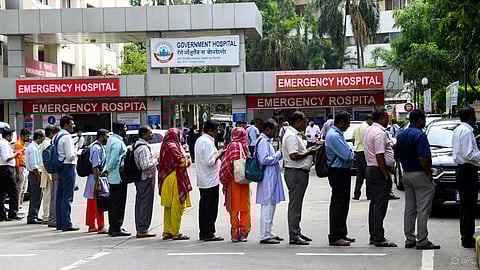
An image of people standing in long queue outside government hospital.
During the sting investigation, India Today TV documented how hospital staff openly demanded or hinted at cash payments to speed up consultations, scans, and procedures. AI image
Published on
Updated on

A sting operation conducted by India Today TV in June 2025 exposed widespread bribery, unethical practices, and systemic failures across several government hospitals in Lucknow. The investigation revealed how patients were routinely asked to pay cash for basic services, forced to buy medicines meant to be free, and pushed toward private diagnostics despite seeking care in public facilities.

The findings highlighted how informal payments and poor oversight have quietly reshaped patient experiences inside hospitals meant to serve the public without cost.

Bribes for Faster Access to Care

During the investigation, India Today TV documented how hospital staff openly demanded or hinted at cash payments to speed up consultations, scans, and procedures. Patients were initially told to expect long waiting periods. Soon after, staff members suggested that a small payment could move them ahead in the queue.

In one case, a patient named Indrajeet, who was seeking treatment for his children, said that paying extra had become routine. Another individual identified as Raja was alleged by patients to regularly collect money from visitors to push them ahead in lines. These payments ranged from small amounts such as Rs. 100 to higher sums such as Rs. 500, depending on the service, creating a parallel system where access depended on money rather than medical need.

Free Medicines Available Only Outside

The sting also uncovered a disturbing pattern around medicines. Drugs listed under government schemes as free were frequently declared unavailable inside hospital pharmacies. Patients were instead directed to buy the same medicines from private shops located just outside hospital premises.

At Shyama Prasad Mukherjee Civil Hospital, several patients said they had never received prescribed medicines from the hospital. Mukesh Maurya, who was undergoing treatment for a thyroid condition, said he was repeatedly told that stocks had run out and had no choice but to buy medicines from outside. Another patient, Ratnesh, explained that doctors often marked prescriptions in subtle ways that signaled pharmacists to sell medicines externally.

These practices increased out of pocket expenses and raised concerns about misuse of public resources and possible coordination with private sellers.

Diagnostics Shifted to Private Labs

India Today TV also found that patients were frequently sent to private diagnostic centres for tests that should have been available within government hospitals. In several facilities, staff told patients that machines were not working or services were unavailable, leaving them with no option but to seek tests elsewhere.

At the Indiranagar Community Health Centre, patients waited for hours in makeshift conditions with limited seating and shelter. Many said they were referred either to larger hospitals or private labs for basic tests. These referrals added travel, cost, and confusion for patients who had already come seeking affordable care.

An image of multiple medicine strips held by a gloved hand.
Drugs listed under government schemes as free were frequently declared unavailable inside hospital pharmacies. Karola G/Pexels

Infrastructure and Oversight Gaps

Beyond bribery and referrals, the investigation painted a picture of neglected infrastructure and overstretched systems. Waiting areas lacked basic amenities, information desks were missing, and patients often did not know where to go next. Staff shortages and lack of accountability appeared to enable unethical behavior to continue unchecked.

Government Response After the Broadcast

Following the broadcast in June 2025, senior health officials acknowledged irregularities. Uttar Pradesh Deputy Chief Minister and Health Minister Brajesh Pathak confirmed that surprise inspections had revealed doctors at Balrampur Hospital prescribing medicines from private brands despite adequate availability of free drugs.

He stated that notices were issued to concerned doctors and disciplinary action was initiated. Officials also reiterated that hospitals maintained sufficient medicine stocks and had access to emergency procurement funds, though these were not always used effectively.

(Rh/ARC)

An image of people standing in long queue outside government hospital.
Inside the Kidney Transplant Scams: The Gurgaon Case That Unmasked India’s Largest Organ-Trafficking Racket

Related Stories

No stories found.
logo
Medbound Times
www.medboundtimes.com