
- Home
- About Us
- Contact Us
- Biography
- MedBound Hub
- InternshipInternship
- Daily Pulse
- Medicine
- Physical Therapy
- InterviewInterview
- Pharmacy
- Biotechnology
- College/InstituteCollege/Institute
- Dentistry
- Blog
- Wellness & Nutrition
- Nursing
- Opinion

An oleum gas leak at Bhageria Industries in Palghar MIDC, Maharashtra, triggered evacuation of over 2,600 students, workers, and residents.
Officials said the gas leaked from a 2,500-litre storage day tank inside the chemical unit, releasing fumes that spread to nearby areas.
At least three people reported eye irritation following exposure, but authorities confirmed no serious injuries or hospitalisations.
Emergency response teams, including NDRF and fire brigade personnel, contained the leak and prevented further spread of the gas.
Authorities issued safety advisories and launched an investigation to determine the cause of the oleum gas leak.
Palghar, Maharashtra, 2 March, 2026: A hazardous oleum gas leak at a chemical manufacturing unit in Maharashtra’s Palghar district on Monday triggered a large emergency response and evacuation of residents, workers, and school students. Authorities confirmed that no serious injuries occurred, although some individuals experienced eye irritation and required medical observation.
The incident occurred at Bhageria Industries Ltd in the MIDC industrial area in Boisar, part of the Tarapur industrial belt in Palghar district, one of Maharashtra’s major chemical manufacturing hubs.
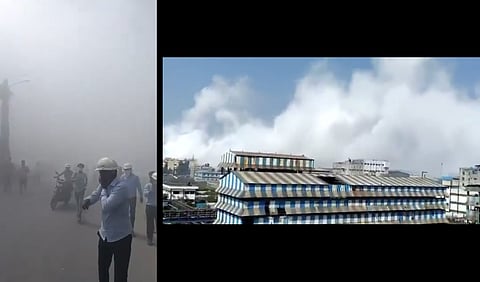
The incident occurred around 2 pm at Bhageria Industries Ltd, located in the Maharashtra Industrial Development Corporation area in Boisar, approximately 100 kilometres from Mumbai. Officials said oleum gas leaked from a storage day tank with a capacity of about 2,500 litres within the chemical unit premises.
The leak produced a dense white cloud that spread outside the industrial premises due to wind movement, affecting surrounding areas including Salwad and Pasthal villages. Authorities estimated the gas plume spread within a radius of approximately 4 to 5 kilometres.
Officials from the Palghar district administration and disaster management department received the alert and activated emergency response protocols immediately.
Authorities evacuated more than 2,600 people from nearby locations as a precautionary measure. This included about 1,600 students from Tarapur Vidyamandir school and over 1,000 workers from surrounding industries.
In addition, officials evacuated 458 workers and staff members from within the Bhageria Industries facility itself to prevent exposure.
Police and local authorities restricted access to affected areas and diverted traffic to support emergency operations and ensure public safety.
District officials stated that evacuation decisions were taken based on the potential health risks associated with inhaling oleum fumes.
Officials reported that at least three individuals experienced eye irritation after exposure to the gas. Medical teams shifted affected persons to nearby healthcare facilities for examination and observation. Doctors confirmed that none of the exposed individuals developed serious complications.
Authorities stated that no hospital admissions were required for severe respiratory injury, burns, or life threatening exposure.
Health officials continued monitoring exposed individuals as a precautionary measure.
Multiple emergency response agencies responded to the incident, including the National Disaster Response Force, fire brigade, Palghar police, MIDC authorities, and local disaster management teams.
Response teams initially encountered difficulty accessing the leak source due to dense fumes and chemical exposure risk. Personnel used protective gear and self contained breathing apparatus to safely enter the facility.
Emergency teams controlled the leak by placing sand barriers around the affected tank and implementing chemical containment measures. Officials also deployed water spray systems in surrounding areas to help reduce airborne chemical concentration.
Authorities later confirmed that the leak was brought under control and containment measures prevented further spread of the gas.
Palghar District Collector Indu Rani Jakhar stated that authorities acted quickly to evacuate people and control the leak. She confirmed that the situation was under control and authorities were continuously monitoring air quality and safety conditions.
Officials advised residents in nearby areas to remain indoors, avoid the affected zone, and follow official instructions.
Authorities specifically warned residents not to pour water directly on the chemical source, as oleum reacts with water and can release additional corrosive fumes.
Officials also advised residents to rinse exposed eyes or skin thoroughly with clean water if exposure occurred and seek medical evaluation if symptoms developed.
Authorities confirmed that the exact cause of the oleum leak remains under investigation. Officials from MIDC, chemical safety authorities, and district administration are conducting inspections to determine the reason for the tank leak and assess compliance with industrial safety regulations.
No structural damage, fire, or explosion occurred during the incident.
Oleum, also called fuming sulphuric acid, contains dissolved sulphur trioxide in concentrated sulphuric acid. It is widely used in industrial chemical manufacturing.
When released into the air, oleum emits sulphur trioxide fumes that react with moisture in the air, forming sulphuric acid particles. These particles can irritate exposed tissues.
Oleum releases sulphur trioxide gas, which reacts with moisture in the respiratory tract to form sulphuric acid. This reaction can irritate mucous membranes and cause inflammation. Rapid evacuation and limiting exposure are essential to prevent respiratory injury.
Short term exposure may cause:
Eye irritation
Skin irritation
Throat irritation
Breathing difficulty
Coughing
Severe exposure can cause chemical burns and respiratory injury, although no such cases were reported in this incident.
Rapid evacuation, limiting exposure, and prompt washing of exposed areas significantly reduce health risks.
Authorities confirmed that containment measures were successful and the situation remained under control.
1. International Labour Organization, World Health Organization, and United Nations Environment Programme. International Chemical Safety Card: Sulfuric Acid. https://chemicalsafety.ilo.org/dyn/icsc/showcard.display?p_lang=en&p_card_id=0362
2. UK Health Security Agency. Sulphuric Acid: Toxicological Overview. https://www.gov.uk/government/publications/sulphuric-acid-properties-incident-management-and-toxicology
