
- Home
- About Us
- Contact Us
- Biography
- Column
- MedBound Hub
- InternshipInternship
- Daily Pulse
- Medicine
- Physical Therapy
- InterviewInterview
- Pharmacy
- Biotechnology
- College/InstituteCollege/Institute
- Dentistry
- Blog
- Wellness & Nutrition
- Nursing
- Opinion

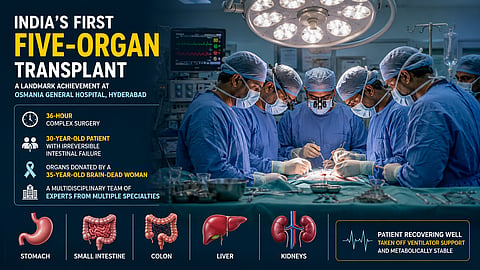
Doctors at Osmania General Hospital (OGH) in Hyderabad have performed a simultaneous five-organ transplant on a 30-year-old man from Telangana's Rajanna Sircilla district. The surgery lasted approximately 36 hours and involved transplanting five abdominal organs from a deceased donor into the patient.
According to hospital officials, the patient had irreversible intestinal failure caused by a rare intestinal disorder. The procedure was carried out by a multidisciplinary team that included transplant surgeons, anaesthesiologists, gastroenterologists, critical care specialists, transplant coordinators, and nursing staff. The donor organs were retrieved through the state's deceased organ donation programme and transplanted during the same operation.
Under the leadership of Dr. Ch. Madhusudan, Head of Gastroenterology and Chief Transplant Surgeon, the Osmania General Hospital team carried out a rare five-organ multivisceral transplant.
The transplant involved replacing five organs of the digestive system:
Stomach
Duodenum
Pancreas
Small intestine
Right colon
Telangana Health Minister Damodar Raja Narasimha congratulated the medical team following the procedure and said it reflects the expertise of doctors in the state's government hospitals, according to The Hindu.
This extraordinary achievement showcases the exceptional skill, dedication and commitment of our government doctors.
Damodar Raja Narasimha, Telangana Health Minister
OGH Superintendent Dr. Rakesh Sahay said the transplant involved a multidisciplinary team comprising specialists from the Departments of Nephrology, Urology, Surgical Gastroenterology, and Anaesthesia, among others. He added that all five organs transplanted into the patient were donated by a woman who had been declared brain dead at the hospital. According to Dr. Sahay, her eyes, skin, liver, and a kidney were also donated for transplantation, as reported in The Hindu.
Hospital officials said the patient's intestinal disorder had permanently damaged the function of his digestive tract. Because the intestine could no longer absorb nutrients and fluids adequately, he relied on long-term parenteral nutrition, in which nutrients are delivered directly into the bloodstream through an intravenous line.
Doctors determined that transplanting multiple abdominal organs offered the most appropriate treatment to restore digestive function, as reported in The South First.
Speaking to TNIE, Dr. Madhusudan said,
The patient was admitted to OGH six months ago and placed on the Jeevandan organ transplant waiting list. Finding a suitable deceased donor was challenging because the procedure required not only blood group compatibility but also lymphocyte cross-matching. A donor was identified three months ago, but the organs were found to be unsuitable for transplantation.
Dr. Ch. Madhusudan, Head of Gastroenterology and Chief Transplant Surgeon
In a post on X, the National Organ and Tissue Transplant Organization (NOTTO) described the procedure as a landmark achievement. According to NOTTO, it was the first five-organ multivisceral transplant performed at a government hospital in India and the first such procedure in the country for a patient diagnosed with Familial Adenomatous Polyposis (FAP).
According to TNIE, the transplant became possible after the family of a 35-year-old woman consented to organ donation following her declaration of brain death. According to hospital officials, she had suffered a severe brain hemorrhage associated with pregnancy-induced hypertension. After the donor organs were retrieved, the multidisciplinary team completed the five-organ transplant
According to Telangana health officials, the transplant was performed at Osmania General Hospital under the Aarogyasri health insurance scheme. The donor organs were obtained through the state's organ donation programme.
Hospital authorities stated that the procedure involved extensive coordination among multiple specialties because the organs had to be retrieved, preserved, and transplanted within a limited time to maintain their viability.
Following the surgery, the patient remains under close medical supervision. Doctors are monitoring the function of the transplanted organs and administering immunosuppressive medications to reduce the risk of organ rejection.
(Rh/TP/MSM)
