World Population Day 2026: Why India's Digital Census Matters for Healthcare

World Population Day 2026 highlights how India's first digital census could support stronger healthcare systems through timely and reliable demographic data
World Population Day 2026
India's first digital census could strengthen healthcare planning through accurate population data and evidence-based policymaking.AI Image
Published on
Updated on

Every year on July 11, World Population Day is observed to highlight how population trends influence nearly every aspect of our lives, from healthcare and education to economic growth and environmental sustainability.

The 2026 observance continues this global effort by encouraging governments, policymakers, organizations, and communities to work towards sustainable development, equitable access to resources, and a better quality of life for all.

As the world's population continues to grow, countries are faced with increasingly complex challenges, including ensuring access to quality healthcare, strengthening food security, creating employment opportunities, improving education, and addressing the impacts of climate change.

This year's observance also coincides with India's preparations for its 16th Census, the country's first fully digital population census. Beyond being a technological advancement, the digital census has the potential to strengthen evidence-based healthcare planning by providing more timely, accurate, and comprehensive demographic information.

World Population Day 2026 Theme

The theme for World Population Day 2026 is "Realizing the hopes and aspirations of young people – today and for the future."1

The theme emphasizes the importance of supporting young people as they make decisions about their education, careers, relationships, and parenthood. It is based on the global report Lives, Choices and Futures, which surveyed more than 108,000 adults aged 18–39 across 73 countries to better understand their aspirations, the choices they hope to make, and the challenges that influence their futures.

What Is India's First Digital Census and How Is It Different?

India's upcoming census represents the most significant transformation in population enumeration since the first synchronous census was conducted in 1881. Unlike previous censuses that relied entirely on paper questionnaires, the digital census will use secure mobile applications for data collection, allowing enumerators to record information electronically using smartphones or tablets.2

For the first time, citizens will also have the option of self-enumeration, enabling households to submit their details online before verification by census officials. The census will continue to be conducted in two phases: the House Listing and Housing Census, which records information about housing conditions and household amenities, followed by Population Enumeration, which collects demographic, educational, occupational, linguistic, and socioeconomic information for every individual.

The shift to digital data collection is expected to reduce manual errors, improve data validation, and accelerate the availability of census results, making demographic information available to policymakers much sooner than in previous census cycles.6

Why Accurate Population Data Matter for Healthcare Planning
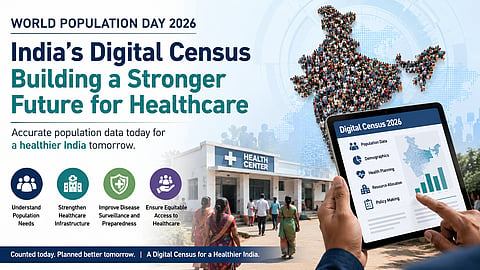
Although a census is commonly associated with counting people, its role extends far beyond determining population size. Census data provide detailed information about age distribution, sex ratio, migration patterns, household characteristics, and geographic population distribution, all of which form the backbone of healthcare planning.

Without current demographic information, governments are forced to rely on projections based on older data. Following the postponement of India's 2021 Census, policymakers continued to depend largely on data collected in 2011, despite significant changes in population growth, urbanization, migration, and ageing. This information gap has important implications for healthcare planning and equitable resource allocation.3

How Census Data Improve Healthcare Planning in India

Accurate census data form the foundation for evidence-based public health planning by helping governments understand where services are needed most and how resources should be allocated.4

  • Healthcare infrastructure:

    Population density and geographic distribution help identify areas that require new primary health centers, community health centers, district hospitals, and tertiary care facilities, ensuring more equitable access to healthcare.

  • Healthcare workforce:

    Updated population data enable policymakers to estimate the need for doctors, nurses, community health officers, laboratory technicians, and other healthcare professionals, supporting better workforce distribution, especially in underserved regions.

  • Maternal and child health:

    Information on women of reproductive age, births, and child populations helps plan antenatal care, immunization programmes, neonatal services, and nutrition initiatives while ensuring adequate supplies of vaccines and medicines.

  • Preparing for an ageing population:

    As India's elderly population grows, census data help governments anticipate increasing demand for geriatric care, rehabilitation services, long-term care, and the management of chronic diseases such as diabetes, hypertension, and cardiovascular disorders.

How Digital Census Technology Supports Better Healthcare Planning

India's first digital census introduces several technological features that can support more efficient healthcare planning6:

  • Improved data accuracy: Automated validation checks help reduce incomplete or inconsistent entries, improving the quality and reliability of census data.

  • Better mapping of healthcare needs: The use of Geographic Information Systems (GIS) and geo-tagging enables precise mapping of households, helping identify underserved areas and guide decisions on where to establish hospitals and primary healthcare facilities.

  • Faster decision-making: Digital data collection and processing allow demographic information to be analyzed more quickly, enabling policymakers to respond promptly to emerging healthcare needs.

  • Greater coverage in remote areas: Census applications can function offline, allowing data collection in regions with limited internet connectivity and synchronizing information once a network becomes available.

Census 2026
Accurate population data are essential for building equitable, evidence-based healthcare systems in India.AI Image

Expert Insight: Why Accurate Census Data Matter for Public Health

To better understand the role of India's digital census in strengthening healthcare planning, MedBound Times spoke with Dr. Deepika Bishnoi, MD (Community Medicine). She believes the digital census is not merely a technological upgrade but an important opportunity to strengthen evidence-based healthcare planning across the country.

India's first digital Census represents more than a technological milestone. It is an opportunity to build a more responsive and evidence-driven health system. Accurate population data will help governments estimate healthcare needs, identify vulnerable groups, and plan services ranging from maternal and child health programmes to non-communicable disease prevention and elderly care.

Dr. Deepika Bishnoi, MD (Community Medicine)

Dr. Bishnoi also pointed out that India is undergoing major demographic transitions, including population ageing, urbanization, migration, and changing disease patterns. She said better population data can help governments design health interventions that are aligned with these evolving realities.

She also noted that integrating digital census data with Geographic Information Systems (GIS) could help policymakers identify underserved communities and respond more effectively to changing population needs.

The success of the first digital census will not be measured merely by the use of technology, but by how effectively the resulting data are transformed into action. Ultimately, a stronger census means stronger public health planning, better resource allocation, and a greater ability to ensure that every community is counted, represented, and served.

Dr. Deepika Bishnoi, MD (Community Medicine)

Challenges in Implementing India's Digital Census

While India's digital census promises faster and more accurate data collection, several challenges must be addressed to ensure its success.5,6

  • Data privacy and security:

    As personal information will be collected and stored digitally, strong cybersecurity measures and strict confidentiality safeguards are essential. The Census Act, 1948 ensures that individual census data remain confidential and are used only for statistical purposes.

  • Bridging the digital divide:

    Online self-enumeration may not be accessible to everyone. Limited digital literacy, poor internet connectivity, and challenges faced by elderly or remote populations highlight the need for continued field-based enumeration to ensure no one is left behind.

  • Training the workforce:

    Successfully conducting the world's largest population count requires extensive training of millions of enumerators and supervisors to use digital tools effectively and maintain data quality across the country.

A Digital Census for a Healthier India

On World Population Day 2026, India's first fully digital census highlights the growing importance of accurate population data in shaping public health. Beyond counting people, the census will provide valuable insights that can guide healthcare infrastructure, workforce planning, disease surveillance, and equitable distribution of health resources.

If implemented effectively, the digital census can strengthen evidence-based policymaking and help build a more responsive, inclusive, and resilient healthcare system. Ultimately, ensuring that every individual is counted is an important step toward improving the health and well-being of communities across India.

References

1. United Nations. “World Population Day.” Accessed July 7, 2026. https://www.un.org/en/observances/world-population-day.

2. Registrar General and Census Commissioner of India. 2025. Office of the Registrar General & Census Commissioner, India. Ministry of Home Affairs. https://censusindia.gov.in.

3. Koya, Shivaraj, and Sanjay Kumar. 2023. “India's Indefinitely Delayed Census.” The Lancet 402 (10403): 962–963. https://doi.org/10.1016/S0140-6736(23)01477-0.

4. CSR Education. “How the Census of India Contributes to Health Care Planning.” CSR Education. Accessed July 7, 2026. https://csr.education/health-development/census-india-health-care-planning/

5. Insights on India. 2025. "16th Census of India." June 5, 2025. https://www.insightsonindia.com/2025/06/05/16th-census-of-india/.

6. The Better India. 2026. "How Does India's New Digital Census Work?" https://thebetterindia.com/technology/how-does-indias-new-digital-census-work-11445578.

World Population Day 2026
Could Living Near Water Mean You’ll Live Longer?
logo
Medbound Times
www.medboundtimes.com