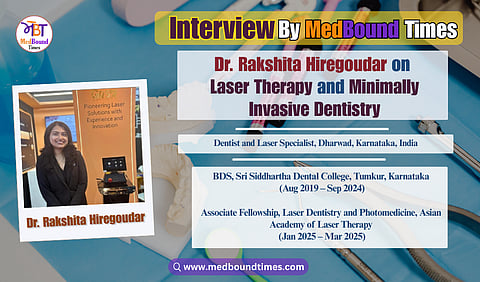
Banner for Interview with Dr. Rakshita Hiregoudar
Dr. Rakshita Hiregoudar explains laser dentistry, benefits, safety, and how photomedicine enables faster healing and comfort.

Laser Dentistry and Photomedicine: Dr. Rakshita Hiregoudar on Healing with Light and the Future of Minimally Invasive Care

Dr. Rakshita Hiregoudar shares how laser therapy is transforming dental care through precision, faster healing, and patient comfort, while guiding young dentists on building expertise in this field.
Published on

In this edition of MedBound Times, Dr. Akriti Mishra speaks with Dr. Rakshita Hiregoudar, a young dentist exploring the evolving field of laser dentistry and photomedicine. A BDS graduate from Sri Siddhartha Dental College, she has pursued an Associate Fellowship in Laser Dentistry and Photomedicine from the Asian Academy of Laser Therapy. In this interview, she discusses how laser technology is changing the way dental care is delivered, making treatments more precise, comfortable, and patient-friendly, while sharing her perspective as an early-career clinician building a niche in this space.

Q

Dr. Akriti: Please introduce yourself and describe how you became interested in laser therapy and photomedicine within dentistry.

A

Dr. Rakshita Hiregoudar: I'm Dr. Rakshita Hiregoudar, i completed my BDS in 2024 from Sri Siddhartha dental college and was exploring opportunities to grow beyond the traditional route, that's when i came across the power of healing with Lasers, the power of precise cut with lasers and that's how I developed interest in Laser Dentistry and Photomedicine and pursued an Associate Fellowship in Laser Dentistry and Photomedicine from Asian Academy of Laser Therapy.

Q

Dr. Akriti: For a general audience, how would you explain what laser dentistry is and what makes it different from conventional dental procedures?

A

Dr. Rakshita Hiregoudar: For the general audience, I describe lasers as a healing device or as healing with light. It is basically a modern dental approach to treat tissues gently and precisely.

What makes it different is that laser treatments are minimally invasive, more comfortable and associated with less bleeding and faster healing.

Q

Dr. Akriti: What kinds of problems or conditions can laser therapy treat?

A

Dr. Rakshita Hiregoudar: Laser therapy can be used to manage a wide range of dental conditions, which is what makes it such a versatile tool in clinical practice. Its applications extend from pain management to tissue healing and supportive care across multiple dental specialties.

Clinically, laser therapy is commonly used for conditions such as chronic temporomandibular joint (TMJ) pain, oral ulcers, inflammatory lesions, and cancer-related oral mucositis. It also plays a role in reducing pain, inflammation, and promoting faster healing after procedures such as extractions, minor oral surgeries, and periodontal treatments.

Lasers can be integrated into routine dental procedures as well from cavity preparation and varnish application to supporting disinfection and healing in root canal treatments. Through photobiomodulation, laser therapy helps improve tissue response, supports healing at the cellular level, and enhances post-treatment comfort.

One of the most significant benefits is that laser therapy can reduce post-operative discomfort and inflammation, allowing many patients to recover more comfortably, sometimes with reduced dependence on medications such as antibiotics or analgesics, depending on the clinical situation.

In essence, laser therapy is not limited to a single procedure. It complements and enhances almost every aspect of dental care by improving healing, reducing pain, and supporting the body’s natural regenerative processes.

Q

Dr. Akriti: Is laser therapy safe, and does it have any side effects?

A

Dr. Rakshita Hiregoudar: Yes, laser therapy is considered safe when it is used correctly and in accordance with established laser safety protocols. Like any advanced medical technology, its safety depends on proper training, appropriate case selection, and correct parameter settings.

When administered by a trained clinician, laser therapy is well tolerated by patients and is associated with minimal adverse effects. Protective measures - such as the use of wavelength-specific safety eyewear for both the clinician and the patient, controlled energy settings, and adherence to clinical guidelines  are essential to ensure safe application.

When these protocols are followed, laser therapy does not damage surrounding tissues and instead supports controlled treatment and healing. Any temporary effects, such as mild warmth or transient sensitivity, are usually short-lived and self-limiting.

Q

Dr. Akriti: Does laser therapy hurt, and how long does a typical session take?

A

Dr. Rakshita Hiregoudar: Laser therapy is generally very comfortable for patients, and in many situations it can be performed without the need for local anesthesia. In my clinical experience, there have been instances where laser therapy was carried out without administering analgesics or local anesthetic, while still maintaining patient comfort.

This is largely because of photobiomodulation, which can be used before a procedure to modulate pain and inflammation. When applied appropriately, it helps prepare the tissues, making subsequent procedures more comfortable. After the treatment, photobiomodulation can again be used to support healing and reduce post-operative discomfort. As a result, patients often experience little to no pain during or after the procedure.

Healing with laser therapy is also noticeably faster when the correct wavelength, parameters, and protocols are followed. In many cases, tissue healing can occur within two to three days, depending on the condition being treated.

I recall a specific case involving a three-year-old pediatric patient with a traumatic lip laceration. With laser therapy, the injury healed completely within four sessions over the course of a week. The child was able to resume eating, drinking, and normal activities comfortably, without lingering pain or functional difficulty.

Q

Dr. Akriti: How soon can a patient expect to see results, and are the results permanent?

A

Dr. Rakshita Hiregoudar: Patients often begin to notice the benefits of photobiomodulation very early, in many cases from the very first session itself. This may present as reduced pain, decreased inflammation, or improved comfort, depending on the condition being treated.

Regarding the longevity of results, the outcomes are generally long-lasting when the therapy is appropriately planned and delivered. In a majority of cases, patients experience sustained improvement. However, in chronic conditions, maintenance sessions may be recommended at regular intervals, such as once every two weeks.

This maintenance approach is not because laser therapy is ineffective, but because chronic conditions involve ongoing biological processes. Periodic laser therapy helps reinforce the therapeutic effect and supports continued cellular balance, ensuring that the clinical benefits are maintained over time.

Q

Dr. Akriti: How do you approach selecting the appropriate laser wavelength or device for specific dental treatments?

A

Dr. Rakshita Hiregoudar: My approach to selecting the appropriate laser wavelength or device is strongly grounded in structured training and biological understanding. Having been trained under the Asian Academy of Laser Therapy, I was guided not just on how to use lasers, but on how to choose what is most appropriate and effective for clinical practice.

Rather than focusing on having multiple wavelengths within a single device, I prioritize selecting the right wavelength based on tissue interaction and biological response. From a photobiological standpoint, mitochondrial absorption which plays a key role in cellular healing and energy production is particularly high around the 810nm wavelength. This makes it highly effective for photobiomodulation, pain modulation, and tissue healing.

In my clinical practice, 810nm is therefore my primary go-to wavelength. When combined with 650nm, it offers the advantage of both therapeutic healing and precise soft-tissue applications. This combination allows clinicians to work efficiently while supporting biological healing at the same time.

With advanced technologies such as combination coherence, it is possible to perform procedures where healing begins simultaneously as tissue is being treated. This integration of cutting precision and biological support represents the best of both worlds and leads to more predictable outcomes and improved patient comfort.

Q

Dr. Akriti: What are common misconceptions among dentists about laser therapy in dentistry, and how do you address them?

A

Dr. Rakshita Hiregoudar: One of the most common misconceptions among dentists about laser therapy is that it is used only for cutting soft tissue and is primarily relevant to specific specialties such as periodontics. This perception is quite widespread, and I shared it myself during my undergraduate and internship years, largely because this is how lasers are traditionally introduced during dental training. In undergraduate education, lasers are often presented mainly as an alternative to the scalpel, and as a result, many clinicians continue to use them in a limited way in practice. 

That perspective changed for me when I began my training. I learned that laser therapy has a multidimensional role in dentistry, extending far beyond surgical cutting to include pain management, inflammation control, tissue healing, photobiomodulation, and supportive therapies across various dental disciplines.

A key gap I observe, particularly in the Indian dental ecosystem, is lack of comprehensive knowledge and exposure. With the right education and understanding of laser–tissue interaction, clinicians can apply laser therapy more effectively and ethically. When used correctly, the difference is evident ,not just in clinical outcomes, but in how patients feel when they leave the clinic. The focus shifts from merely performing a procedure to genuinely supporting healing.

To my fellow clinicians, I would say this: do not view lasers as just another advanced or fashionable addition to your clinic. Instead, invest time in understanding their applications, protocols, and limitations. Unfortunately, even today, structured laser education is limited at the undergraduate level. Pursuing focused training or fellowships in laser dentistry can help clinicians build a niche, elevate their practice, and deliver care that is both modern and patient-centered.

Q

Dr. Akriti: Could you outline key safety protocols and training prerequisites that a dentist should follow before adopting lasers in their practice?

A

Dr. Rakshita Hiregoudar: When it comes to incorporating laser therapy into clinical practice, safety protocols and proper training are absolutely essential.

From a safety standpoint, the most fundamental requirement is the use of wavelength-specific protective eyewear. Laser safety goggles must be worn not only by the patient, but also by the clinician and the assisting staff throughout the procedure. In addition, it is important to strictly adhere to the operating guidelines and protocols provided by the laser equipment manufacturer, including recommended power settings, modes, and application techniques.

Beyond this, two additional key safety measures are crucial. First, maintaining a controlled treatment environment, including proper signage, restricted access during laser use, and avoidance of reflective surfaces, which helps prevent accidental exposure. Second, ensuring correct parameter selection and tissue awareness is vital; using inappropriate settings or techniques can compromise safety and outcomes. This highlights the importance of understanding laser–tissue interaction rather than simply operating the device.

Regarding prerequisite training, I strongly believe that in-depth education is far more valuable than short, procedure-focused courses. While brief courses may introduce clinicians to laser-assisted cutting, they often limit learning to a single device or application. In contrast, structured fellowship programs provide a comprehensive understanding of laser physics, tissue interaction, wavelength selection, and real-life clinical applications across multiple scenarios.

Fellowship-based training allows clinicians to move beyond mechanical usage and develop biological insight into how lasers work. Along with certification, this depth of learning enables safer, more predictable, and ethically sound clinical practice. In my view, such comprehensive training is a far stronger foundation for anyone looking to integrate laser therapy responsibly into their dental practice.

Q

Dr. Akriti: What role does scientific evidence and clinical research play in establishing best practices for laser dentistry today?

A

Dr. Rakshita Hiregoudar: The scientific evidence and research play an important role as laser treatment is protocol driven and its need of the hour to stay updated with the current evolving research to make precise decisions regarding the treatment parameters number of sessions and expected clinical outcomes. Evidence-based studies in areas such as photobiomodulation and laser-assisted procedures guide us on how to use lasers safely, effectively, and predictably.

Q

Dr. Akriti: With technology advancing rapidly, how do you see photomedicine evolving in dentistry over the next decade?

A

Dr. Rakshita Hiregoudar: I see laser dentistry evolving in much the same way ultrasonic scalers did  from being considered an advanced option to becoming an integral part of routine dental practice. In the near future, I believe lasers will be a standard component in every dental clinic.

This is largely because laser-assisted dentistry aligns closely with what patients seek today: painless, bloodless, and minimally invasive treatments with faster healing and greater comfort. By reducing pain, anxiety, and post-operative discomfort, lasers have the potential to significantly address dental fear and phobia.

As patient expectations continue to evolve, laser technology will play a key role in transforming dental care into a more comfortable, precise, and patient-friendly experience making it not just an advancement, but a necessity in modern dentistry.

Q

Dr. Akriti: What advice would you give to early-career dentists who are interested in developing expertise in laser therapy or integrating it into their practice?

A

Dr. Rakshita Hiregoudar: For early-career dentists and fresh graduates, my first advice would be to move away from rigid labels such as “basic” or “advanced” dentistry. What truly matters is how thoughtfully and effectively you cater to your patients because that is what ultimately shapes their experience and trust.

While pursuing a master’s degree is a valuable path, it is not the only route to growth. There are many opportunities beyond postgraduate education to build expertise, refine skills, and develop a meaningful niche. I chose to pursue an Associate Fellowship in Laser Dentistry, and today I work as a laser consultant across multiple clinics. Starting early helped me gain clarity, confidence, and clinical exposure sooner than I had expected.

Choosing the right academy and mentor plays a crucial role in this journey. Structured training, real-world application, and proper guidance allow clinicians to truly understand laser therapy rather than simply use it.

I would strongly encourage young dentists not to delay learning lasers by thinking they are “too early” in their careers or that laser technology is too advanced to invest in at this stage. You don’t need to wait until you’re ‘ready’ to learn laser dentistry. When you start early, understand the science, and find the right mentor, the growth that follows can redefine your entire practice.

I am genuinely grateful for the path I chose. Learning laser therapy early in my career helped me grow in ways I hadn’t anticipated  both professionally and personally and it continues to shape the kind of clinician I aspire to be.

Dr Rakshita Hiregoudar offers a fresh and practical perspective on how laser dentistry is gradually redefining clinical practice. She highlights that beyond being an advanced tool, laser therapy brings a fundamental shift in how treatments are delivered, focusing on precision, reduced discomfort, and faster healing. Her insights simplify complex concepts like photobiomodulation and make them accessible for both clinicians and patients, reinforcing the idea that modern dentistry is moving toward more minimally invasive and biologically supportive approaches. A key takeaway from her journey is the importance of starting early and learning with intention. She emphasizes that building expertise in emerging technologies does not require waiting for the “right time,” but rather choosing the right training, mentorship, and mindset. For young dentists, her message is clear: with curiosity, structured learning, and a patient-centered approach, it is possible to create a meaningful and future-ready dental practice that aligns with evolving patient expectations.

Dear Doctors and Healthcare Professionals, to be featured in DocScopy please email us at marketing@medboundtimes.com or connect with us via +91 7428 068 932.

Banner for Interview with Dr. Rakshita Hiregoudar
Dr. Charu Sinha Shares Career Lessons, Entrepreneurship Journey, and Insights for Young Dental Professionals

Related Stories

No stories found.
logo
Medbound Times
www.medboundtimes.com